


Pull the cover off a new 400-amp residential service and count the conductors. Nine times out of ten you will not find one enormous set of 400 kcmil feeding a single 400-amp main. You will find a meter socket stamped Class 320, two 200-amp disconnects bolted to a common bus, and two ordinary sets of 4/0 aluminum heading off in different directions. The “400-amp service wire size” that people search for and the wire that actually gets installed are often two different answers.
This is where the job goes sideways. An electrician sizes from NEC Table 310.16 and lands on 600 kcmil copper, which is correct for a commercial service and badly oversized for a house. Another uses the dwelling table on a strip mall and fails inspection. A third gets the conductors right and then puts a 6 AWG grounding electrode conductor on a service that needs 1/0. Every one of those is a code section away from being right.
Study smarter with VoltageLab
Built for electricians, apprentices, and electrical engineers who want faster practice and better exam prep.
⭐️ Join thousands of electricians upgrading their skills
This guide gives you the dwelling answer from Table 310.12, the non-dwelling answer from Table 310.16, the parallel arrangement most 400-amp services actually use, and the neutral, grounding electrode conductor and voltage-drop numbers that go with each. Every value here names the table it came from.
Quick Answer
For a 400-amp service to a one-family dwelling, NEC Table 310.12 allows 400 kcmil copper or 600 kcmil aluminum as a single set of 120/240 V service-entrance conductors. That table applies the 83 % allowance, so the conductors only have to carry 332 A (400 × 0.83) rather than a full 400 A.
In the field almost nobody pulls a single 600 kcmil set. A Class 320 meter-main splits into two 200-amp disconnects, and each one gets its own 2/0 copper or 4/0 aluminum from the same Table 310.12. For a non-dwelling 400-amp service the dwelling table does not apply at all — you size from Table 310.16 at 75 °C and land on 600 kcmil copper, or 500 kcmil copper under the 240.4(B) next-standard-size allowance.
Key Takeaways
- NEC Table 310.12 gives 400 kcmil copper or 600 kcmil aluminum for a 400-amp single-phase 120/240 V dwelling service, and it is the only table that legally applies to a house.
- Table 310.12 works because of the 83 % allowance: a 400-amp dwelling service needs conductors good for 332 A, not 400 A.
- A residential “400-amp” meter socket is normally a Class 320 unit rated 320 A continuous and 400 A non-continuous — the largest self-contained single-phase meter most utilities will set without a CT cabinet.
- Two 200-amp sets are the common build: 2/0 copper or 4/0 aluminum per set, each set taken from the 200-amp row of Table 310.12.
- For a non-dwelling 400-amp service, Table 310.16 at 75 °C gives 600 kcmil copper or 900 kcmil aluminum, and 240.4(B) with 230.90(A) Exception No. 2 lets 500 kcmil copper or 750 kcmil aluminum take a 400 A device.
- A 400 kcmil copper service needs a 1/0 copper grounding electrode conductor from Table 250.66 — but only 6 AWG copper where it terminates on a ground rod, per 250.66(A).
- Terminations on any 400-amp service equipment are 75 °C rated under 110.14(C)(1)(b), so the 90 °C column is for derating arithmetic only and never for the final size.
What a 400-amp residential service actually is
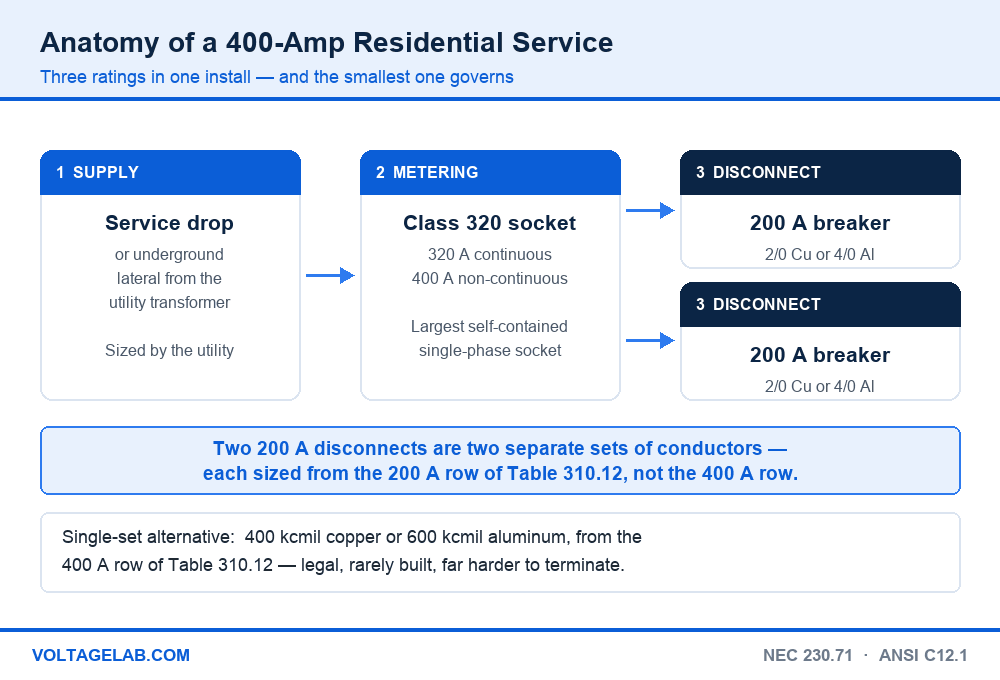
The nameplate on the equipment and the number the utility works from are not always the same. A 400-amp residential service is built from a self-contained meter socket, a service disconnect arrangement, and the service-entrance conductors between them. Each piece has its own rating, and the smallest one governs.
Pass your electrical exam the first time
Practice real NEC exam questions with full code-referenced explanations and progress tracking — built for journeyman, master and apprentice exam prep.
Thousands of NEC practice questions with code-referenced answers
The meter socket is the constraint most people miss. Self-contained residential sockets top out at Class 320, and a Class 320 socket is listed for 320 A continuous duty with 400 A non-continuous capability. That is why the same product gets called a “400-amp meter base” by one supplier and a “320-amp service” by the utility. Push past a genuine 400 A continuous demand and you leave self-contained metering entirely for a CT cabinet.
Downstream, the disconnect is rarely a single 400 A breaker. NEC 230.71 permits up to six service disconnects, and the usual residential product is a meter-main with two 200-amp breakers in it. Each of those breakers is the origin of a separate set of conductors, and each set is sized on its own.
Decoding “Class 320” and why the number is not 400
Meter socket classes are ANSI C12.1 designations, not NEC ones. The class number is the continuous rating of the metering equipment: a Class 200 socket carries 200 A continuously, a Class 320 socket carries 320 A continuously. Manufacturers list the Class 320 socket for 400 A non-continuous because residential load rarely sits at maximum for three hours or more. Since a calculated dwelling load from Article 220 is already a demand-factored number rather than a continuous one, the socket and the service rating line up in practice even though the printed numbers differ.
400 amp service wire size — the four routes compared
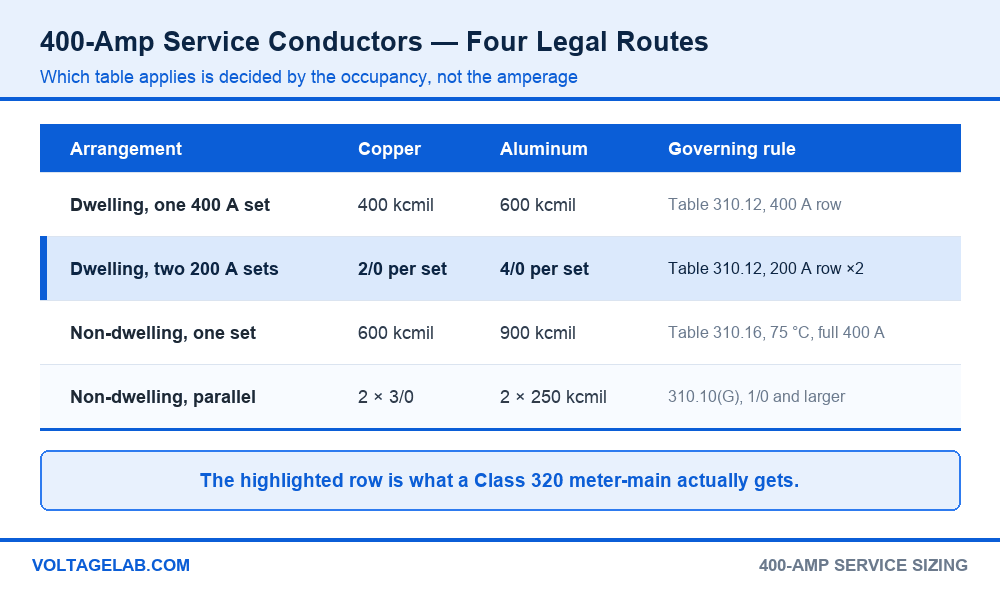
Four arrangements will all satisfy the Code for a 400-amp service. They are not interchangeable, and which one you use is decided by whether the building is a dwelling and how the disconnects are arranged.
| Arrangement | Copper | Aluminum | Governing rule |
|---|---|---|---|
| Dwelling, one 400 A set | 400 kcmil | 600 kcmil | Table 310.12, 400 A row |
| Dwelling, two 200 A sets | 2/0 per set | 4/0 per set | Table 310.12, 200 A row, applied twice |
| Non-dwelling, one set | 600 kcmil | 900 kcmil | Table 310.16, 75 °C, full 400 A |
| Non-dwelling, parallel | 2 × 3/0 | 2 × 250 kcmil | 310.10(G) paralleling, 1/0 and larger |
The highlighted row is the one you will build most often. Two 200-amp sets from a meter-main are not a “400-amp feeder split in half” — they are two independent sets, each one supplied by its own 200 A overcurrent device, each sized from the 200 A row of Table 310.12. That is why the copper drops from 400 kcmil to 2/0 and the aluminum from 600 kcmil to 4/0.
The violation inspectors write up most: using Table 310.12 on anything that is not a dwelling. The title of 310.12 is “Single-Phase Dwelling Services and Feeders,” and 310.12(A) limits it to one-family dwellings and the individual dwelling units of two-family and multifamily dwellings, supplied by a single-phase 120/240 V system. Put 600 kcmil aluminum on a 400-amp service to a shop, an office or a common house panel serving an apartment building and it is undersized — that job needs 900 kcmil aluminum from Table 310.16.
Sizing it yourself — NEC Table 310.16 and the 83 % allowance
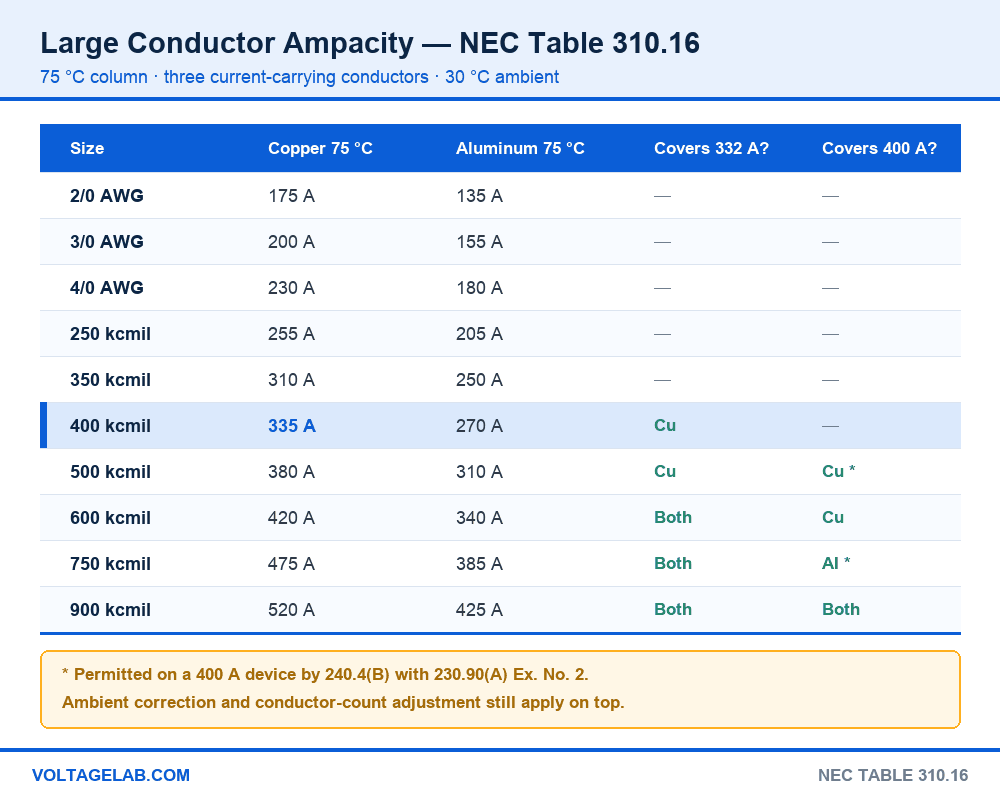
Table 310.12 is a shortcut. The arithmetic behind it is worth knowing, because the moment your installation has a high ambient, a buried run or more than three current-carrying conductors in a raceway, the shortcut stops applying and you are back to first principles.
| Conductor size | Copper, 75 °C | Aluminum, 75 °C | Covers 332 A? | Covers 400 A? |
|---|---|---|---|---|
| 2/0 AWG | 175 A | 135 A | No | No |
| 3/0 AWG | 200 A | 155 A | No | No |
| 4/0 AWG | 230 A | 180 A | No | No |
| 250 kcmil | 255 A | 205 A | No | No |
| 350 kcmil | 310 A | 250 A | No | No |
| 400 kcmil | 335 A | 270 A | Copper only | No |
| 500 kcmil | 380 A | 310 A | Copper only | Copper via 240.4(B) |
| 600 kcmil | 420 A | 340 A | Both | Copper |
| 750 kcmil | 475 A | 385 A | Both | Aluminum via 240.4(B) |
| 900 kcmil | 520 A | 425 A | Both | Both |
The five-step method for a 400-amp service
- Run the load calculation first. Article 220 tells you what the service has to be, and plenty of houses that ask for 400 A calculate out under 300 A. The service rating comes from the calculation, not from the panel someone already bought.
- Decide whether Table 310.12 applies. One-family dwelling or individual dwelling unit, single-phase 120/240 V, conductor carrying the whole service or feeder load. If all three are true, read the size straight off the table and stop.
- If it does not apply, take 100 % of the rating to Table 310.16. Use the 75 °C column, because 110.14(C)(1)(b) ties you to 75 °C terminations on anything over 100 A.
- Apply ambient correction and conductor-count adjustment. Table 310.15(B)(1) for ambient, Table 310.15(C)(1) where more than three current-carrying conductors share a raceway. These multiply against the 90 °C ampacity if your conductor is 90 °C rated, and the corrected result still cannot exceed the 75 °C termination value.
- Check voltage drop over the run length. Not a requirement, but the informational notes to 210.19(A) and 215.2(A) point at 3 % and 5 %, and a long service lateral will fail that before it fails on ampacity.
The one that catches everyone: the 90 °C column is arithmetic, not an answer. Buy 500 kcmil THWN-2 and it is a 90 °C conductor rated 430 A, but every lug in a 400-amp meter-main is listed at 75 °C. Under 110.14(C)(1)(b) you start the derating from 430 A and the final corrected ampacity is still capped at the 75 °C value of 380 A. The 90 °C rating buys you derating headroom in a hot attic, never a smaller conductor.
Where the dwelling table applies — and where it does not
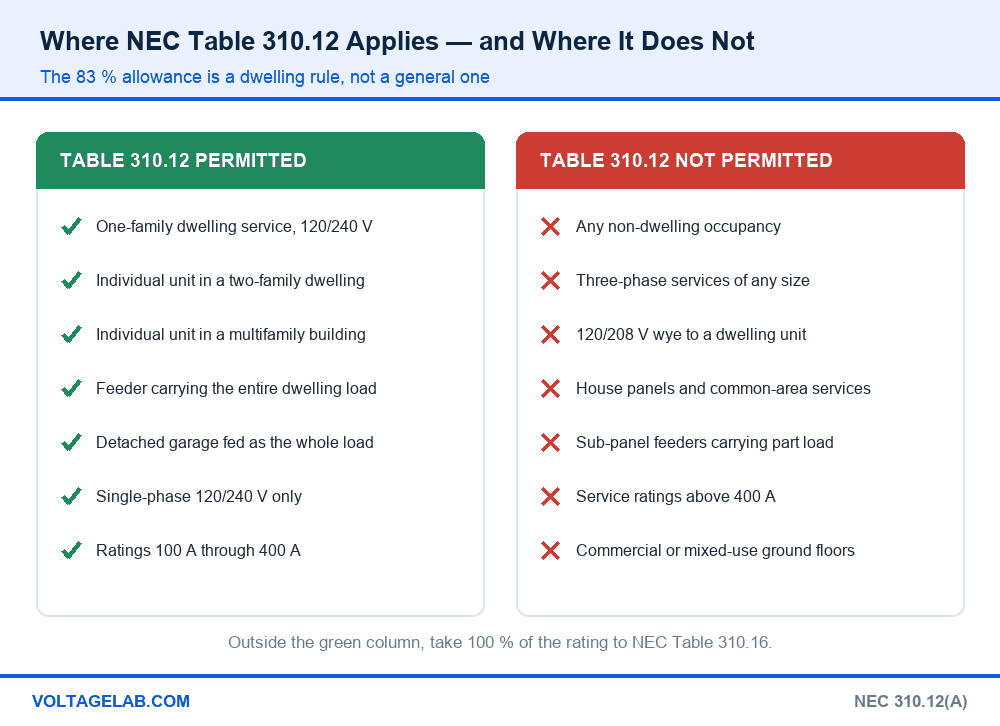
Table 310.12 is permitted here
- Service-entrance conductors to a one-family dwelling, 120/240 V single-phase.
- Service conductors to an individual dwelling unit in a two-family or multifamily building.
- A feeder that carries the entire load supplied by that dwelling service — the run from a meter-main out to a detached garage panel that is the whole load, for instance, under 310.12(B).
- Both service and feeder conductors sized off the same row, as long as each one carries the full service load.
Table 310.12 is not permitted here
- Any non-dwelling occupancy — shops, offices, farms, churches, mixed-use ground floors.
- Three-phase services of any size, including 120/208 V wye to a dwelling unit.
- House panels and common-area services in a multifamily building, because those serve the building rather than an individual dwelling unit.
- A sub-panel feeder that carries only part of the dwelling load — that one is sized from Article 215 and Table 310.16 at the breaker rating.
- Service ratings above 400 A, which is where Table 310.12 ends.
Sizing the neutral and the grounding electrode conductor
The ungrounded conductors are the easy part. Two more conductors have to be sized off them, and both come from tables that most people look up less often.
The grounded (neutral) service conductor is sized by 220.61 for the maximum unbalanced load, but 250.24(C) puts a floor under it: it can never be smaller than Table 250.102(C)(1) based on the largest ungrounded conductor. For 400 kcmil copper that floor is 1/0 copper; for 600 kcmil aluminum it is 3/0 aluminum. Where the ungrounded conductors are paralleled, the table is entered with the combined circular-mil area of one phase.
The grounding electrode conductor comes from Table 250.66 using the same largest-ungrounded-conductor figure. A 400 kcmil copper service falls in the “over 350 through 600 kcmil” row and takes 1/0 copper. Three subsections then cap it by electrode type: 250.66(A) says the GEC to a rod, pipe or plate electrode need not be larger than 6 AWG copper, 250.66(B) caps the run to a concrete-encased electrode at 4 AWG copper, and 250.66(C) caps a run to a ground ring at the size of the ring itself. Run 1/0 to the water pipe and 6 AWG to the rods and both are correct on the same service.
400 amp vs 200 amp vs two 200-amp services
Most 400-amp upgrades start as a 200-amp panel that ran out of room. Before you commit to the bigger service, the three realistic options are worth laying side by side.
Study smarter with VoltageLab
Built for electricians, apprentices, and electrical engineers who want faster practice and better exam prep.
⭐️ Join thousands of electricians upgrading their skills
| Consideration | 200 A service | 200 A + sub-panel | 400 A (Class 320) |
|---|---|---|---|
| Service conductor, copper | 2/0 AWG | 2/0 AWG | 400 kcmil, or 2 × 2/0 |
| Adds capacity | No | No | Yes |
| Adds breaker spaces | No | Yes | Yes |
| Utility work required | None | None | New drop or lateral |
| Handles 2 EV chargers + heat pump | Rarely | Rarely | Comfortably |
| Typical trench or mast work | None | Minor | Full re-service |
If the panel is full but the calculated load is not, a sub-panel is the cheaper honest answer. If the calculation genuinely exceeds 200 A, the 400-amp service is the only route. The supporting details sit in related guides: the full 310.16 ampacity chart, the rules on using a breaker as the service disconnect, the conductor choices in THHN and THWN-2, the overhead options in triplex versus quadruplex service cable, and the bonding jumper sizing that goes with any service this size.
Is a 400-amp service the right choice?
Pros
- Room for two EV chargers, a heat pump and an electric range without a load-management device.
- Two 200-amp panels let you split the house and a shop or ADU on separate disconnects.
- Two 200-amp sets are far easier to pull and terminate than one 600 kcmil set.
- Lower voltage drop on long runs at the same load, because the conductors are oversized relative to actual demand.
- Backup generator and battery interconnections have somewhere sensible to land.
Cons
- The utility has to replace the drop or lateral and may charge for transformer capacity.
- Class 320 metering is the ceiling — a true 400 A continuous load pushes you into a CT cabinet.
- Most houses that ask for it calculate out well under 300 A, so the capacity is never used.
Working with 400-amp service conductors in the field
Conductors this size behave differently from branch-circuit wire. The termination torque matters more, the bend radius is unforgiving, and voltage drop over a long lateral becomes a real number rather than a rounding error.
| One-way run | 400 kcmil copper | 600 kcmil aluminum |
|---|---|---|
| 50 ft | 1.0 V (0.43 %) | 1.1 V (0.47 %) |
| 100 ft | 2.1 V (0.86 %) | 2.3 V (0.94 %) |
| 150 ft | 3.1 V (1.28 %) | 3.4 V (1.41 %) |
| 200 ft | 4.1 V (1.71 %) | 4.5 V (1.88 %) |
| 250 ft | 5.1 V (2.14 %) | 5.7 V (2.35 %) |
Do
- Torque every lug to the value printed on the equipment label, with a calibrated wrench — 110.14(D) requires it.
- Use listed antioxidant compound on aluminum terminations and wire-brush the strands first.
- Confirm the utility’s own service manual before ordering the meter socket — clearances and socket class are theirs to specify, not the NEC’s.
- Keep paralleled sets identical in length, material, insulation and termination method, as 310.10(G) requires.
- Run the Chapter 9 conduit fill calculation before you buy the pipe — 400 kcmil and 600 kcmil fill faster than people expect.
Avoid
- Sizing off the 90 °C column and terminating on 75 °C lugs.
- Applying Table 310.12 to anything that is not a dwelling unit.
- Paralleling conductors smaller than 1/0 — 310.10(G)(1) prohibits it.
- Mixing copper in one parallel set with aluminum in another for the same phase.
- Treating the Table 250.66 result as the size for every electrode — the 250.66(A) through (C) caps usually make it smaller.
Frequently asked questions
What size wire do I need for a 400 amp service?
For a one-family dwelling on 120/240 V single-phase, 400 kcmil copper or 600 kcmil aluminum, straight from NEC Table 310.12. If the service splits into two 200-amp disconnects — which is how most residential 400-amp services are built — each set is 2/0 copper or 4/0 aluminum from the 200-amp row of the same table. For a non-dwelling service, Table 310.12 does not apply and you need 600 kcmil copper or 900 kcmil aluminum from Table 310.16.
Can I use 4/0 aluminum for a 400 amp service?
Only per set in a two-disconnect arrangement. A single set of 4/0 aluminum is rated 180 A at 75 °C, nowhere near the 332 A a 400-amp dwelling service needs. But where a Class 320 meter-main feeds two separate 200-amp breakers, each one supplies its own 4/0 aluminum set, and the 200-amp row of Table 310.12 covers it.
Why is a 400 amp service sometimes called a 320 amp service?
Because the meter socket is a Class 320 unit, rated 320 A continuous and 400 A non-continuous. That class is the largest self-contained single-phase meter socket available in North America, so a “400-amp residential service” and a “320-amp service” are usually the same installation described by two different ratings on the same piece of equipment.
What is the 83 % rule for service conductors?
NEC 310.12 lets service and feeder conductors to a dwelling be sized at 83 % of the service rating, because dwelling load calculations under Article 220 already build in demand factors that keep actual current well below the nameplate. A 400-amp service therefore needs conductors with an ampacity of at least 332 A rather than 400 A, which is exactly why 400 kcmil copper at 335 A qualifies.
What size ground wire is needed for a 400 amp service?
Table 250.66 puts a 400 kcmil copper service in the “over 350 through 600 kcmil” row, which calls for 1/0 copper or 3/0 aluminum. That full size only applies where the grounding electrode conductor runs to a water pipe or ground ring. Under 250.66(A) the run to a ground rod need not be larger than 6 AWG copper, and under 250.66(B) the run to a concrete-encased electrode is capped at 4 AWG copper.
Can you parallel conductors for a 400 amp service?
Yes, and 310.10(G) allows it for conductors 1/0 and larger. Two sets of 3/0 copper give 400 A at 75 °C, and two sets of 250 kcmil aluminum give 410 A. Every conductor in a parallel set must match the others in length, material, circular-mil area, insulation type and termination method, and if both sets share one raceway the six current-carrying conductors trigger an 80 % adjustment from Table 310.15(C)(1).
Does the neutral have to be the same size as the hots on a 400 amp service?
No. The grounded service conductor is sized by 220.61 for the maximum unbalanced load, which on a house with 240 V appliances is a good deal less than the total. The floor is set by 250.24(C), which says it can never be smaller than the Table 250.102(C)(1) value for the largest ungrounded conductor — 1/0 copper behind a 400 kcmil copper service, or 3/0 aluminum behind 600 kcmil aluminum.
How far can you run 400-amp service conductors?
Ampacity does not limit the length, but voltage drop does in practice. A single set of 400 kcmil copper at 320 A loses about 2.1 V over 100 feet and 5.1 V over 250 feet on a 240 V system, so a run stays comfortably inside the 3 % the informational note to 215.2(A) suggests out past 300 feet. Laterals longer than that are usually the point at which upsizing one trade size starts to pay for itself.
The bottom line
The 400-amp service wire size question has a clean answer once you establish which table you are in. A dwelling gets Table 310.12 and its 83 % allowance: 400 kcmil copper or 600 kcmil aluminum for one set, 2/0 copper or 4/0 aluminum per set where a Class 320 meter-main splits into two 200-amp disconnects. Anything that is not a dwelling unit gets the full 400 A taken to Table 310.16 at 75 °C, which is 600 kcmil copper or 900 kcmil aluminum.
Two restraints decide whether the install passes. The first is 110.14(C)(1)(b) — everything on a service this size terminates at 75 °C, so the 90 °C column never sets your final size. The second is the scope line at the top of 310.12, which is the single most misapplied sentence in conductor sizing. Get the load calculation done first, confirm the utility’s own requirements for the meter socket, and then let the table do its job. If you want the underlying ampacity work in full, start with how to read NEC Table 310.16.
FREE PRACTICE TOOL
Think you'd pass this on a real exam?
Test what you just read with instant-feedback quizzes built around real code questions — not generic trivia.
5
Code standards
10,000+
Active learners
100%
Free to start
Instant explanations on every answer, right or wrong
NEC, BS7671, AS/NZS, CEC, and DIN VDE covered
Bite-sized quizzes you can finish in 5 minutes
No signup required to try your first quiz
No account needed · Takes less than 2 minutes