


Look up at the wire running from the utility pole to the weatherhead on a house, and you will see three strands twisted around each other in a slow spiral. Two of them are black and insulated; the third is bare and slightly duller. That is triplex. Now look at the same drop feeding a strip mall or a machine shop and count again — there are four strands, and three of them are insulated. That one is quadruplex.
The two cables look almost identical from the ground, get ordered from the same page of the same catalogue, and are separated in the supply house only by a code word like Appaloosa or Zuzara. But they serve completely different electrical systems, and swapping one for the other is not a substitution you can make on the truck. Order triplex for a three-phase service and you are one conductor short before you leave the yard.
Study smarter with VoltageLab
Built for electricians, apprentices, and electrical engineers who want faster practice and better exam prep.
⭐️ Join thousands of electricians upgrading their skills
This guide covers what triplex and quadruplex actually are, how the bundle is built, how their ampacity is published and why it does not come from the table you are used to, where the NEC applies to them and where it hands off to the utility, and the mistakes that show up on service upgrades.
Quick Answer
Quadruplex is an overhead service drop cable with three insulated aluminium phase conductors laid helically around a bare neutral messenger. It feeds three-phase, four-wire services — 208Y/120 V or 480Y/277 V. Triplex is the same cable with only two insulated conductors, and it feeds the 120/240 V single-phase service on nearly every house in North America.
Count the insulated conductors and you have your answer: two means single-phase, three means three-phase. The bare strand is never a phase — it is the neutral, and it doubles as the messenger that carries the mechanical load of the span. Both are rated 600 V phase to phase, with PE insulation good to 75 °C or XLPE good to 90 °C.
Key Takeaways
- Quadruplex carries three insulated phase conductors plus a bare neutral messenger, for three-phase four-wire service
- Triplex carries two insulated conductors plus the same bare messenger, for 120/240 V single-phase service
- The bare messenger is doing two jobs at once — it is the grounded neutral and the structural support for the span
- Phase conductors are 1350-H19 aluminium insulated with polyethylene (75 °C) or crosslinked polyethylene (90 °C), rated 600 V
- Published ampacities are free-air, in-sun values on a 40 °C basis — they are not NEC Table 310.16 numbers and must never be cross-read with it
- Triplex code names come from shellfish and molluscs; quadruplex code names come from horse breeds
- Overhead service drop cable is not direct-burial cable — underground runs need UL 854 URD, which is a different listing
What quadruplex service drop cable actually is
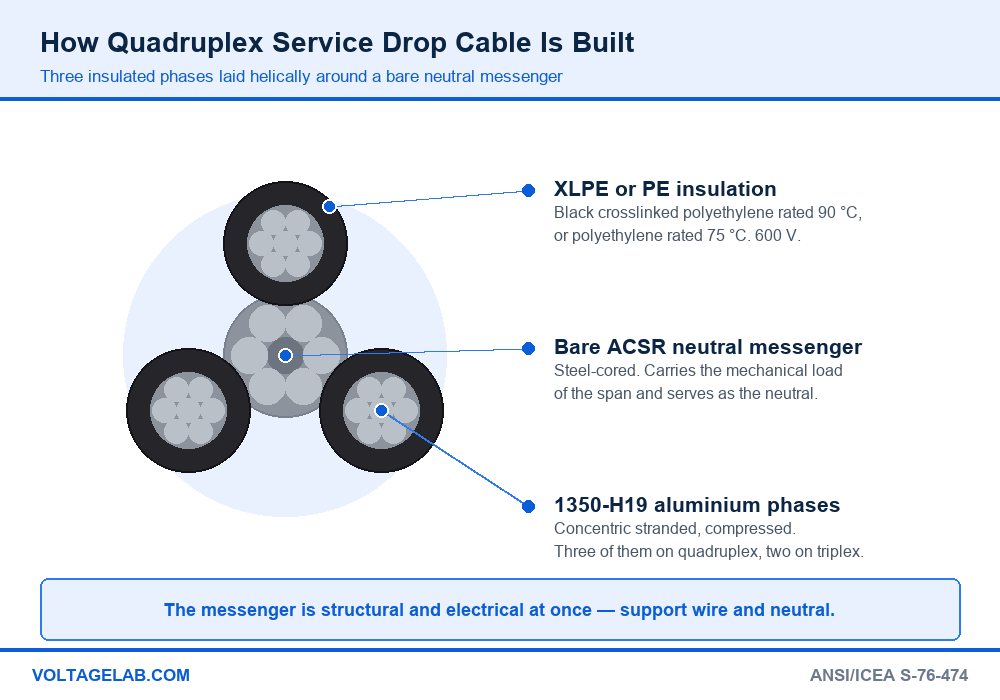
Quadruplex is a multiplex assembly, not a jacketed cable. Nothing wraps the bundle. The conductors are simply laid together in a long helical twist so they behave as one cable in the wind, and each conductor has to survive on its own:
Pass your electrical exam the first time
Practice real NEC exam questions with full code-referenced explanations and progress tracking — built for journeyman, master and apprentice exam prep.
Thousands of NEC practice questions with code-referenced answers
- Three insulated phase conductors. Concentric stranded, compressed 1350-H19 aluminium. On a 208Y/120 V service these are the A, B and C phases.
- Insulation. Black polyethylene rated 75 °C, or black crosslinked polyethylene (XLPE) rated 90 °C. Both are rated 600 volts phase to phase, and both are formulated to survive permanent sunlight exposure.
- A bare neutral messenger. Usually ACSR — aluminium strands over a steel core — because the steel gives it the tensile strength to hold the span. AAC and 6201-alloy (AAAC) messengers are also offered where the span is shorter or the utility spec calls for them.
That bare messenger is the piece worth understanding. It is simultaneously the grounded conductor of the circuit and the structural member the whole assembly hangs from. The insulated phases are wrapped around it and carry essentially no mechanical load — pull tension goes into the messenger through the dead-end grip, which is why an ACSR messenger with a steel core is the default choice on longer spans. If you have worked through sag and tension on overhead lines, the messenger is the conductor those calculations are about.
The assemblies are built to ANSI/ICEA S-76-474, with the aluminium itself covered by the ASTM B-230, B-231, B-232, B-399 and B-498 series depending on whether the strand is 1350 aluminium, alloy or steel-reinforced.
Why it is called quadruplex — and what the code names mean
The prefix counts the conductors in the bundle, not the phases. Duplex is two, triplex is three, quadruplex is four. Because the bare messenger is always one of them, the number of insulated conductors is always one less than the name suggests — quadruplex has four conductors but only three phases.
You will rarely order it by size alone, because the industry sells these by code word. The naming follows two separate conventions that are genuinely useful once you notice them:
- Triplex code names are shellfish and molluscs — Periwinkle, Conch, Whelk, Zuzara, Cherrystone, Razor, Limpet, Voluta, Triton.
- Quadruplex code names are horse breeds — Morgan, Palomino, Appaloosa, Suffolk, Grullo, Hackney, Shetland, Arabian, Bronco.
So if a supplier quotes you Appaloosa, you are getting quadruplex before anyone mentions a conductor count. If they quote Periwinkle, it is triplex. The code word also pins the size — Appaloosa is 4/0 across the board — which is why utilities write their standards in code words rather than AWG.
Triplex vs quadruplex — the comparison that decides the order
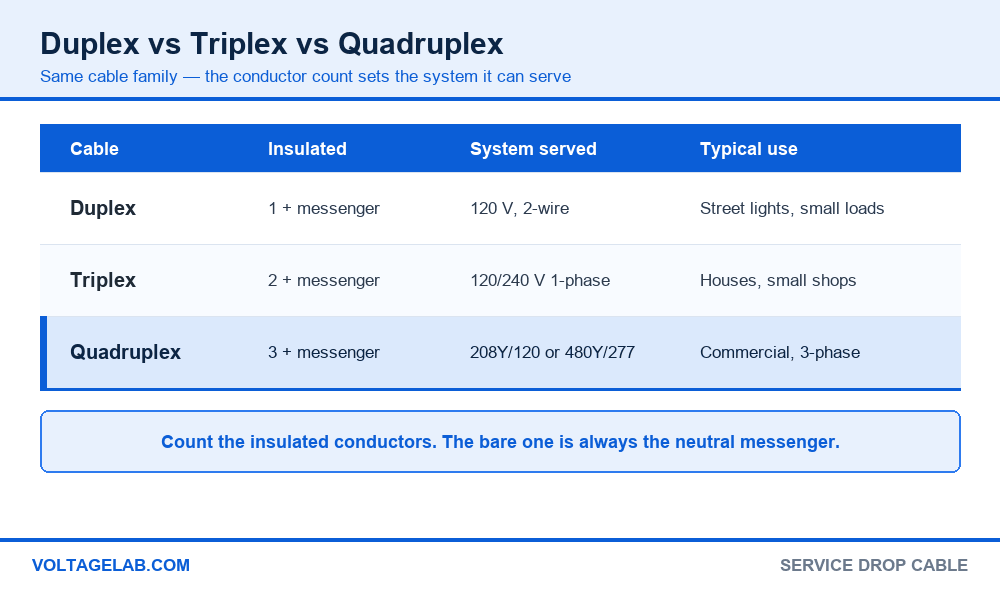
These are not two grades of the same product. They serve different distribution systems, and the choice is made by the service, not by preference:
| Property | Duplex | Triplex | Quadruplex |
|---|---|---|---|
| Total conductors | 2 | 3 | 4 |
| Insulated conductors | 1 | 2 | 3 |
| System served | 120 V, 2-wire | 120/240 V single-phase, 3-wire | 208Y/120 or 480Y/277, 3-phase 4-wire |
| Typical application | Street lighting, signs | Houses, duplexes, small shops | Commercial, multi-family, industrial |
| Code name family | Insects | Shellfish and molluscs | Horse breeds |
| 4/0 ampacity, XLPE | — | 315 A | 275 A |
That last row is the one people miss. 4/0 quadruplex does not carry as much as 4/0 triplex. Same aluminium, same insulation, same messenger — but three insulated conductors bundled together shed heat less effectively than two, so the published ampacity drops from roughly 315 A to 275 A. If you size a three-phase service by looking at a triplex chart, you will be over by about 15%.
The burial trap: overhead triplex and quadruplex are not direct-burial cable. They look almost identical to the underground versions and are sold under the same code words, but underground residential distribution cable is a separate listing — UL 854 URD, with insulation and jacketing rated for wet, buried service. Burying overhead service drop cable is a violation and a callback, and it is one of the most common mistakes on a pole-to-pad conversion. Read the print on the insulation before it goes in a trench.
The reverse substitution is legal but wasteful: URD cable will survive in the air, but it is heavier, more expensive, and has no messenger to take the span tension. If the job is moving a service from poles to a pad, our comparison of overhead versus underground power lines covers the trade-offs on both sides.
Quadruplex ampacity — and why it is not in Table 310.16
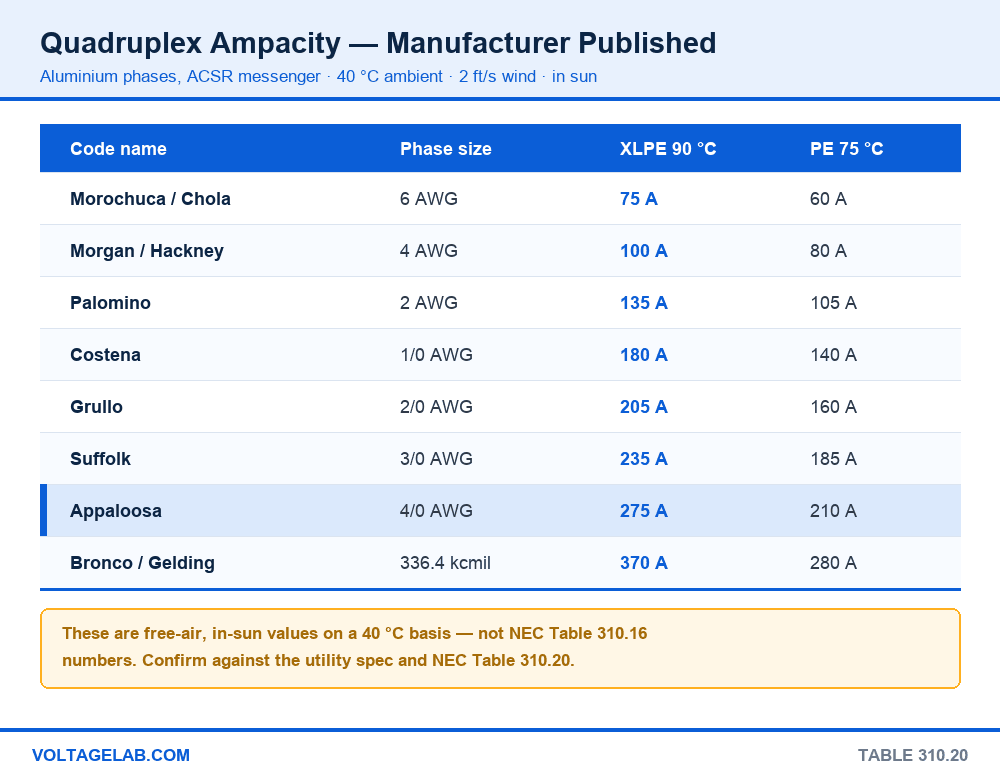
The ampacity table you use every day, NEC Table 310.16, is for conductors in a raceway, cable or earth at a 30 °C ambient. A service drop is none of those things. It hangs in free air, in full sun, with wind moving across it — conditions that cool a conductor far better than a conduit does.
The NEC handles this with a separate table: Table 310.20, Ampacities of Not More Than Three Single Insulated Conductors, Rated Up to and Including 2000 Volts, Supported on a Messenger, built on a 40 °C ambient rather than 30 °C. That title describes triplex and quadruplex exactly — and note the “not more than three,” which quadruplex’s three insulated phases meet precisely.
In practice, most people size from the manufacturer’s published table for the specific code word, because it accounts for the bundle geometry:
Study smarter with VoltageLab
Built for electricians, apprentices, and electrical engineers who want faster practice and better exam prep.
⭐️ Join thousands of electricians upgrading their skills
| Phase size | Quadruplex code name | XLPE 90 °C | PE 75 °C | Triplex XLPE 90 °C |
|---|---|---|---|---|
| 6 AWG | Morochuca / Chola | 75 A | 60 A | 85 A |
| 4 AWG | Morgan / Hackney | 100 A | 80 A | 115 A |
| 2 AWG | Palomino | 135 A | 105 A | 150 A |
| 1/0 AWG | Costena | 180 A | 140 A | 205 A |
| 2/0 AWG | Grullo | 205 A | 160 A | 235 A |
| 3/0 AWG | Suffolk | 235 A | 185 A | 250 A |
| 4/0 AWG | Appaloosa | 275 A | 210 A | 315 A |
| 336.4 kcmil | Bronco / Gelding | 370 A | 280 A | 420 A |
Sizing a service drop in four steps
Step 1 — establish who owns the drop. If the utility owns and installs it, their standard governs the size and you are specifying the equipment it lands on, not the cable. Ask before you calculate. This one step saves more rework than the other three combined.
Step 2 — calculate the load and the service rating. Run the calculation for the occupancy and settle on the service size. For a one-family dwelling rated 100 A through 400 A, NEC 310.12 permits the service conductors carrying the entire dwelling load to be sized at 83% of the service rating — which is why a 200 A house lands on 4/0 aluminium rather than something larger.
Step 3 — pick the conductor from the free-air table. Use the manufacturer’s table for the code word, or NEC Table 310.20, on its 40 °C basis. Do not carry a Table 310.16 number across; the two tables assume different worlds.
Step 4 — check voltage drop over the span. Aluminium and a long drop are a bad combination for regulation, and the ampacity table says nothing about it. Our walkthrough of voltage drop calculations covers the method; on a 480Y/277 V quadruplex feed the percentage is usually comfortable, but on a long 208Y/120 V run it is worth the two minutes.
The one that catches everyone: the published quadruplex ampacity assumes full sun and a 2 ft/sec breeze. Both matter. Still air removes the convective cooling the number depends on, so a drop threaded through dense tree cover in a sheltered yard is not living in the conditions the table describes. Where the run is unusually still, or the ambient regularly exceeds 40 °C, go up a size rather than argue with the chart.
Where the NEC applies — and where it hands off
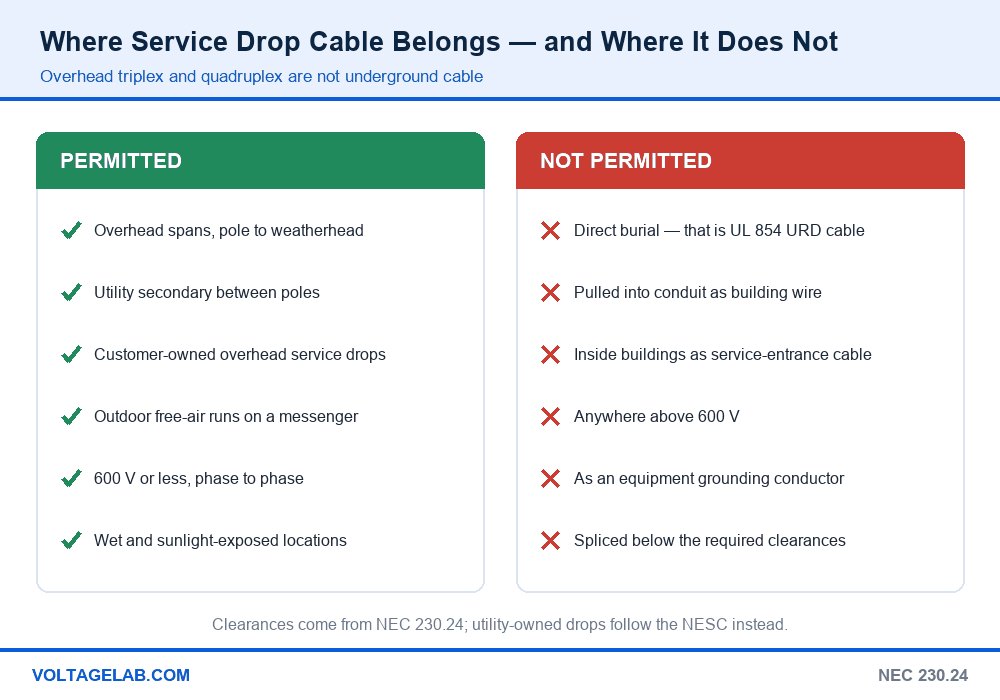
This is the part that confuses people, and it is worth being precise about. NEC 90.2(B)(5) places utility-owned conductors outside the scope of the Code. Most overhead service drops are on the line side of the service point, are owned by the serving utility, and are therefore governed by the NESC — the National Electrical Safety Code — not the NEC.
But Article 230 still contains rules for overhead service conductors, because in some jurisdictions the customer installs, owns and maintains the drop. When that is the case, the NEC applies in full, and 230.24 is there for exactly that situation. The requirements are close to the NESC’s but not identical — the NESC’s general clearance is 12 ft where the NEC’s baseline is 10 ft.
Rules that apply when the drop is on your side of the service point
- NEC 230.23 — minimum size 8 AWG copper or 6 AWG aluminium, with the grounded conductor no smaller than required by 250.24(C)
- NEC 230.24(B) — vertical clearances of 10 ft at the service drip loop and over pedestrian areas, 12 ft over residential property and driveways at 300 V or less, 15 ft where that same area sees more than 300 V, and 18 ft over public streets, alleys and areas subject to truck traffic
- NEC 230.24(A) — clearance above roofs, with the reduced-clearance allowances for low-slope and overhanging conditions
- NEC 230.9 — clearance from building openings, windows and doors
- NEC 250.24(C) — the grounded conductor brought to the service disconnect and sized accordingly
The messenger is a neutral, not a ground
The bare messenger is the grounded conductor — the neutral. It is not an equipment grounding conductor, and it does not become one because it happens to be bare. On the load side of the service disconnect the neutral and the equipment grounding conductor separate and must stay separate. Our guide to Article 200 and grounded conductors covers the distinction, and Table 250.66 handles the grounding electrode conductor sizing that goes with the service.
Quadruplex vs the other ways to get power to a building
| Requirement | Quadruplex | Triplex | URD (UL 854) | SE cable |
|---|---|---|---|---|
| Three-phase service | Yes | No | Yes (quad URD) | Rarely |
| Overhead span, self-supporting | Yes | Yes | No | No |
| Direct burial | No | No | Yes | No |
| Run inside the building | No | No | No | Yes |
| Built-in support member | Messenger | Messenger | None | None |
Once the conductors reach the weatherhead and enter the building, the wiring method changes — SE cable to the meter and disconnect, then THHN/THWN-2 in raceway for whatever comes after. For the wider picture of how the secondary gets to your service in the first place, see our overview of the electrical distribution system, and if you are landing aluminium on lugs, our notes on why aluminium connections fail are worth five minutes before you torque anything.
Is quadruplex the right cable for your service?
Pros
- Self-supporting — the messenger carries the span, no separate catenary needed
- Cheapest way to get three-phase power across an open span
- Aluminium keeps the weight and the cost down on long drops
- Free-air cooling gives better ampacity per AWG than the same wire in conduit
- Faults are visible and repairable without excavation
Cons
- Exposed to wind, ice, falling limbs and vehicle strikes
- Clearance requirements constrain where the drop can land
- Carries less than triplex of the same size because of the extra conductor
- Aluminium terminations need the right lugs, compound and torque
Working with service drop cable in the field
Do
- Confirm the service point and who owns the drop before you order anything
- Order by code word and size — Appaloosa 4/0, not “some quadruplex”
- Dead-end the messenger, never the insulated phases
- Use listed aluminium lugs with antioxidant compound and a torque tool
- Form proper drip loops at the weatherhead
Avoid
- Burying overhead drop cable instead of URD
- Sizing a quadruplex run off a triplex ampacity chart
- Reading Table 310.16 values across to a free-air messenger run
- Treating the bare messenger as an equipment grounding conductor
- Landing aluminium in lugs listed for copper only
Frequently asked questions
What is quadruplex cable?
Quadruplex is an overhead service drop cable made of three insulated aluminium phase conductors twisted around a bare neutral messenger. It supplies three-phase, four-wire services at 208Y/120 V or 480Y/277 V, rated 600 volts phase to phase.
What is the difference between triplex and quadruplex?
The conductor count and the system each one serves. Triplex has two insulated conductors plus a messenger and feeds 120/240 V single-phase. Quadruplex has three insulated conductors plus a messenger and feeds three-phase, four-wire services. They are not interchangeable.
Is the bare wire in quadruplex the ground or the neutral?
The neutral. It is the grounded conductor of the circuit and also the messenger that carries the mechanical load of the span. It is not an equipment grounding conductor, and it must not be used as one on the load side of the service disconnect.
Can quadruplex cable be buried?
No. Overhead service drop cable is not listed for direct burial. Underground runs require URD cable listed to UL 854, which uses insulation and jacketing rated for buried, wet service. The two are sold under similar code words, so check the print on the conductor.
What is the ampacity of 4/0 quadruplex?
Manufacturers publish roughly 275 A for 4/0 aluminium quadruplex with XLPE insulation, and about 210 A with polyethylene. Those figures assume a 40 °C ambient, 2 ft/sec wind and full sun. They are free-air values and cannot be compared with NEC Table 310.16.
Why do quadruplex cables have horse names?
It is an industry naming convention that lets a single code word identify both the cable type and the size. Quadruplex assemblies use horse breeds — Morgan, Palomino, Appaloosa, Suffolk — while triplex uses shellfish and mollusc names such as Periwinkle, Conch and Zuzara.
Does the NEC cover service drop cable?
It depends on ownership. NEC 90.2(B)(5) puts utility-owned conductors outside the Code’s scope, so most drops on the line side of the service point follow the NESC. Where the customer owns and maintains the drop, Article 230 applies in full, including the clearances in 230.24.
What size quadruplex do I need for a 200 amp three-phase service?
4/0 aluminium quadruplex with XLPE insulation is published at about 275 A, which covers a 200 A three-phase service with margin. The 83% allowance in NEC 310.12 is for one-family dwellings, so it does not apply to a commercial three-phase service — size from the actual calculated load and confirm against the utility standard.
The bottom line
Quadruplex earns its place for one reason: it gets three-phase power across an open span without a separate support system, at a cost no other method matches. The conductor count is the whole decision — two insulated conductors for a single-phase service, three for three-phase, and a bare messenger doing double duty in both.
The two things that go wrong are both about restraint. Do not read Table 310.16 numbers across to a cable hanging in free air, and do not put overhead drop cable in a trench because it looks like the underground version. Settle the ownership question first, order by code word, and land the aluminium on lugs that are listed for it. For the code changes worth knowing this cycle, see our summary of what changed in the 2026 NEC.
FREE PRACTICE TOOL
Think you'd pass this on a real exam?
Test what you just read with instant-feedback quizzes built around real code questions — not generic trivia.
5
Code standards
10,000+
Active learners
100%
Free to start
Instant explanations on every answer, right or wrong
NEC, BS7671, AS/NZS, CEC, and DIN VDE covered
Bite-sized quizzes you can finish in 5 minutes
No signup required to try your first quiz
No account needed · Takes less than 2 minutes