


Pull a refrigerator out from the wall on a service call and you will find one of two things behind it. Either a single receptacle with one cable running back to a breaker nobody else uses, or a duplex that also feeds the microwave, the disposal and half the countertop. Both installations pass in some jurisdictions. Only one of them stops the homeowner calling you in July because the food spoiled.
The confusion is real, and it comes from the fact that two different documents are giving orders. The NEC has an opinion about how a refrigerator may be fed, and the appliance manufacturer has a different and usually stricter one. Most arguments on job sites happen because one person is quoting the Code book and the other is quoting the installation manual, and neither realises the Code makes the manual enforceable.
Study smarter with VoltageLab
Built for electricians, apprentices, and electrical engineers who want faster practice and better exam prep.
⭐️ Join thousands of electricians upgrading their skills
This guide covers what the NEC actually says about a dedicated circuit for a refrigerator, how to size that circuit and its conductor, the GFCI and AFCI rules that now apply to it, the receptacle mistake that fails inspections, and how the answer changes for a garage, a basement or a commercial kitchen.
Quick Answer
A dedicated circuit for a refrigerator is permitted but not required by the NEC. NEC 210.52(B)(1) requires the refrigerator receptacle in a dwelling kitchen to be fed from one of the two required 20-ampere small-appliance branch circuits, and Exception No. 2 to that section permits a receptacle outlet serving a specific appliance to be supplied instead from an individual branch circuit rated 15 amperes or greater. Nowhere does the Code say the refrigerator must have its own circuit.
In practice you install one anyway. Almost every manufacturer’s installation manual calls for an individual, properly grounded 15- or 20-ampere circuit, and NEC 110.3(B) requires listed equipment to be installed according to those instructions. That is the provision that turns a fridge dedicated circuit from a recommendation into an enforceable requirement on most jobs.
Key Takeaways
- The NEC permits a refrigerator on an individual branch circuit rated 15 amperes or greater, but it never mandates one
- Manufacturer installation instructions almost always call for a dedicated circuit, and NEC 110.3(B) makes those instructions enforceable
- If the refrigerator is fed from a shared kitchen circuit, that circuit must be one of the 20-ampere small-appliance branch circuits — never the lighting circuit
- A 15-ampere dedicated circuit is legal; 20 amperes with 12 AWG is the safer default and matches what most kitchens already have
- A single receptacle on a 20-ampere individual branch circuit must itself be rated 20 amperes under NEC 210.21(B)(1)
- Since the 2023 NEC, every 125- to 250-volt receptacle in a dwelling kitchen needs GFCI protection, including the one behind the refrigerator
- Kitchen branch circuits also require AFCI protection under NEC 210.12(A), so the fridge circuit usually needs both
What a dedicated refrigerator circuit actually is
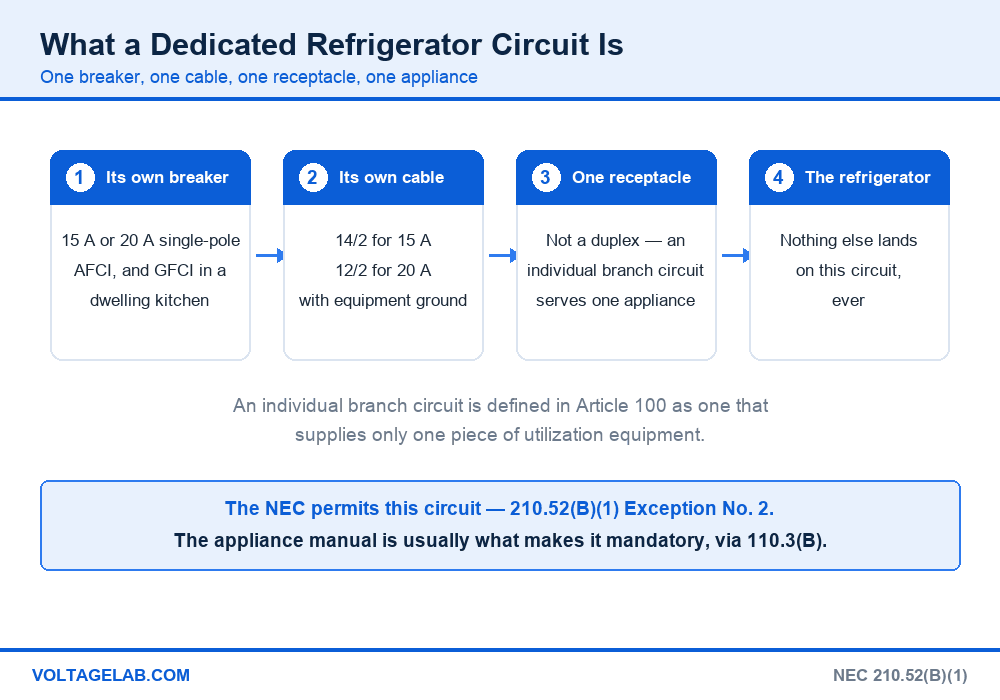
“Dedicated circuit” is job-site language. The Code term is individual branch circuit, defined in Article 100 as a branch circuit that supplies only one utilization equipment. Four things have to line up before you can call a circuit dedicated:
Pass your electrical exam the first time
Practice real NEC exam questions with full code-referenced explanations and progress tracking — built for journeyman, master and apprentice exam prep.
Thousands of NEC practice questions with code-referenced answers
- Its own overcurrent device. One single-pole breaker, 15 or 20 amperes, serving nothing else in the house.
- Its own conductors. A home run back to the panel — 14/2 with ground for a 15-ampere circuit, 12/2 with ground for 20 amperes.
- Its own receptacle. One outlet at the refrigerator location, not a device shared with the countertop or the microwave.
- One appliance. Nothing else lands on it, not now and not when somebody adds a wine cooler two years later.
Miss any one of those and you have an appliance branch circuit, not an individual one. That distinction matters because several Code rules — the receptacle rating in 210.21(B)(1) and the load rules in 210.23 among them — behave differently depending on which you have. Our breakdown of general purpose, appliance and individual branch circuits works through where each type is used.
Why the NEC stops short of requiring one
The NEC is a minimum safety standard, not a performance standard. A refrigerator drawing three amps on a 20-ampere circuit alongside a toaster is not a fire hazard, so the Code has no basis to prohibit it. What the Code does instead is make sure kitchen loads have enough capacity in aggregate: NEC 210.11(C)(1) requires at least two 20-ampere small-appliance branch circuits for the kitchen, pantry, breakfast room and dining room, and 210.52(B)(2) keeps lighting and general-purpose outlets off them.
Food spoilage is not a safety hazard under the NEC’s scope. It is, however, a warranty problem for the manufacturer — which is exactly why the requirement shows up in the manual instead.
Three ways to feed a refrigerator — NEC 210.52(B)
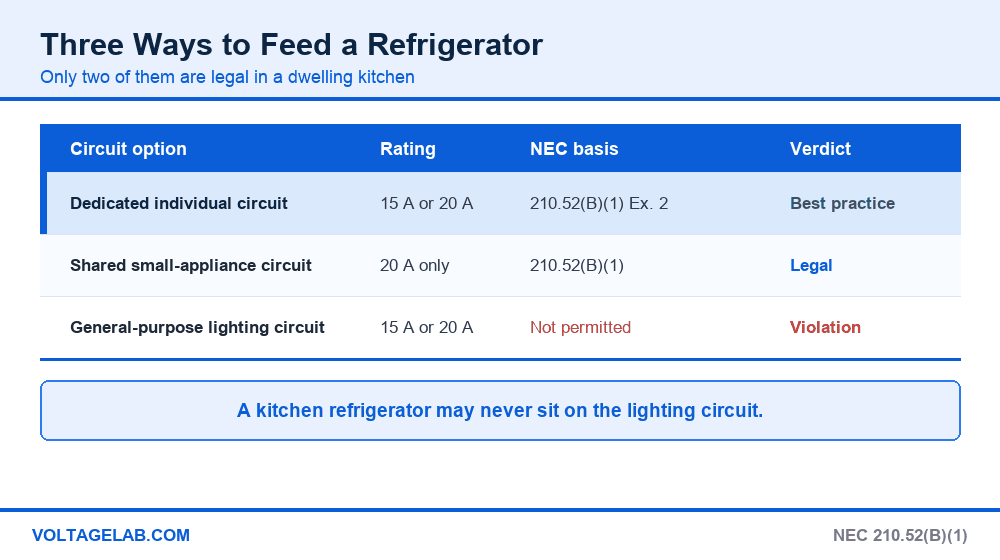
In a dwelling kitchen there are only three circuits a refrigerator could plausibly land on, and the Code treats them very differently:
| Circuit option | Rating | Code basis | Verdict |
|---|---|---|---|
| Individual (dedicated) circuit | 15 A or 20 A | 210.52(B)(1) Exception No. 2 | Permitted — and what the manual usually demands |
| Shared small-appliance branch circuit | 20 A only | 210.52(B)(1), 210.11(C)(1) | Legal, but shares capacity |
| General-purpose lighting circuit | 15 A or 20 A | Prohibited by 210.52(B)(1) | Violation |
The third row is the one that shows up in older houses. A refrigerator wired into the same circuit as the kitchen ceiling light and the hallway receptacles was normal before the small-appliance branch circuit requirement matured, and it is a straightforward violation today. If you find one during a remodel, it comes out.
Note the asymmetry in the middle row: a shared circuit must be 20 amperes because that is what 210.11(C)(1) requires of small-appliance branch circuits, but a dedicated circuit may be 15 amperes because Exception No. 2 sets the floor at “15 amperes or greater.” A 15-ampere circuit is legal only when it is the refrigerator’s own.
The receptacle trap: under NEC 210.21(B)(1), a single receptacle installed on an individual branch circuit must have an ampere rating not less than the circuit. Land a single 15-ampere 5-15R on a 20-ampere dedicated fridge circuit and you have a violation. Either use a single 5-20R, or install a duplex — a duplex is two receptacles, so 210.21(B)(1) no longer applies and Table 210.21(B)(3) permits 15-ampere receptacles on a 20-ampere circuit. Inspectors catch this one regularly.
Sizing the circuit: 15 amps or 20 amps?
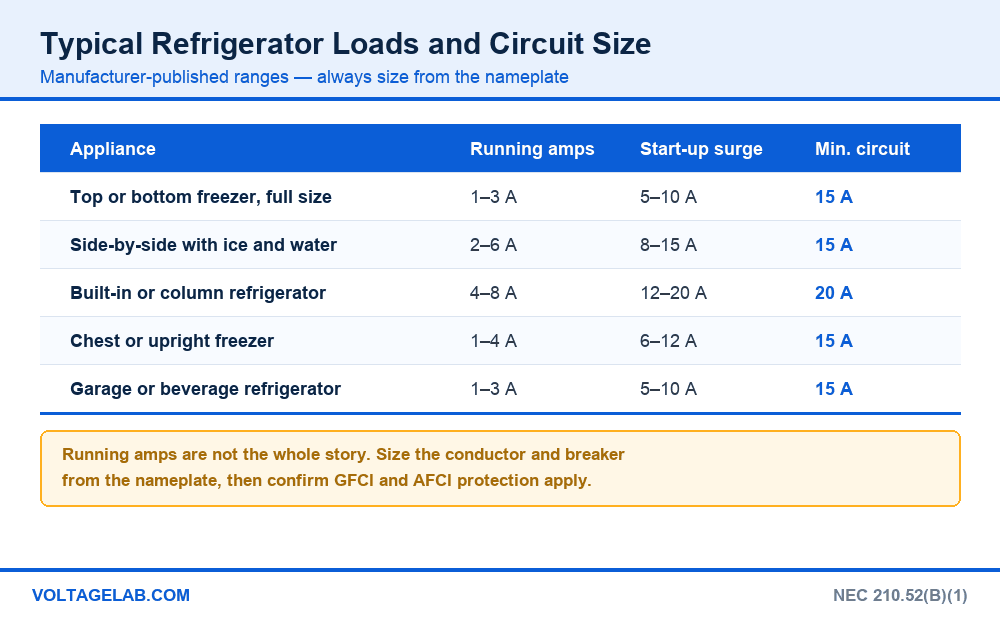
A household refrigerator is a small load. Running current is typically between one and six amperes at 120 volts, and even a large side-by-side with an ice maker and through-the-door water rarely exceeds seven. The compressor draws several times that for a fraction of a second at start-up, which is why the circuit is sized well above the running load rather than close to it. If you want the mechanical side of that, our explainer on the working principle of a refrigerator covers the compressor cycle.
| Circuit | Overcurrent device | Copper conductor | Receptacle | Permitted load | Code basis |
|---|---|---|---|---|---|
| 15 A individual | 15 A single-pole | 14 AWG | Single 5-15R or duplex | Any load for which the circuit is rated | 210.23, 240.4(D) |
| 20 A individual | 20 A single-pole | 12 AWG | Single 5-20R, or a duplex | Any load for which the circuit is rated | 210.21(B)(1), 240.4(D) |
| 20 A shared small-appliance | 20 A single-pole | 12 AWG | Duplex 5-20R | Cord-connected equipment limited to 80% of rating | 210.23(A), 210.11(C)(1) |
That last column is worth reading twice. NEC 210.23 limits cord-and-plug-connected equipment to 80 percent of the circuit rating only where the branch circuit supplies two or more outlets. On a true individual branch circuit, the section permits the circuit to supply any load for which it is rated. A refrigerator is also not a continuous load — it cycles — so the 125 percent continuous-load multiplier in 210.19 and 210.20 does not apply either.
A four-step method for sizing the circuit
Step 1 — read the nameplate, not a chart. The rating plate is usually inside the fresh food compartment on the side wall or behind the crisper. Take the amperes from it. If the unit is not on site yet, take the figure from the spec sheet for that model number.
Step 2 — read the installation manual. This is the step people skip. If the manual says “20 ampere dedicated circuit,” you install a 20-ampere dedicated circuit; 110.3(B) leaves no room to argue. Built-in and column refrigerators frequently specify 20 amperes where a freestanding unit of the same capacity specifies 15.
Step 3 — pick the conductor from 240.4(D). 14 AWG copper on a 15-ampere breaker, 12 AWG on a 20-ampere breaker. These are hard caps on small conductors regardless of what the ampacity tables show, a point we cover in more depth in the guide to THHN and THWN-2 conductor ratings.
Study smarter with VoltageLab
Built for electricians, apprentices, and electrical engineers who want faster practice and better exam prep.
⭐️ Join thousands of electricians upgrading their skills
Step 4 — check the panel has room, physically and electrically. A dedicated circuit needs a free space and enough calculated capacity in the service. On a remodel where several dedicated circuits are being added at once, run the numbers first — our walkthrough on calculating home electrical load before adding a major appliance covers the method.
The one that catches everyone: a dedicated circuit does not exempt the refrigerator from GFCI protection. Since the 2023 NEC removed the words “where the receptacles are installed to serve the countertop surfaces” from 210.8(A)(6), every 125- through 250-volt receptacle in a dwelling kitchen requires GFCI protection — countertop, pantry, microwave and the one behind the refrigerator, dedicated circuit or not. Under the 2020 NEC and earlier, that receptacle was frequently exempt. Confirm which edition your jurisdiction has adopted before you assume either way.
GFCI, AFCI and where the refrigerator sits
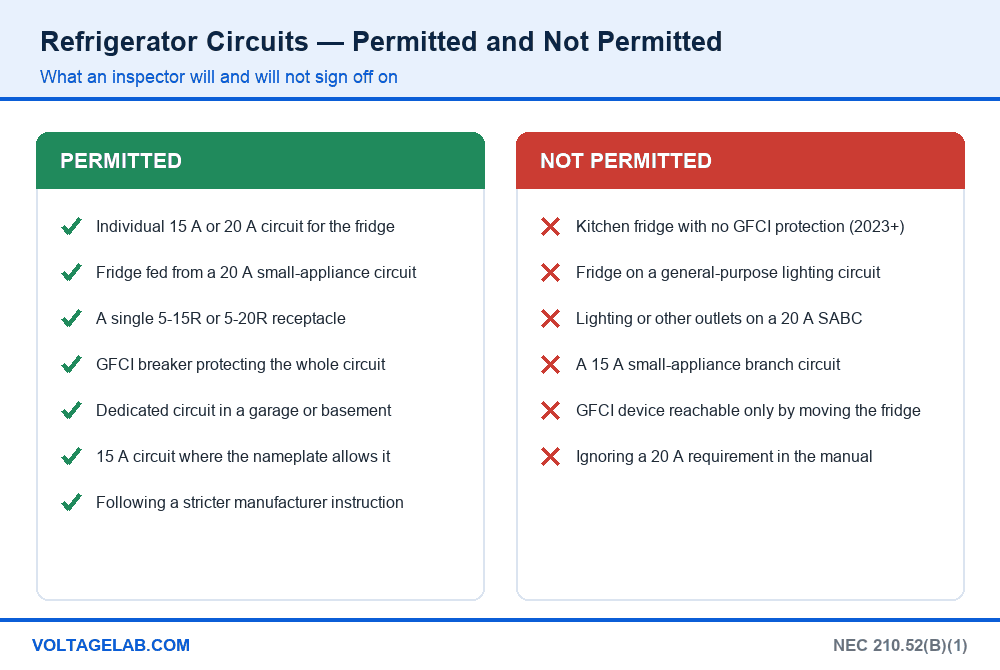
The protection requirements travel with the room, not with the appliance. A dedicated circuit changes nothing about them.
GFCI — NEC 210.8(A)
- Dwelling kitchens. 210.8(A)(6) in the 2023 NEC and later covers all 125- through 250-volt receptacles in the room. The refrigerator receptacle is included.
- Garages and accessory buildings. 210.8(A)(2) has covered these for decades, and the old exemptions for receptacles that were not readily accessible or that served a single dedicated appliance were deleted long ago. A garage beer fridge needs GFCI protection.
- Basements. 210.8(A)(5) in the 2020 NEC and later covers all basements of dwelling units, finished or not.
- Commercial kitchens. 210.8(B)(2) covers receptacles in kitchens and areas for food or beverage preparation in other than dwelling units.
There is a practical wrinkle. NEC 210.8 requires GFCI devices to be installed in a readily accessible location, and a GFCI receptacle wedged behind a loaded refrigerator is not readily accessible by the Article 100 definition — you cannot reach it without moving an obstacle. The clean answer on a dedicated circuit is a GFCI breaker in the panel, which is always reachable and protects the whole run. If you would rather use a device, feed the fridge receptacle from the load side of an accessible GFCI upstream. Our guide to testing a GFCI outlet correctly covers verifying either arrangement.
AFCI — NEC 210.12(A)
210.12(A) requires arc-fault protection on all 120-volt, single-phase, 15- and 20-ampere branch circuits supplying outlets or devices in dwelling unit kitchens, among other rooms. The refrigerator circuit is not carved out. That means a kitchen fridge circuit generally needs both arc-fault and ground-fault protection, which in practice means a dual-function breaker. If you are unclear on which device does what, our comparison of GFCI vs AFCI protection and where each is required lays out the difference.
Nuisance tripping, and what changed
Compressor motors and inverter-driven refrigerators put high-frequency noise on the circuit, and older GFCI devices sometimes read that as leakage. Nuisance trips on refrigerator circuits are a genuine, documented complaint — and they are not a legal reason to omit the protection. If a circuit trips repeatedly, treat it as a fault to find: check the equipment grounding conductor, check for a damaged cord, and test the appliance on a known-good protected circuit before blaming the device. Newer high-frequency-rated GFCIs are designed specifically to ignore that noise.
Kitchens, garages, basements and commercial spaces
| Location | Dedicated circuit | GFCI | AFCI | Typical circuit |
|---|---|---|---|---|
| Dwelling kitchen | Permitted, usually required by the manual | Yes (2023 NEC) | Yes | 20 A, 12 AWG |
| Attached garage | Permitted | Yes | No | 20 A, 12 AWG |
| Basement | Permitted | Yes (2020 NEC) | Varies by room use | 15 A or 20 A |
| Commercial kitchen | Normal practice; check the equipment listing | Yes, 210.8(B) | Not required | Per nameplate |
Two points on that table. In a garage or basement the small-appliance branch circuit rules of 210.52(B) do not apply at all — those are specific to the kitchen, pantry, breakfast room and dining room — so a refrigerator there can legitimately sit on a general-purpose circuit. And in commercial work, 210.52 does not apply either; the circuit comes from the equipment nameplate and the listing, and dedicated circuits are the norm because the loads are larger and the consequences of a trip are worse.
For the rest of the kitchen receptacle layout — spacing, countertop rules and island requirements — see our guide to kitchen island outlet code and placement, and for the branch circuit fundamentals underneath all of this, NEC Article 210 and how branch circuits are rated.
Is a dedicated circuit worth it?
Pros
- A toaster and a kettle on the counter can no longer trip the refrigerator offline
- Satisfies the manufacturer’s installation instruction, protecting the warranty and your 110.3(B) compliance
- Compressor start-up surge has the whole circuit to itself
- A GFCI trip has one obvious cause instead of five candidates
- Frees capacity on the small-appliance circuits for the countertop, where it is actually needed
Cons
- Consumes a breaker space, which is scarce in older panels
- A retrofit home run through a finished kitchen wall is real labour
- Adds nothing the NEC itself demands, so it can be a hard sell on a tight remodel budget
Installing the circuit in the field
Do
- Read the installation manual before you pick the breaker size
- Put the GFCI in the panel so it stays readily accessible
- Set the receptacle high enough and shallow enough that the fridge sits flat to the wall
- Label the panel directory clearly — “Refrigerator,” not “Kitchen 3”
- Confirm which NEC edition your jurisdiction has adopted before quoting a GFCI rule
Avoid
- Landing a single 15-ampere receptacle on a 20-ampere individual circuit
- Skipping GFCI because the circuit is dedicated — that has never been an exemption
- Adding a second outlet to the fridge circuit “while the wall is open”
- Feeding a kitchen refrigerator with an extension cord or a plug strip
- Assuming a 15-ampere circuit is fine on a built-in without checking the nameplate
Frequently asked questions
Does a refrigerator need a dedicated circuit by NEC?
No. The NEC permits a dedicated circuit under 210.52(B)(1) Exception No. 2 but does not require one. It only requires that a kitchen refrigerator receptacle be fed from one of the required 20-ampere small-appliance branch circuits if it is not on its own individual circuit. The requirement usually comes from the manufacturer’s installation instructions, which NEC 110.3(B) makes enforceable.
Should a fridge dedicated circuit be 15 or 20 amps?
Either is legal for an individual branch circuit. Use 20 amperes with 12 AWG copper unless you have a reason not to — it matches the rest of the kitchen, gives headroom for a larger replacement appliance later, and is what most built-in and column refrigerators specify. A 15-ampere circuit with 14 AWG is fine for a standard freestanding unit whose nameplate supports it.
Does a refrigerator need GFCI protection?
In a dwelling kitchen under the 2023 NEC or later, yes — 210.8(A)(6) covers every 125- to 250-volt receptacle in the room with no exception for the refrigerator or for dedicated circuits. Garage and basement refrigerators have needed it for longer under 210.8(A)(2) and 210.8(A)(5). Under the 2020 NEC and earlier, a kitchen refrigerator receptacle not serving a countertop was often exempt, so check the adopted edition.
Can a refrigerator share a circuit with a microwave?
Legally yes, if both are on a 20-ampere small-appliance branch circuit. Practically it is a poor idea: a microwave alone can draw 12 to 13 amperes, and adding compressor start-up surge on top of that leaves very little margin. If either manual calls for a dedicated circuit, sharing is also a 110.3(B) violation.
What size wire do I run for a refrigerator circuit?
14 AWG copper for a 15-ampere circuit, 12 AWG copper for a 20-ampere circuit, both with an equipment grounding conductor. Those are the small-conductor limits in NEC 240.4(D), and they apply regardless of what the ampacity tables allow. On long runs, check voltage drop before settling on 14 AWG.
Does a garage or basement refrigerator need its own circuit?
The NEC does not require it, and the small-appliance branch circuit rules of 210.52(B) do not extend to those spaces — a garage or basement refrigerator may sit on a general-purpose circuit. It does need GFCI protection. Check the manual, because the manufacturer’s dedicated-circuit instruction applies wherever the appliance is installed.
Can I plug a refrigerator into an extension cord or power strip?
No, and every manufacturer says so in the manual. Flexible cords are not a substitute for the fixed wiring of a structure under NEC 400.12, and the connection quality and voltage drop through a cord are exactly the conditions that damage a compressor. If the receptacle is in the wrong place, move the receptacle.
How do I tell whether an existing fridge circuit is dedicated?
Plug a load into the refrigerator receptacle, switch off the breaker you believe serves it, then check every other outlet, light and appliance in the kitchen and adjacent rooms. If anything else went dead, the circuit is shared. Confirm the panel directory afterwards and correct it if it was wrong.
The bottom line
The honest answer to whether a refrigerator needs a dedicated circuit is that the NEC permits one and the appliance manufacturer requires one, and 110.3(B) is the hinge that connects those two facts. Quoting 210.52(B)(1) to prove a dedicated circuit is optional wins the Code argument and loses the job, because the manual on the box says otherwise and the inspector can read it too.
Install a 20-ampere individual branch circuit with 12 AWG copper, protect it with a dual-function breaker in the panel where the GFCI stays readily accessible, use a receptacle rated for the circuit, and label the panel so the next person knows what it is. If you are working across jurisdictions on different code cycles, our comparison of the 2017, 2020, 2023 and 2026 NEC editions shows exactly where the GFCI rules diverged.
FREE PRACTICE TOOL
Think you'd pass this on a real exam?
Test what you just read with instant-feedback quizzes built around real code questions — not generic trivia.
5
Code standards
10,000+
Active learners
100%
Free to start
Instant explanations on every answer, right or wrong
NEC, BS7671, AS/NZS, CEC, and DIN VDE covered
Bite-sized quizzes you can finish in 5 minutes
No signup required to try your first quiz
No account needed · Takes less than 2 minutes