


Every portable generator on a jobsite has one round outlet that is not like the others. Three curved slots instead of straight blades, and a cord end you push in and twist a quarter turn until it clicks. That is a NEMA L5-30R, and it is there because a straight-blade plug will walk out of a vibrating generator by lunchtime.
The trouble starts at the parts counter. There are at least four common 30-amp connectors, they all look roughly alike in a photograph, and none of them mate with each other. Bring back an L14-30 for a 120-volt tool feed and you have bought a 240-volt device. Bring back a TT-30 and you have bought the RV pedestal outlet.
Study smarter with VoltageLab
Built for electricians, apprentices, and electrical engineers who want faster practice and better exam prep.
⭐️ Join thousands of electricians upgrading their skills
This guide covers what the L5-30R is rated for, how to read the NEMA designation, how to wire it and size the branch circuit behind it, how it differs from the connectors it gets confused with, and the GFCI rule that catches people on temporary power.
Quick Answer
The NEMA L5-30R is a 125-volt, 30-amp, 2-pole, 3-wire grounding twist-lock receptacle. It takes an L5-30P plug, it is wired with one hot, one neutral and one equipment ground, and it feeds from a 30-amp single-pole breaker on 10 AWG copper. Maximum load is 3,750 VA, or 24 amps / 3,000 VA for anything continuous.
Read the designation as four separate facts: L = locking, 5 = the 125-volt two-pole three-wire grounding family, 30 = 30 amps, R = receptacle. The plug is the L5-30P. It is not interchangeable with the TT-30 on an RV pedestal, the 250-volt L6-30, or the four-wire L14-30 on a 240-volt generator.
Key Takeaways
- NEMA L5-30R is rated 125 volts, 30 amperes, 2-pole and 3-wire grounding, and it mates only with an L5-30P plug
- A 30-amp, 125-volt branch circuit is 10 AWG copper on a 30-amp single-pole breaker
- The full 30-amp rating is 3,750 VA, but any load running three hours or more is limited to 24 amps by the 80 percent continuous-load rule
- NEC 210.21(B)(1) requires a single receptacle on an individual branch circuit to be rated no less than the circuit, so an L5-30R belongs on a 30-amp circuit and not a 40- or 50-amp one
- NEC 590.6(A)(1) names 30-ampere receptacles explicitly — temporary power feeds need GFCI protection, not just the 15- and 20-amp outlets
- TT-30 is the 30-amp straight-blade RV pedestal outlet and is a completely different device despite sharing 125 volts and 30 amps
- An adapter changes the connector on the end of a cord — it never changes the rating of the circuit feeding it
What the NEMA L5-30R actually is
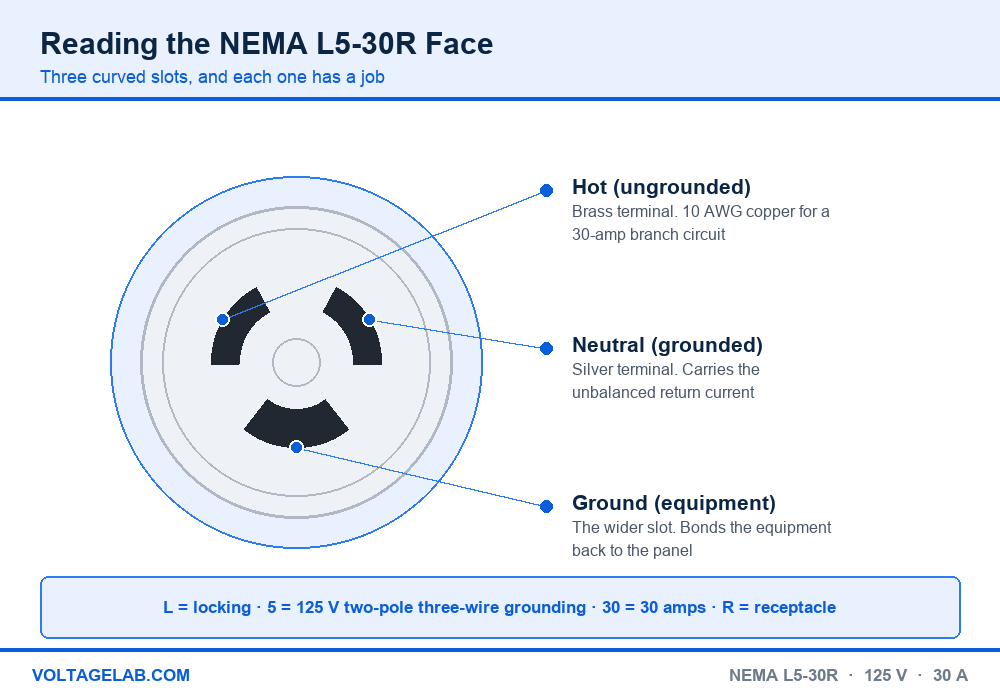
An L5-30R is a locking receptacle built to one of the configurations in the NEMA WD-6 standard. Physically it is a round device face with three curved slots arranged around a centre boss. You insert the matching plug straight in, rotate it a quarter turn, and the curved blades slide behind the face so the cord cannot pull straight out.
Pass your electrical exam the first time
Practice real NEC exam questions with full code-referenced explanations and progress tracking — built for journeyman, master and apprentice exam prep.
Thousands of NEC practice questions with code-referenced answers
Electrically there is nothing exotic about it. It is an ordinary 120-volt circuit with three conductors:
- Hot (ungrounded). Lands on the brass terminal. One 10 AWG copper conductor from a 30-amp single-pole breaker.
- Neutral (grounded). Lands on the silver terminal. Carries the return current — on a two-wire 120-volt circuit that is the full load current, not an unbalanced remainder.
- Equipment ground. Lands on the green terminal. This is the fault-clearing path, and on a locking device it is the wider of the three slots.
The “2-pole, 3-wire grounding” description confuses people because it sounds like three current-carrying conductors. It is not. Two poles means two current-carrying conductors — hot and neutral. The third wire is the ground, which carries nothing until something goes wrong. For the full picture on that conductor, see our guide to equipment grounding conductors.
Decoding the designation: L, 5, 30, R
- L — Locking. Without it you have a straight-blade device from the same family.
- 5 — The configuration family: 125 volts, 2-pole, 3-wire grounding. The number encodes voltage and pole/wire arrangement together, which is why 6 means 250 V and 14 means 125/250 V four-wire.
- 30 — The ampere rating.
- R — Receptacle. P is the plug, so the cord end that goes into an L5-30R is an L5-30P.
Once you can read the code, the whole chart opens up. L5-20R is the same 125-volt family at 20 amps. L6-30R is 250 volts at 30 amps. The letters and numbers are doing all the work — the picture on the packaging is the least reliable part.
L5-30 vs TT-30 vs L6-30 vs L14-30
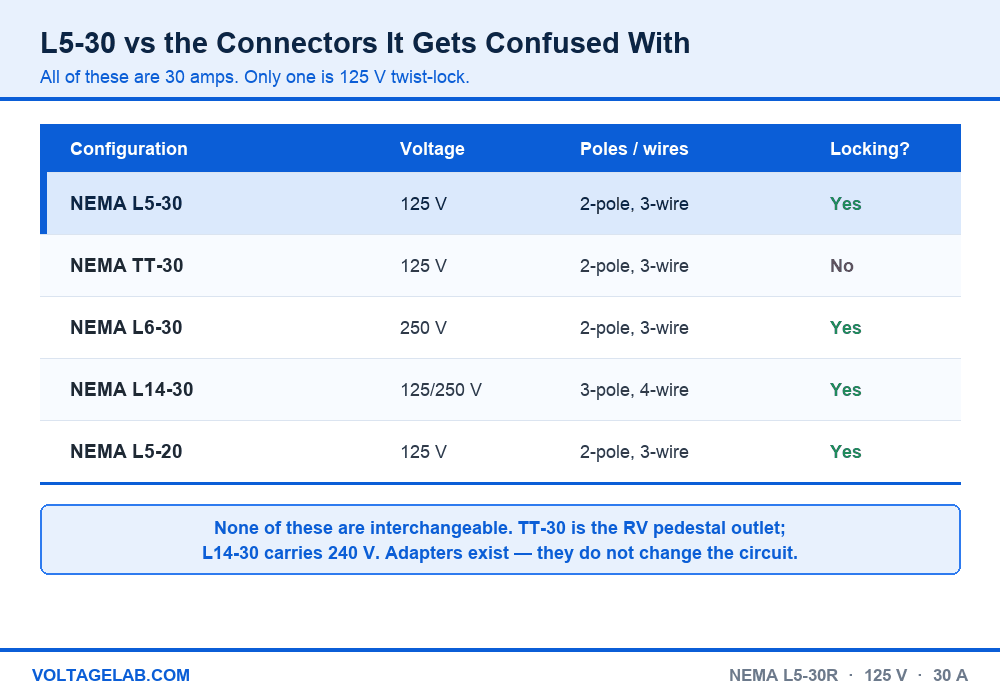
These four are the ones that get mixed up, because every one of them is a 30-amp device and three of them lock:
| Configuration | Voltage | Poles / wires | Locking? | Where you see it |
|---|---|---|---|---|
| NEMA L5-30 | 125 V | 2-pole, 3-wire | Yes | Generators, jobsite feeds, stage power |
| NEMA TT-30 | 125 V | 2-pole, 3-wire | No | RV park pedestals, travel trailers |
| NEMA L6-30 | 250 V | 2-pole, 3-wire | Yes | 240 V equipment with no neutral |
| NEMA L14-30 | 125/250 V | 3-pole, 4-wire | Yes | Generator 240 V outlet, transfer switches |
| NEMA L5-20 | 125 V | 2-pole, 3-wire | Yes | 20 A locking loads, AV and broadcast |
Two of these matter more than the rest. TT-30 is the one homeowners buy by mistake, because an RV cord and a generator cord are both “30 amp” and both 120 volts — but TT-30 is straight-blade and will not twist into anything. L14-30 is the one that is genuinely dangerous to confuse, because it carries two hot legs at 240 volts. It has four slots to the L5-30’s three; count them before you wire anything.
Code trap: Most electricians associate GFCI with 15- and 20-amp receptacles and stop there. NEC 590.6(A)(1) names 30-ampere receptacles explicitly: all 125-volt, single-phase, 15-, 20- and 30-ampere receptacle outlets that are not part of the permanent wiring and are in use by personnel require GFCI protection. A temporary L5-30R feed on a construction site is squarely inside that rule, and 590.6(B) sweeps up the rest. Feeding tools from an ungrounded generator does not exempt you either — protect the outlet.
Wiring an L5-30R and sizing the branch circuit
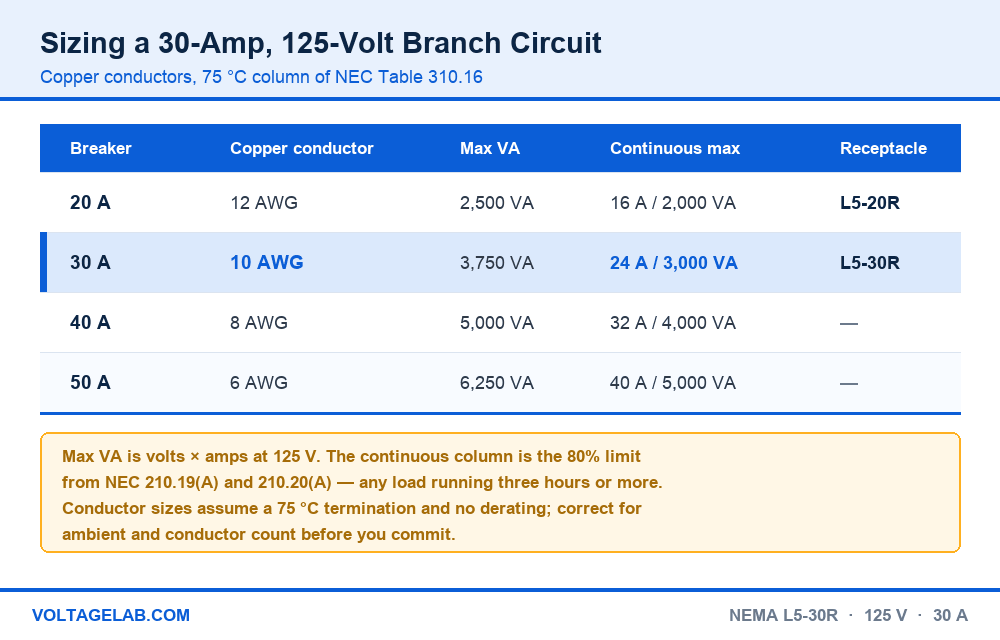
The device is simple; the circuit behind it is where the Code lives. A 30-amp, 125-volt branch circuit is a single-pole 30-amp breaker feeding 10 AWG copper, with a 10 AWG equipment ground.
| Breaker | Copper conductor | Max VA at 125 V | Continuous max (80%) | Matching receptacle |
|---|---|---|---|---|
| 20 A | 12 AWG | 2,500 VA | 16 A / 2,000 VA | L5-20R |
| 30 A | 10 AWG | 3,750 VA | 24 A / 3,000 VA | L5-30R |
| 40 A | 8 AWG | 5,000 VA | 32 A / 4,000 VA | — |
| 50 A | 6 AWG | 6,250 VA | 40 A / 5,000 VA | — |
Wiring it in five steps
- Confirm the load first. Take the nameplate amps of whatever is plugging in. If it runs three hours or more it is a continuous load and your ceiling is 24 amps, not 30.
- Pull 10 AWG copper — two current-carrying conductors plus a 10 AWG equipment ground. THHN/THWN-2 in a raceway is the usual choice; correct the ampacity for ambient temperature and conductor count before you settle on the size.
- Land the conductors by colour. Hot to brass, neutral to silver, ground to green. On a locking device the terminals are usually marked on the back of the body — read them rather than assuming the layout matches a standard duplex.
- Torque every terminal to the listed value. Locking devices live on equipment that vibrates, which is exactly where a loose lug becomes a hot spot. NEC 110.14(D) now requires a calibrated tool for this.
- Protect at 30 amps. Single-pole 30-amp breaker, and GFCI protection wherever 210.8 or 590.6 calls for it.
On long generator or jobsite runs, voltage drop usually decides the conductor size before ampacity does. A 24-amp load at the end of 150 feet of 10 AWG is already past the 3 percent advisory figure — run the numbers using our voltage drop calculation guide before you commit to a wire size.
The one that catches everyone: you cannot put an L5-30R on a 40- or 50-amp breaker to “give it room”. NEC 210.21(B)(1) requires a single receptacle on an individual branch circuit to have an ampere rating not less than that of the branch circuit. A 30-amp device on a 50-amp circuit means the breaker will never protect the receptacle. The rule works the other way round, though — a 30-amp single receptacle on a 20-amp circuit is fine.
Where an L5-30R belongs — and where it does not
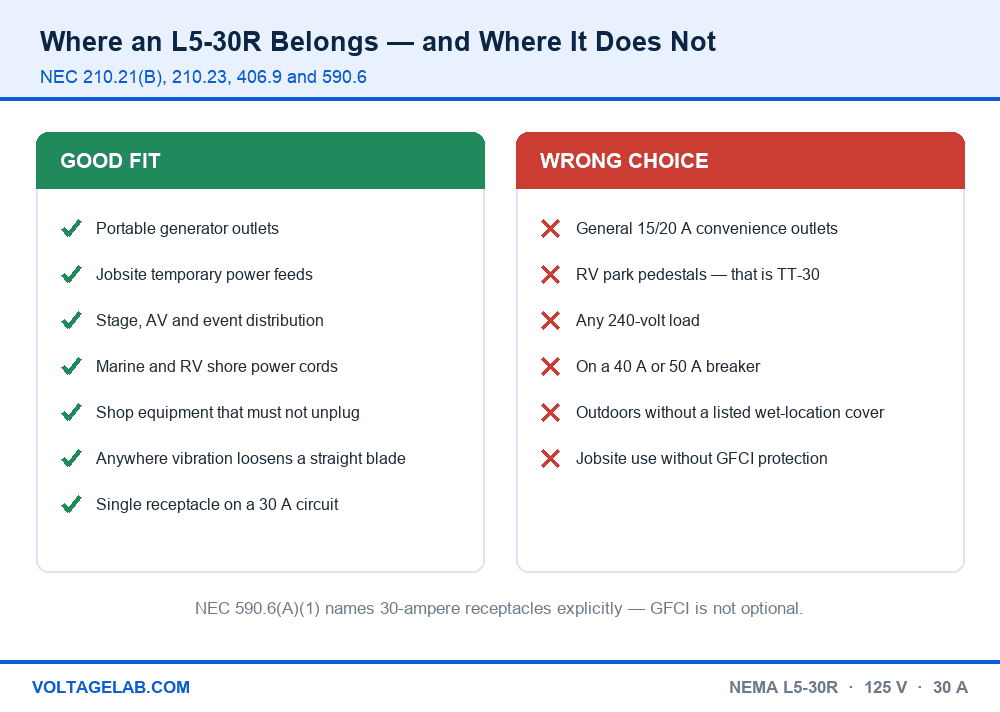
Good applications
- Portable generators. The 30-amp 120-volt outlet on most contractor generators is an L5-30R, and the locking ring is the entire point on a machine that shakes.
- Temporary jobsite power. Spider boxes and temp poles distribute from an L5-30 feed, then break it down to 5-20R outlets.
- Stage, AV and event distribution. A cord that unplugs mid-show is not an option, which is why the locking series dominates entertainment power.
- Marine and RV shore power cords. Plenty of 30-amp shore cords terminate in an L5-30 end, even though the pedestal itself is usually TT-30.
- Fixed shop equipment that must not be knocked loose, where a cord-and-plug connection is still wanted for servicing.
Where it is the wrong device
- General convenience outlets. A 30-amp circuit is not a general-purpose circuit. NEC 210.23 permits a 30-amp branch circuit to supply utilization equipment in any occupancy, and fixed lighting with heavy-duty lampholders only in other than dwelling units — so it is not where you put receptacles for laptops and drills.
- RV park pedestals. That is TT-30 territory. An L5-30R on a pedestal guarantees every visiting rig needs an adapter.
- Anything 240 volts. The 5 family is 125 volts. Use L6-30 for 240 volts with no neutral, or L14-30 where a neutral is needed.
- Outdoors without the right cover. NEC 406.9 governs wet and damp location receptacles — a weatherproof in-use cover listed for the device, not a flap meant for a duplex.
Working out what you can actually plug in
Take the load’s nameplate rating in watts or VA and divide by 125. A 2,400-watt heater draws about 19 amps — comfortable on a 30-amp circuit even as a continuous load. A 3,600-watt load is 28.8 amps, which fits the circuit’s 30-amp rating but blows straight past the 24-amp continuous ceiling. If the equipment is cord-and-plug connected, remember that 210.23 also caps any single cord-and-plug-connected item at 80 percent of the branch circuit rating. For background on how branch circuits are classified, see NEC Article 210 and our breakdown of branch circuit types.
Twist-lock vs straight blade — when locking is worth it
| Need | L5-30 twist-lock | TT-30 straight blade | 5-20 duplex | Hardwired |
|---|---|---|---|---|
| Resists vibration | Yes | No | No | Yes |
| Carries 30 A | Yes | Yes | No | Yes |
| Quick disconnect | Yes | Yes | Yes | No |
| Common cord ends | Moderate | RV only | Universal | — |
| Device cost | Highest | Moderate | Lowest | Lowest |
The honest summary is that locking devices cost more and are worth it only where a dropped connection causes real damage. If you are laying out ordinary receptacles, our guides to NEC 210.52 outlet placement, mounting height, and how many outlets a 20-amp circuit takes are the relevant reading. For the higher-current cousin used on ranges and EV chargers, see the NEMA 14-50 outlet.
Is the L5-30R the right device for your job?
Pros
Study smarter with VoltageLab
Built for electricians, apprentices, and electrical engineers who want faster practice and better exam prep.
⭐️ Join thousands of electricians upgrading their skills
- The connection cannot vibrate or be pulled loose
- Carries a full 30 amps on ordinary 120-volt equipment
- Effectively the standard outlet on contractor generators
- Still a cord-and-plug connection, so equipment can be swapped without an electrician
- Available in wet-location and industrial-grade versions
Cons
- Devices and cord ends cost several times a straight-blade equivalent
- Nothing else plugs into it without an adapter
- Easily confused with TT-30, L6-30 and L14-30 at the counter
Working with twist-lock devices in the field
Do
- Read the stamped configuration on the device body, not the picture on the box
- Count the slots — three means 125 V, four means the L14 family at 240 V
- Size for the 24-amp continuous ceiling whenever the load runs three hours or more
- Fit GFCI protection on every temporary and outdoor installation
- Use an in-use cover listed for the device where it is exposed to weather
Avoid
- Putting a 30-amp receptacle on a 40- or 50-amp breaker
- Assuming an adapter upgrades the circuit — it only changes the connector
- Wiring 10 AWG to a device whose terminals are only listed for 12 AWG
- Treating a 30-amp circuit as general-purpose receptacle space
- Skipping the torque spec because the terminal “feels tight”
Frequently asked questions
What does NEMA L5-30R mean?
L is locking, 5 is the 125-volt 2-pole 3-wire grounding configuration family, 30 is the ampere rating, and R means receptacle. Put together: a 125-volt, 30-amp, twist-locking grounding receptacle. The matching plug is the L5-30P.
What wire size does an L5-30R need?
10 AWG copper for a 30-amp branch circuit, with a 10 AWG equipment grounding conductor. That is the 75 °C column of NEC Table 310.16 before any correction. Long runs often need 8 AWG for voltage drop rather than ampacity.
Is L5-30 the same as TT-30?
No. Both are 125-volt, 30-amp, 2-pole 3-wire grounding devices, but L5-30 is twist-locking and TT-30 is straight-blade. They do not mate. TT-30 is the RV pedestal configuration; L5-30 is what generators and jobsite feeds use. Adapters exist in both directions.
How many watts can an L5-30R deliver?
3,750 VA at the full 30-amp rating (125 V × 30 A). For any load running three hours or more the 80 percent continuous rule brings that down to 24 amps, or 3,000 VA. Size the circuit against whichever figure applies to your load.
Can I put an L5-30R on a 50-amp breaker?
No. NEC 210.21(B)(1) requires a single receptacle on an individual branch circuit to have an ampere rating not less than the branch circuit rating. A 30-amp receptacle on a 50-amp circuit leaves the device unprotected. Going the other way is allowed — a 30-amp single receptacle on a 20-amp circuit is compliant.
Does an L5-30R need GFCI protection?
On temporary power, yes — NEC 590.6(A)(1) specifically covers 125-volt, single-phase, 15-, 20- and 30-ampere receptacles that are not part of the permanent wiring. For permanent installations the answer depends on location under NEC 210.8, which the 2023 Code expanded to cover receptacles up to 50 amperes on circuits rated 150 volts or less to ground.
What is the difference between L5-30 and L14-30?
L5-30 is 125 volts, 2-pole, 3-wire — one hot, one neutral, one ground. L14-30 is 125/250 volts, 3-pole, 4-wire — two hots, a neutral and a ground. L14-30 is what a generator’s 240-volt outlet and most transfer switches use. Count the slots: three versus four.
Can I use an adapter to run a 30-amp tool from a regular outlet?
An adapter changes the shape of the connector, never the capacity of the circuit behind it. Plugging a 30-amp load into a 20-amp circuit through an adapter overloads the conductors while the breaker is still deciding whether to trip. Feed the load from a circuit rated for it.
The bottom line
The L5-30R earns its place wherever a 120-volt connection carries real current and absolutely cannot fall out — generators, temp power, stage rigs, shop equipment that vibrates. It is an ordinary 30-amp branch circuit with a better connector on the end, and the device itself is the least complicated part of the installation.
Two restraints decide most of these jobs. Rating match: 210.21(B)(1) ties the receptacle to the circuit, so an L5-30R means a 30-amp breaker on 10 AWG — never a bigger breaker for headroom. The continuous ceiling: 30 amps is the circuit, 24 amps is what you may actually load on it for three hours or more. Get those two right, check whether 210.8 or 590.6 puts a GFCI in front of it, and the rest is reading the stamp on the device. For the branch-circuit fundamentals underneath all of it, start with NEC Article 210.
FREE PRACTICE TOOL
Think you'd pass this on a real exam?
Test what you just read with instant-feedback quizzes built around real code questions — not generic trivia.
5
Code standards
10,000+
Active learners
100%
Free to start
Instant explanations on every answer, right or wrong
NEC, BS7671, AS/NZS, CEC, and DIN VDE covered
Bite-sized quizzes you can finish in 5 minutes
No signup required to try your first quiz
No account needed · Takes less than 2 minutes