


A homeowner calls because the utility wants the meter moved, and you find the original 1970s service: a meter socket, forty feet of conduit into the basement, and a 200-amp main breaker in a load centre bolted to the far wall behind the furnace. The breaker shuts everything off. It is rated 200 amps. It looks like a service disconnect. The inspector still fails it.
That gap between “it turns the power off” and “it is the service disconnecting means” is where this question bites people. A 200 amp disconnect is not a category of hardware you buy off a shelf and drop anywhere — it is a role defined by NEC Article 230, Part VI, and a breaker only fills that role when the enclosure around it, the location it sits in, and the markings on its cover all line up.
Study smarter with VoltageLab
Built for electricians, apprentices, and electrical engineers who want faster practice and better exam prep.
⭐️ Join thousands of electricians upgrading their skills
This guide covers what the Code actually requires of a service disconnecting means, when a 200 A main breaker satisfies those requirements, how to size the breaker and the conductors feeding it, where it may and may not be installed, and the emergency disconnect rule that now applies on top of all of it at every one- and two-family dwelling.
Quick Answer
Yes — a 200 A breaker can be your service disconnect, and on most residential services it is. What makes it legal is not the breaker but the enclosure: the panelboard, switch or meter-main it sits in must be listed and marked “Suitable for Use as Service Equipment,” it must be the only service disconnect in that enclosure, it must be readily accessible outside the building or inside nearest the point of entrance of the service conductors [NEC 230.70(A)(1)], and it must be plainly marked as the service disconnect [230.70(B)].
In practice, a 200 amp disconnect is one of three things: a main-breaker load centre listed as service equipment, a meter-main combination with a 200 A main, or a separate 200 A enclosed breaker or switch feeding a main-lug panel downstream. A main-lug-only subpanel with a 200 A breaker fed from somewhere else is never the service disconnect.
Key Takeaways
- A circuit breaker qualifies as service equipment only when the enclosure it is installed in is listed and marked “Suitable for Use as Service Equipment”
- NEC 230.70(A)(1) requires the service disconnect to be readily accessible, either outside the building or inside nearest the point of entrance of the service conductors
- NEC 230.71 permits up to six service disconnects, but since the 2020 edition each one must be in its own separate enclosure — the old six-handles-in-one-panel arrangement is no longer allowed on new work
- NEC 230.79 sets the minimum rating at the calculated load, and never less than 100 amperes 3-wire for a one-family dwelling
- A 200 A dwelling service under NEC Table 310.12(A) needs conductors with at least 166 amperes of ampacity — 2/0 AWG copper or 4/0 AWG aluminium at 75 °C
- The main bonding jumper lands at the service disconnect and nowhere else; every panel downstream keeps neutral and ground separate
- Since the 2020 NEC, one- and two-family dwellings also need an outdoor emergency disconnect under 230.85, with specific wording on the label
What the NEC means by “service disconnecting means”
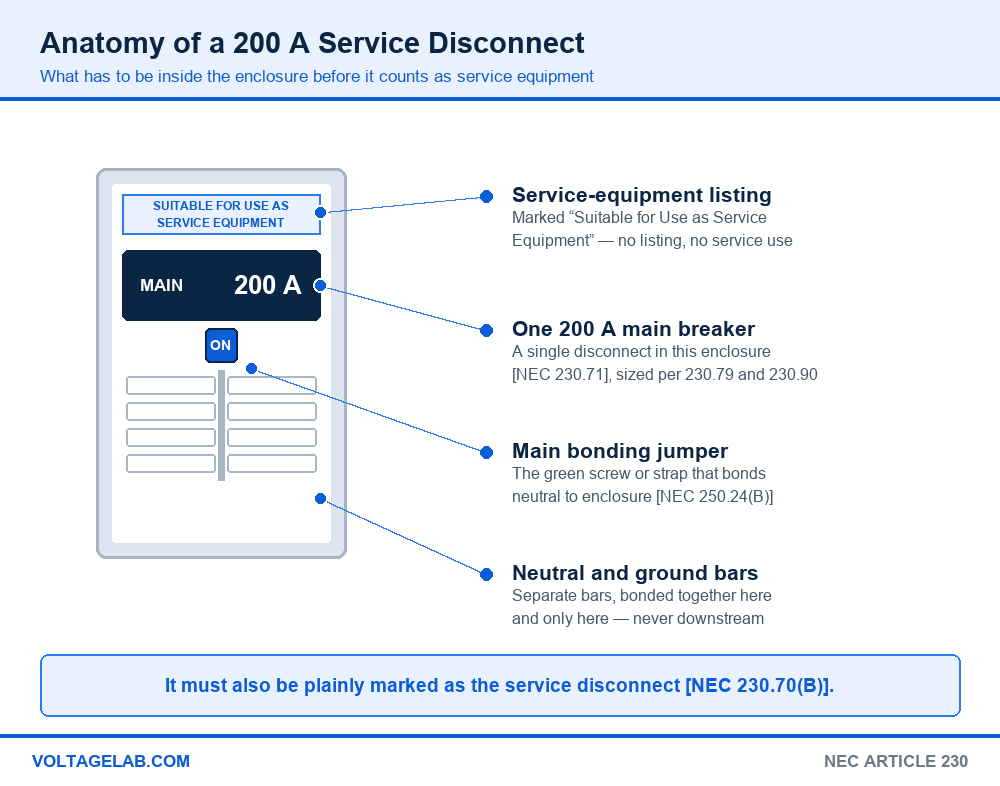
The service disconnecting means is the single point where every ungrounded service conductor entering the building can be opened at once. Everything on its line side is unprotected by any overcurrent device you control — the only thing between those conductors and the transformer is the utility’s fusing. That is why the Code cares so much about where it sits and how it is built.
Pass your electrical exam the first time
Practice real NEC exam questions with full code-referenced explanations and progress tracking — built for journeyman, master and apprentice exam prep.
Thousands of NEC practice questions with code-referenced answers
Four things have to be true before a 200 A breaker counts:
- The enclosure is listed as service equipment. Look for the words Suitable for Use as Service Equipment on the nameplate or the label inside the door. A load centre sold as a main-breaker panel usually carries it; a main-lug-only panel does not.
- The neutral is bonded here. The main bonding jumper — the green screw or the supplied strap — connects the grounded conductor to the enclosure at the service disconnect and only there [NEC 250.24(B)]. Our guide to bonding jumper types and sizing covers how that jumper is sized.
- The location satisfies 230.70(A)(1). Readily accessible, and either outside the building or inside nearest the point where the service conductors enter.
- It is marked. NEC 230.70(B) requires the disconnect to be permanently marked to identify it as the service disconnect. On a service with more than one, the marking has to make clear which loads each one controls — see our notes on NEC and NFPA signage requirements for panels and equipment.
“Suitable for use as” vs “suitable only for use as”
These two labels look almost identical on a nameplate and they mean different things. Suitable for Use as Service Equipment means the equipment may be used as service equipment, and may also be used elsewhere — as a feeder disconnect, for example. Suitable Only for Use as Service Equipment means the neutral is factory-bonded and the equipment cannot be used anywhere downstream of the service.
The distinction matters most when you are picking an emergency disconnect under 230.85, because that section specifically excludes equipment marked suitable only for two of its three options. Read the nameplate word for word before you buy.
Which 200 A device can actually be the disconnect?
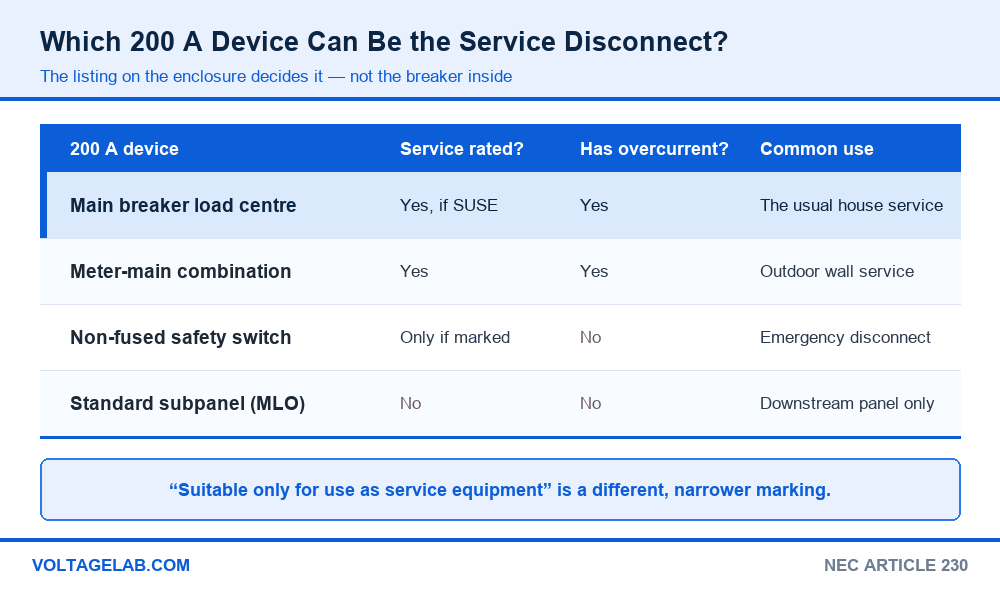
Four pieces of 200-amp hardware show up on service work, and they are not interchangeable:
| 200 A device | Service rated? | Overcurrent protection? | Where it belongs |
|---|---|---|---|
| Main-breaker load centre | Yes, when marked SUSE | Yes | The standard house service |
| Meter-main combination | Yes | Yes | Outdoors, feeding an inside panel |
| Enclosed 200 A breaker | Yes, when marked | Yes | Ahead of a main-lug panel |
| Non-fused safety switch | Only if marked for it | No | Emergency disconnect duty |
| Main-lug-only subpanel | No | No | Downstream of the service only |
Note the third row. A separate enclosed 200 A breaker outside the house, feeding a main-lug panel indoors, is a perfectly ordinary and legal arrangement — the outside breaker is the service disconnect and the indoor panel is a feeder panel with its neutral floated. It costs more, but it solves the “the panel is forty feet inside the building” problem cleanly.
The trap that fails inspections: installing a 200 A main breaker in a panel that is not listed as service equipment, then adding a bonding screw to make the neutral work. The screw does not create the listing. Service equipment is evaluated for the fault current available on the line side with no upstream protection, and an ordinary panelboard has not been tested that way. If the nameplate does not say Suitable for Use as Service Equipment, the enclosure cannot hold the service disconnect — no matter what breaker you put in it.
The second half of that trap is the six-disconnect rule. NEC 230.71 still permits up to six service disconnects for a single service, but since the 2020 edition they must be in separate enclosures — or in separate vertical sections of a switchboard with barriers, or separate compartments of switchgear. Six handles inside one panel was legal for decades and there is an exception for existing installations, but you cannot build it that way today.
Sizing the 200 A disconnect and its conductors — NEC 230.79, 230.90 and 310.12
Two separate sizing rules apply, and people mix them up constantly. NEC 230.79 sets the minimum rating of the disconnecting means: it shall not be less than the calculated load computed under Article 220, and for a one-family dwelling it shall not be less than 100 amperes, 3-wire. NEC 230.90(A) then requires each ungrounded service conductor to have overcurrent protection that does not exceed its ampacity.
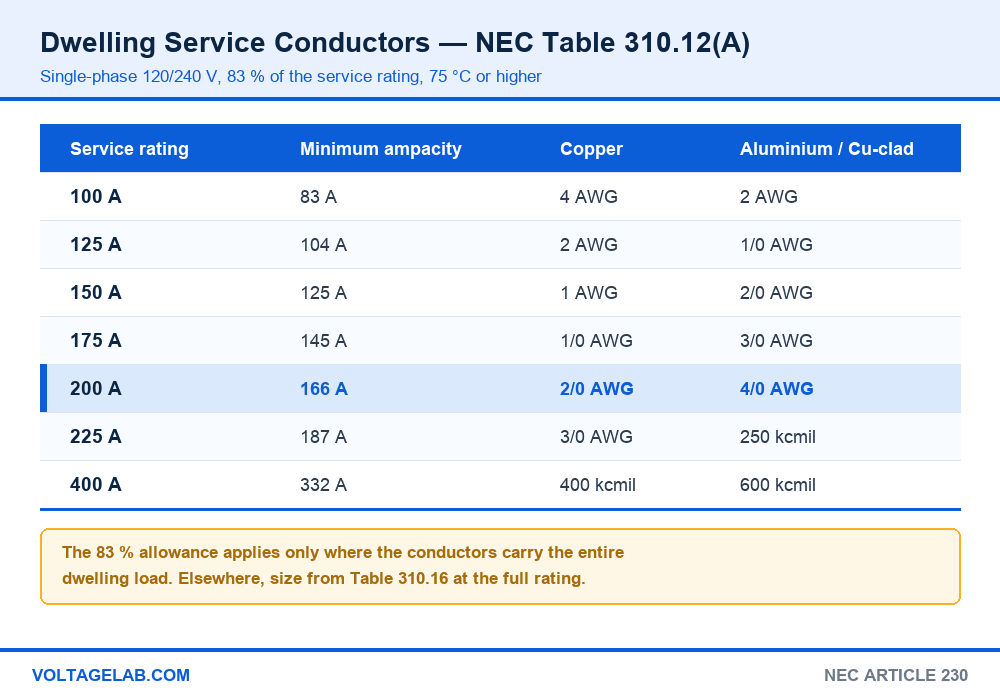
For a dwelling, the conductor side of that gets its own allowance. NEC 310.12(A) lets single-phase 120/240 V service and feeder conductors that carry the entire dwelling load be sized at 83 percent of the service rating, provided the conductors are rated 75 °C or higher:
| Service rating | Minimum ampacity (83 %) | Copper | Aluminium / Cu-clad |
|---|---|---|---|
| 100 A | 83 A | 4 AWG | 2 AWG |
| 125 A | 104 A | 2 AWG | 1/0 AWG |
| 150 A | 125 A | 1 AWG | 2/0 AWG |
| 175 A | 145 A | 1/0 AWG | 3/0 AWG |
| 200 A | 166 A | 2/0 AWG | 4/0 AWG |
| 225 A | 187 A | 3/0 AWG | 250 kcmil |
| 400 A | 332 A | 400 kcmil | 600 kcmil |
The five-step method
Step 1 — run the load calculation. Article 220 gives you the calculated load in amperes. Everything else follows from that number, so do it before you pick hardware. Our walkthrough of calculating a home’s electrical load works through a dwelling example including EV charging.
Step 2 — pick the disconnect rating. It must equal or exceed the calculated load, and never be below the 230.79 floor — 100 A 3-wire for a one-family dwelling, 60 A for most other installations. 200 A is a standard rating under 240.6(A), so there is no rounding argument to have.
Step 3 — size the service conductors. For a dwelling carrying the entire load, use Table 310.12(A) above: 2/0 copper or 4/0 aluminium for 200 A. For anything else — a commercial service, or a feeder that does not carry the whole dwelling load — go to Table 310.16 at the full 200 amperes, which puts you at 3/0 copper or 250 kcmil aluminium at 75 °C.
Study smarter with VoltageLab
Built for electricians, apprentices, and electrical engineers who want faster practice and better exam prep.
⭐️ Join thousands of electricians upgrading their skills
Step 4 — check the overcurrent rule. Under 230.90(A) the 200 A breaker may not exceed the ampacity of the conductors it protects. With 2/0 copper at 175 A from the 75 °C column, a 200 A breaker is permitted here specifically because 310.12 authorises the 83 percent sizing — not because of a general round-up allowance.
Step 5 — size the grounding electrode conductor. Table 250.66 keys off the largest ungrounded service conductor. With 2/0 copper service conductors you need a 4 AWG copper GEC, subject to the usual limits — not required to be larger than 6 AWG to a rod, or 4 AWG to a concrete-encased electrode. See our guide to Table 250.66 grounding electrode conductor sizing.
The one that catches everyone: the 83 percent allowance in 310.12 applies to single-phase 120/240 V dwelling services and feeders that carry the entire load of the dwelling. It is not a general-purpose discount. Split a 200 A service into two 100 A feeders and neither one carries the entire load — size those from Table 310.16 instead. The same goes for any 200 A commercial service.
Where a 200 A service disconnect may and may not go
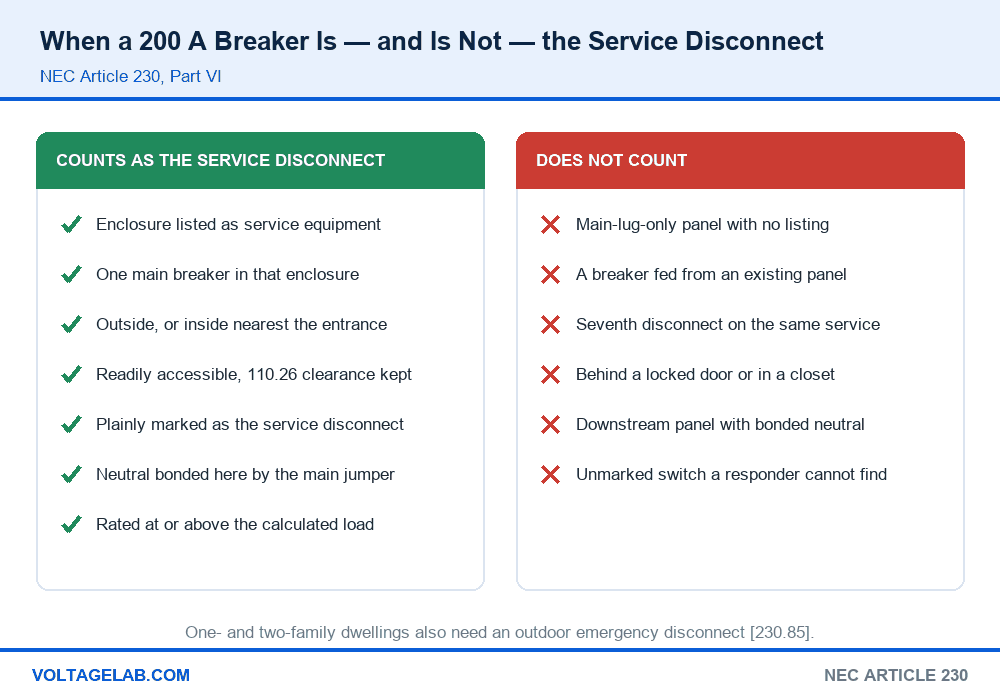
Location is where most of the arguments happen, because 230.70(A)(1) does not give a number. It says the disconnect goes at a readily accessible location, either outside the building or structure, or inside nearest the point of entrance of the service conductors. The NEC deliberately leaves “nearest” to the authority having jurisdiction, and AHJs differ — some allow a few feet, some allow the length of an unfinished basement wall, some will not let service conductors past the first stud bay.
Permitted
- Outside the building on an exterior wall, as a meter-main or a separate enclosed breaker
- Immediately inside where the service raceway or cable penetrates the wall
- In an attached garage or utility space that the raceway enters directly
- Grouped with up to five other service disconnects, each in its own enclosure [230.71]
- Anywhere the working space of NEC 110.26 can be maintained — 3 ft depth, 30 in. width, 6 ft 6 in. headroom for a typical 120/240 V service
Not permitted
- In a bathroom — 230.70(A)(2) prohibits it outright
- Behind a locked door the occupant cannot open, or anywhere not readily accessible
- Deep inside the building with a long run of unprotected service conductors reaching it
- In a clothes closet, over a stairway, or anywhere the 110.26 working space cannot be held
- As a seventh disconnect on a service that already has six
The emergency disconnect — NEC 230.85
Since the 2020 edition, one- and two-family dwelling units need an emergency disconnecting means in a readily accessible outdoor location, so first responders can kill the building without pulling a meter. The 2023 edition tightened the language. It may be one of three things:
- A service disconnect, marked EMERGENCY DISCONNECT, SERVICE DISCONNECT
- A meter disconnect integral to the meter-mounting equipment, not marked as suitable only for use as service equipment, marked EMERGENCY DISCONNECT, METER DISCONNECT, NOT SERVICE EQUIPMENT
- Another listed disconnect switch or circuit breaker marked suitable for use as service equipment but not marked as suitable only for that use, installed on the supply side of each service disconnect and marked EMERGENCY DISCONNECT, NOT SERVICE EQUIPMENT
Markings must comply with 110.21(B) — permanent, legible, suitable for the environment — and the disconnect must have a short-circuit current rating at least equal to the available fault current. The practical consequence for most house work: put the 200 A main outside in a meter-main, mark it with both lines, and you have satisfied 230.70 and 230.85 with one piece of equipment.
200 A main breaker vs the alternatives
| Requirement | 200 A main-breaker panel | Meter-main + MLO panel | Outside breaker + MLO panel | Six disconnects |
|---|---|---|---|---|
| Satisfies 230.70 location | Only if near the entrance | Yes | Yes | Yes, if grouped |
| Meets 230.85 outdoors | No, needs a separate one | Yes | Yes | Yes, if outdoors |
| Neutral bonded at | The panel | The meter-main | The outside breaker | Each enclosure |
| Separate EGC required downstream | No — it is the service | Yes, 4-wire feeder | Yes, 4-wire feeder | Varies |
| Relative cost | Lowest | Moderate | Highest | Highest |
Whichever arrangement you choose, the grounding side follows the same logic — bond at the service, keep the grounded and grounding conductors separate everywhere after it. Our overview of NEC Article 250 grounding and bonding lays out the whole sequence, and grounding an electrical panel covers the terminations inside the can. For the conductors themselves, see THHN/THWN-2 ratings and uses, and for the overhead drop feeding the meter, triplex vs quadruplex service cable.
Is a 200 A main breaker the right disconnect for the job?
Pros
- One piece of equipment is the disconnect, the overcurrent device and the panel
- Cheapest compliant arrangement for a standard dwelling service
- Bonding is handled by the factory-supplied main bonding jumper
- 200 A is a standard rating under 240.6(A), so breakers and lugs are stocked everywhere
- Covers most modern dwelling loads including an EV charger without an upgrade
Cons
- Only works if the panel is genuinely near the point of entrance
- Does not satisfy the outdoor emergency disconnect in 230.85 on its own
- Puts unprotected service conductors inside the building all the way to the panel
Working with a 200 A service disconnect in the field
Do
- Read the enclosure nameplate for the service-equipment listing before you order
- Call the AHJ about “nearest the point of entrance” before you cut the wall
- Install the main bonding jumper at the service and remove any bonding screw downstream
- Label the disconnect per 230.70(B) and 110.21(B), and add the 230.85 wording outdoors
- Torque every lug to the marked value with a calibrated tool per 110.14(D)
Avoid
- Adding a bonding screw to an unlisted panel to make it “service rated”
- Putting six disconnects in one enclosure on new work
- Using the 83 percent allowance on a feeder that does not carry the whole dwelling load
- Bonding neutral to ground in the downstream main-lug panel
- Assuming an old six-handle service can be extended rather than replaced
Frequently asked questions
Can a 200 A breaker be a service disconnect?
Yes, provided the enclosure it is installed in is listed and marked “Suitable for Use as Service Equipment,” it is the only service disconnect in that enclosure, it is readily accessible outside the building or inside nearest the point of entrance, and it is plainly marked as the service disconnect under NEC 230.70(B).
Does a 200 amp disconnect have to be outside?
Not necessarily. NEC 230.70(A)(1) allows it outside the building or inside nearest the point of entrance of the service conductors. But one- and two-family dwellings need an outdoor emergency disconnect under 230.85 regardless, so putting the service disconnect outside usually lets one device do both jobs.
What size wire does a 200 amp service need?
For a single-phase 120/240 V dwelling service carrying the entire load, Table 310.12(A) permits 2/0 AWG copper or 4/0 AWG aluminium at 75 °C. For anything that does not qualify for the 83 percent allowance, size from Table 310.16 at the full 200 amperes — 3/0 copper or 250 kcmil aluminium.
How many service disconnects are allowed?
Up to six per service under NEC 230.71, but since the 2020 edition each must be in its own separate enclosure, separate switchboard section with barriers, or separate switchgear compartment. Existing installations built to earlier editions with six handles in one enclosure are covered by an exception.
Can I use a main-lug panel as my service disconnect?
No. A main-lug-only panel has no disconnecting means and is not listed as service equipment. It can be fed by a service disconnect installed upstream — a meter-main or a separate enclosed breaker — but it cannot be the disconnect itself.
Where does the main bonding jumper go on a 200 A service?
At the service disconnect enclosure and nowhere else, per NEC 250.24(B). If the service disconnect is an outdoor meter-main, the bond goes there and the indoor panel is wired as a feeder panel with isolated neutral and a separate equipment grounding conductor.
What size grounding electrode conductor for a 200 A service?
With 2/0 AWG copper service conductors, Table 250.66 calls for 4 AWG copper. The GEC need not be larger than 6 AWG copper where it runs only to a rod, pipe or plate electrode, or larger than 4 AWG copper where it runs only to a concrete-encased electrode.
Does a 200 A disconnect need overcurrent protection?
The service conductors do. NEC 230.90(A) requires overcurrent protection in each ungrounded service conductor, not exceeding its ampacity — which is why the disconnecting means is normally a breaker. A non-fused switch can be a disconnect, but the overcurrent device still has to exist somewhere in the service equipment.
The bottom line
A 200 A breaker makes a perfectly good service disconnect, and on most houses it is the right answer. What earns it that role is the listing on the enclosure, not the number on the handle — an ordinary panelboard with a 200 A main in it is a feeder panel, however convincing it looks. Confirm the enclosure is marked as service equipment, put it where 230.70(A)(1) allows, land the main bonding jumper there and nowhere downstream, and mark the cover so the next person and the fire department can both read it.
The two restraints that actually cost people money are the location rule and the emergency disconnect. Decide early whether the service disconnect goes outside — because if it does, one meter-main handles 230.70 and 230.85 together, and if it does not, you are buying a second enclosure. For the wider set of changes reshaping service work in the current cycle, see our summary of what changed in the 2026 NEC.
FREE PRACTICE TOOL
Think you'd pass this on a real exam?
Test what you just read with instant-feedback quizzes built around real code questions — not generic trivia.
5
Code standards
10,000+
Active learners
100%
Free to start
Instant explanations on every answer, right or wrong
NEC, BS7671, AS/NZS, CEC, and DIN VDE covered
Bite-sized quizzes you can finish in 5 minutes
No signup required to try your first quiz
No account needed · Takes less than 2 minutes