



 Scan to install
The homeowner says “the GFI in the bathroom keeps popping.” The supply house counter calls the same box a “GFI outlet.” The inspector’s correction notice says “provide GFCI protection per 210.8.” The plan set has “GFCI” next to every kitchen counter receptacle. All four are talking about the same device.
That is the short answer to the GFI vs GFCI question, but it is not the whole story. There really are different ground-fault devices with different trip levels, and they get confused with each other the same way GFI and GFCI do. Install the wrong one and the circuit looks protected while a person standing in water is not.
This guide covers where the two names came from, how a GFCI actually works, the Class A trip threshold and trip times in UL 943, how GFCIs differ from GFPE, SPGFCI and RCDs, where NEC 210.8 requires them, and the installation mistakes that fail inspections.
Quick Answer
GFI vs GFCI: there is no difference. GFI (ground fault interrupter) is the informal name; GFCI (ground-fault circuit interrupter) is the term used in the NEC and in the product standard, UL 943. A “GFI outlet” and a “GFCI receptacle” are the same device.
What does differ is the device class. A Class A GFCI trips at 6 milliamps and protects people. GFPE (ground-fault protection of equipment) trips at hundreds of amps and protects equipment only. When the Code says GFCI, it means a Class A personnel-protection device, whatever the box calls it.
Key Takeaways
- GFI and GFCI name the same device; only GFCI appears in the NEC and UL 943
- A Class A GFCI must trip at 6 mA of ground-fault current and must not trip below 4 mA
- Trip time follows an inverse curve: about 5.6 seconds at 6 mA, about 25 milliseconds at 264 mA
- GFPE is equipment protection with trip settings up to 1,200 A and does not protect people
- NEC 210.8 requires the GFCI device itself to be in a readily accessible location
- A GFCI works without an equipment grounding conductor, which is why it is a legal fix for two-wire circuits under 406.4(D)(2)
- GFCIs made since mid-2015 self-test and lock out power at end of life
What GFI and GFCI mean — and how the device works
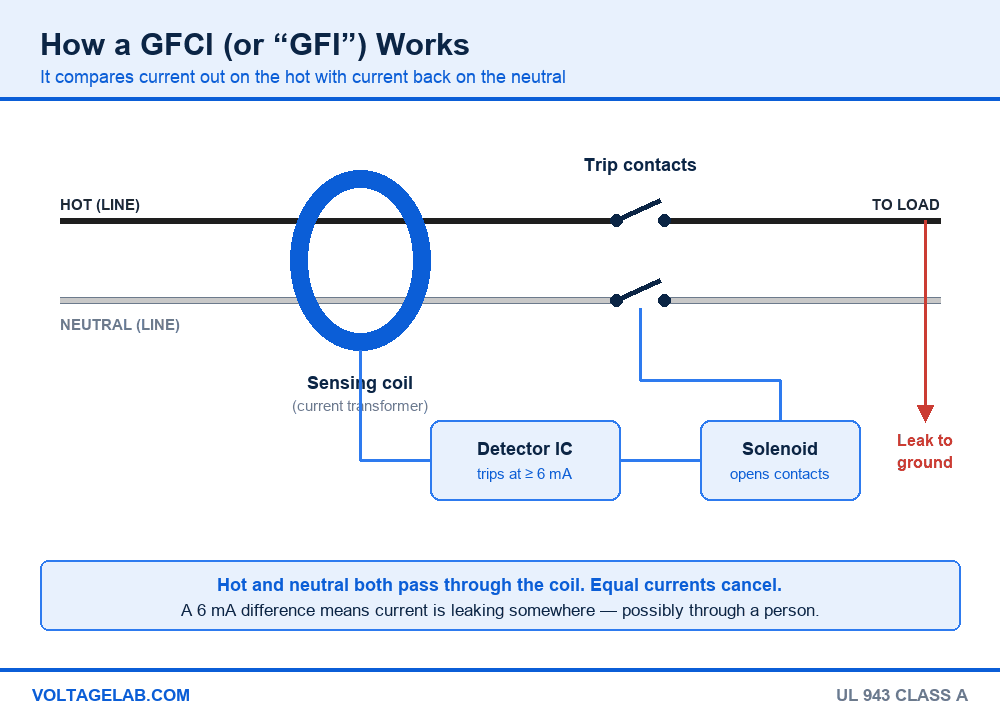
NEC Article 100 defines a ground-fault circuit interrupter as a device intended to protect personnel that de-energizes a circuit, or part of one, within an established time when ground-fault current exceeds the values set for a Class A device. The informational note gives those values: trip at 6 mA or more, no trip below 4 mA.
Inside, every GFCI does the same thing:
- Sensing coil. The hot and neutral conductors both pass through a small toroidal current transformer. In a healthy circuit the current going out equals the current coming back, their magnetic fields cancel, and the coil sees nothing.
- Detector circuit. If some current returns by another path — through a wet hand, a pipe, or the equipment ground — the coil sees the imbalance. At 6 mA the detector fires.
- Solenoid and contacts. The detector drives a solenoid that opens the hot and neutral contacts. The RESET button relatches them.
- TEST button. Pushes a small current around the coil through a resistor to simulate a fault.
- Self-test and end-of-life. GFCIs built to the UL 943 revision effective June 2015 monitor themselves and deny power if they can no longer protect.
Where the two names came from
Ground-fault interrupters entered the NEC around 1970, first for underwater pool lighting and outdoor receptacles. Early product literature and catalogs used both “ground fault interrupter” and “ground-fault circuit interrupter,” and the shorter GFI stuck in everyday speech. The Code and UL settled on GFCI, which is why every requirement you will look up — 210.8, 406.4(D), 590.6, 680 — uses that term. On a job, use GFCI in writing and accept GFI when people say it.
GFI vs GFCI vs GFPE, SPGFCI and RCD
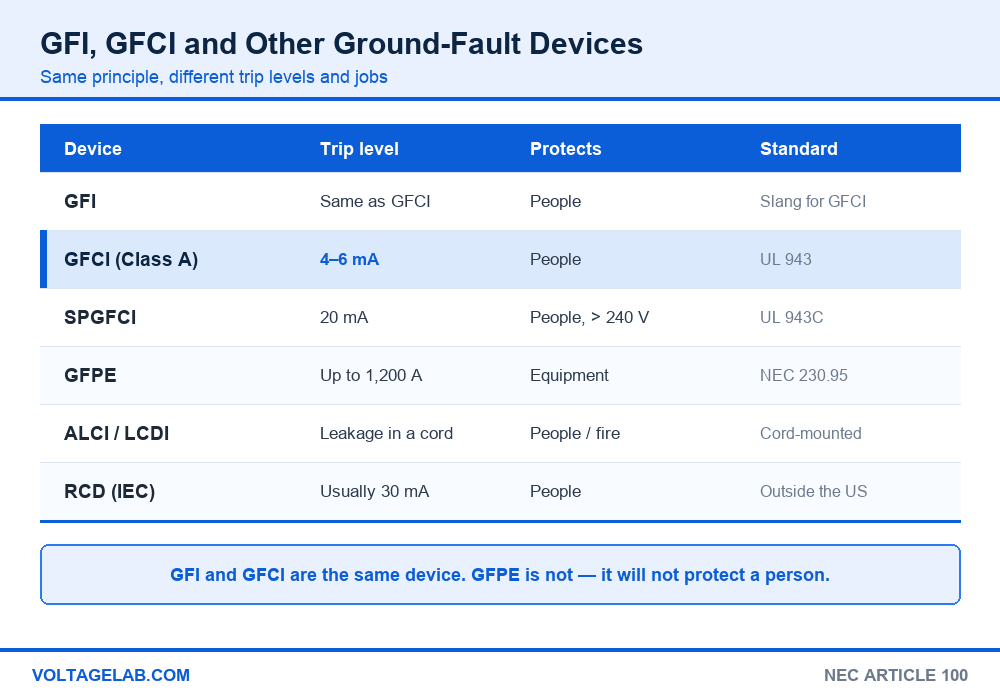
The real distinctions are between device classes, not names. Article 100 of the 2023 NEC defines GFCI, special-purpose GFCI and ground-fault protection of equipment as separate terms:
| Device | Trip level | Protects | Where you see it |
|---|---|---|---|
| GFI | Same as GFCI | People | Informal name for a GFCI |
| GFCI (Class A) | 6 mA (no trip below 4 mA) | People | Every 210.8 location — what the Code means by GFCI |
| SPGFCI | 20 mA | People | Circuits above the Class A voltage range, UL 943C |
| GFPE | Up to 1,200 A on services | Equipment only | Large services and feeders, 230.95 and 215.10 |
| ALCI / LCDI | Leakage in a cord | People / fire | Plug-mounted on hair dryers and window AC cords |
| RCD | Commonly 30 mA | People | IEC countries — not a Class A GFCI |
Two of those cause real trouble on US jobs. A GFPE device protects switchgear and conductors from arcing ground faults; it is far too insensitive to save a person. And imported equipment fitted with a 30 mA RCD does not satisfy a 210.8 requirement, because 30 mA is well above the Class A threshold.
The equipment-protection trap: 30 mA “equipment protection” breakers sold for heat tracing and de-icing look exactly like GFCI breakers and have a TEST button. They are GFPE devices, not Class A GFCIs. Using one on a garage, outdoor or bathroom circuit leaves the 210.8 requirement unmet. Read the label for “GFCI” or “Class A” before it goes in the panel.
GFCI trip threshold and trip time — UL 943 Class A
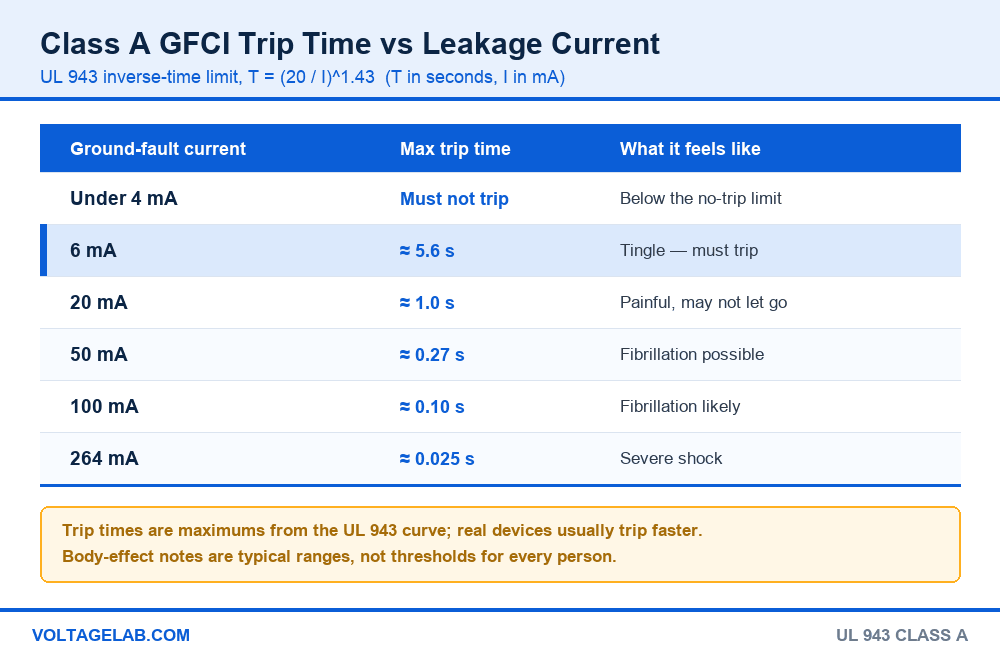
A Class A GFCI does not trip instantly at 6 mA. UL 943 sets an inverse-time limit, commonly published as T = (20 / I)1.43, where T is the maximum trip time in seconds and I is the ground-fault current in milliamps. The bigger the leak, the faster the device must open.
| Ground-fault current | Maximum trip time | Typical effect on a person |
|---|---|---|
| Below 4 mA | Must not trip | Usually imperceptible to a mild tingle |
| 6 mA | ≈ 5.6 s | Perceptible shock |
| 10 mA | ≈ 2.7 s | Painful; let-go becomes difficult |
| 20 mA | ≈ 1.0 s | May be unable to let go |
| 50 mA | ≈ 0.27 s | Ventricular fibrillation possible |
| 100 mA | ≈ 0.10 s | Ventricular fibrillation likely |
| 264 mA | ≈ 0.025 s | Severe shock |
The 4–6 mA window exists for a reason. Every circuit has some normal leakage through insulation and appliance filters. Setting the no-trip limit at 4 mA keeps nuisance tripping down; setting the must-trip limit at 6 mA keeps it below the level where most adults lose the ability to let go.
Choosing the right GFCI in four steps
Step 1 — confirm GFCI is required. Check the location against 210.8(A) for dwellings or 210.8(B) for other occupancies, then the appliance list in 210.8(D). Our comparison of GFCI vs AFCI requirements walks through both lists.
Step 2 — pick the device type. A GFCI receptacle when the first outlet on the circuit is accessible and in the protected area. A GFCI breaker when it is not, or when the whole circuit needs protection. A dead-front GFCI when the reset must sit somewhere other than the outlet, such as beside a hot tub or above a dishwasher.
Step 3 — check access. NEC 210.8 requires the GFCI device to be installed in a readily accessible location. A receptacle behind a refrigerator or under a sink cabinet does not qualify.
Step 4 — wire LINE and LOAD correctly. Supply goes on LINE. Use the LOAD terminals only if you want downstream receptacles protected, and label each one “GFCI Protected.” Modern devices will not reset if LINE and LOAD are reversed.
The one that catches everyone: a GFCI does not need an equipment grounding conductor to work. It compares hot and neutral, nothing else. That is why NEC 406.4(D)(2) lets you replace a two-wire ungrounded receptacle with a GFCI marked “No Equipment Ground.” It is also why a plug-in tester will often fail to trip a GFCI on an ungrounded circuit — the tester needs a ground path to create its fault. Use the TEST button there.
Where NEC 210.8 requires GFCI protection
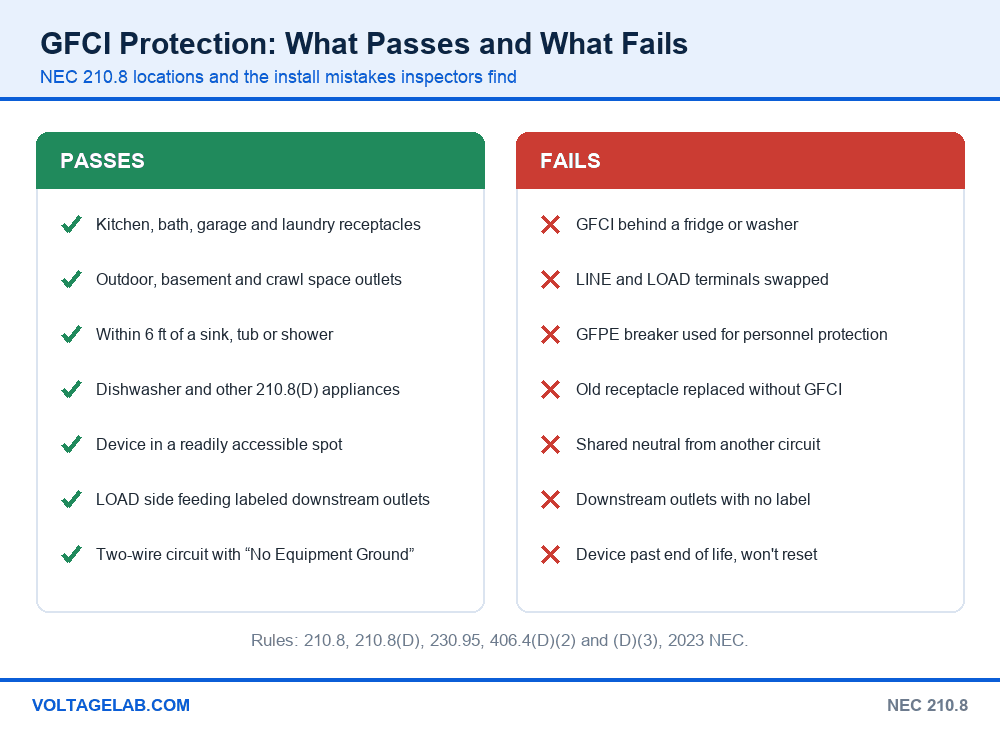
In the 2023 NEC, 210.8(A) covers 125-volt through 250-volt receptacles in dwelling units supplied by single-phase branch circuits rated 150 volts or less to ground. 210.8(B) covers other occupancies, including larger and three-phase circuits up to the limits it sets. The list below is the short version; always read the edition your jurisdiction has adopted.
Dwelling locations under 210.8(A)
- Bathrooms
- Garages and accessory buildings
- Outdoors
- Crawl spaces and basements
- Kitchens — see our guide to kitchen island outlet code
- Within 6 ft of a sink, bathtub or shower stall
- Laundry areas — covered in dedicated circuits for washer and dryer
- Boathouses and indoor damp or wet locations
Installs that fail
- A GFCI receptacle behind an appliance, which is not readily accessible
- LINE and LOAD swapped, so the face is protected but downstream outlets are not
- A GFPE or 30 mA equipment-protection breaker used where 210.8 requires a GFCI
- A receptacle replaced in a 210.8 location without adding GFCI protection, contrary to 406.4(D)(3)
- A GFCI breaker on one leg of a multi-wire branch circuit with a shared neutral — it trips immediately
- Downstream receptacles fed from LOAD with no “GFCI Protected” label
Temporary power is its own case. NEC 590.6 requires GFCI protection for receptacles used by personnel on construction sites, which is why the cord-end GFCIs on job-site spider boxes exist. Our article on preventing electrical shocks on the job site covers the field side.
GFCI receptacle vs GFCI breaker vs dead-front vs portable
| Question | GFCI receptacle | GFCI breaker | Dead-front | Portable / cord |
|---|---|---|---|---|
| Reset location | At the outlet | In the panel | Wherever you mount it | On the cord |
| Protects the branch-circuit wiring | Only downstream of it | Whole circuit | Only downstream of it | No |
| Satisfies 210.8 for a permanent install | Yes | Yes | Yes | No |
| Cost | Lowest | Highest | Middle | Middle |
| Best for | Kitchens, baths, garages | Hidden or hard-to-reach outlets, hot tubs | Dishwashers, disposals, spas | Job sites, rentals, older homes |
When a GFCI starts tripping, the device is rarely the fault. Work through our step-by-step guide to testing a GFCI outlet before replacing it. For how many receptacles one GFCI can sensibly feed, see how many outlets on a 20-amp circuit, and for the GFCI changes in the newest cycle, our summary of 2026 NEC changes.
Drill the GFCI and AFCI rules
210.8 locations change almost every code cycle, and exam questions love the edges of the list. The VoltageLab: Electrician App (also on Android) has a GFCI/AFCI quiz topic where every answer cites the code section behind it. It is free to download.
GFCI receptacle or GFCI breaker?
GFCI receptacle — pros
- Reset is where the user is, so a trip gets noticed and fixed
- Costs a fraction of a GFCI breaker
- Isolates trips to one area instead of the whole circuit
- Works in any panel brand, including obsolete ones
GFCI receptacle — cons
- Deep body makes crowded boxes hard to close
- Wiring upstream of it is unprotected
- Downstream outlets go dead with no obvious reason unless labeled
Working with GFCIs in the field
Do
- Identify LINE with a meter before landing conductors
- Put the “GFCI Protected” sticker on every LOAD-side receptacle
- Press TEST and RESET before you leave the job
- Use weather-resistant GFCIs with in-use covers outdoors
- Tell the owner to test monthly, per the manufacturer’s instructions
Avoid
- Feeding a refrigerator or sump pump from a GFCI hidden behind it
- Stacking two GFCIs in series on the same circuit
- Borrowing a neutral from another circuit downstream of a GFCI
- Trusting a plug-in tester on an ungrounded circuit
- Calling a 30 mA equipment-protection breaker a GFCI
Frequently asked questions
Is a GFI the same as a GFCI?
Yes. GFI is the informal name and GFCI is the formal one used in the NEC and UL 943. A GFI outlet and a GFCI receptacle are the same device with the same 6 mA Class A trip level.
What does GFCI stand for?
Ground-fault circuit interrupter. GFI stands for ground fault interrupter, the shorter version of the same term.
At what current does a GFCI trip?
A Class A GFCI must trip when ground-fault current reaches 6 mA and must not trip below 4 mA. Trip time shortens as current rises, from about 5.6 seconds at 6 mA to about 25 milliseconds at 264 mA under the UL 943 curve.
What is the difference between a GFCI and GFPE?
A GFCI protects people and trips at 6 mA. GFPE protects equipment from damaging ground faults, with trip settings measured in amps — up to 1,200 A on services under NEC 230.95. GFPE does not satisfy any GFCI requirement.
Does a GFCI need a ground wire?
No. It measures the difference between hot and neutral current, so it trips on a ground fault even with no equipment grounding conductor. NEC 406.4(D)(2) allows a GFCI as a replacement for an ungrounded two-wire receptacle, marked “No Equipment Ground.”
Is a GFCI breaker better than a GFCI outlet?
Neither is better in general. The breaker protects the whole circuit and suits hidden or hard-to-reach outlets. The receptacle is cheaper and puts the reset where the user is. Both satisfy 210.8 when installed in a readily accessible location.
How often should a GFCI be tested?
Manufacturers instruct monthly testing with the TEST button. Devices built since mid-2015 also self-test and will deny power when they reach end of life.
The bottom line
GFI vs GFCI is a question about words, and the answer is that there is no difference. The question that matters is whether the device is a Class A GFCI: 6 mA, listed to UL 943, and installed where someone can reach the reset. That is what every 210.8 requirement asks for.
Read the label so an equipment-protection device does not end up doing a personnel-protection job, wire LINE and LOAD the right way round, and keep the device out from behind appliances. For the other half of the protection picture, see our guide to GFCI vs AFCI, and for the exact wording of the defined terms, NEC Article 100 definitions.