


The terms “grounding bushing” and “bonding bushing” are used interchangeably in the field — and that loose terminology masks an important distinction. The NEC treats these devices differently, requires them under different circumstances, and ties each to different code sections. Installing the wrong type, or skipping one when it is required, will fail a service inspection.
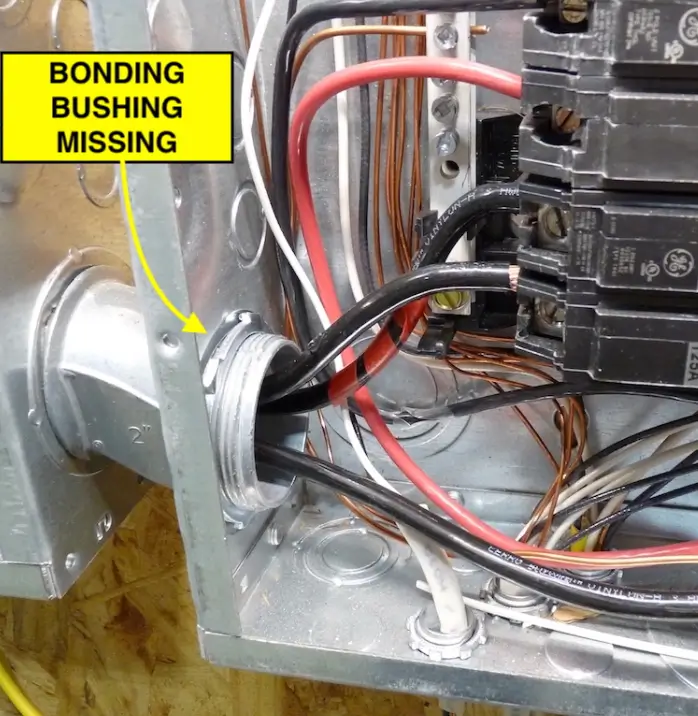
This guide explains what each bushing type is, the specific NEC sections that require them, where each applies on the service versus the load side, and how to size the bonding conductor attached to a bonding bushing.
Study smarter with VoltageLab
Built for electricians, apprentices, and electrical engineers who want faster practice and better exam prep.
⭐️ Join thousands of electricians upgrading their skills
- What a grounding bushing is and when it is required
- What a bonding bushing is and when it is required
- NEC 250.92 — service equipment bonding requirements
- NEC 250.97 — bonding for circuits over 250 volts to ground
- The concentric/eccentric knockout problem explained
- Bonding conductor sizing for service raceways
- Load-side applications — when neither bushing may be required
Quick Reference: Grounding Bushing vs. Bonding Bushing
| Feature | Grounding Bushing | Bonding Bushing |
|---|---|---|
| Primary purpose | Maintains EGC continuity when conduit transitions to non-metallic raceway or when conduit threads could damage conductor insulation | Provides electrical bonding of metal raceway to enclosure where standard locknuts through concentric/eccentric knockouts are insufficient |
| Has conductor lug? | Yes — for connecting an EGC wire | Yes — for connecting a bonding conductor or jumper |
| Primary NEC trigger | EGC continuity is interrupted (conduit to PVC transition, etc.) | NEC 250.92(B) — service-side bonding; NEC 250.97 — circuits over 250V to ground with concentric/eccentric knockouts |
| Used on service side? | Can be used | Specifically required — NEC 250.92(B) |
| Used on load side? | Yes — at EGC path interruptions | Required at concentric/eccentric knockouts with voltage over 250V to ground — NEC 250.97 |
| Conductor sizing reference | NEC Table 250.122 (based on OCPD) | NEC Table 250.102(C)(1) — service side; NEC Table 250.122 — load side |
Table 1: Grounding Bushing vs. Bonding Bushing — NEC Comparison (2023 Edition)
What Is a Grounding Bushing?
A grounding bushing is an insulated bushing with a lug or set screw that allows an equipment grounding conductor to be connected directly to the bushing and, through it, to the conduit and enclosure. Its primary function is to maintain continuity of the equipment grounding path when the conduit itself cannot reliably serve as the EGC — typically at a transition from metallic to non-metallic raceway.
A grounding bushing also protects conductor insulation at the end of metallic conduit. Standard metal locknuts and bushings have sharp edges — particularly after field cutting — that can abrade insulation. An insulated grounding bushing has a plastic or nylon insert that the conductors pass through, protecting them from the metal edge while also providing the EGC connection point.
When Is a Grounding Bushing Required?
At metal-to-nonmetal transitions: When a metallic raceway system (RMC, IMC, EMT) transitions to a non-metallic raceway (PVC, ENT), the metallic raceway is no longer continuous to the enclosure. A grounding bushing at the metallic conduit end, connected to an EGC, re-establishes the grounding path through that wire rather than through the raceway.
At large conduit entries where insulation protection is needed: NEC 300.4(G) requires that where raceways containing conductors 4 AWG or larger enter a cabinet, box, or other enclosure through a knockout, the conductors shall be protected by a substantial fitting providing a smooth, rounded insulating surface — unless the conductors are separated from the fitting by substantial insulating material. An insulated grounding bushing satisfies this requirement at metallic conduit entries.
What Is a Bonding Bushing?
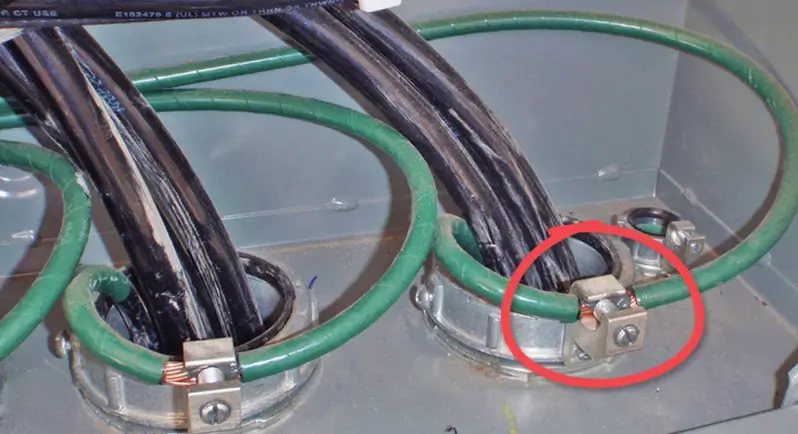
A bonding bushing serves a different primary purpose: it ensures reliable electrical bonding of a metal raceway to a metal enclosure where the physical connection through standard concentric or eccentric knockouts cannot be depended upon for bonding continuity.
Pass your electrical exam the first time
Practice real NEC exam questions with full code-referenced explanations and progress tracking — built for journeyman, master and apprentice exam prep.
Thousands of NEC practice questions with code-referenced answers
A standard punchout (clean, round knockout) in a metal enclosure provides a reliable mechanical and electrical connection when a locknut is made up tightly. However, a concentric knockout (the ringed partial-knockout found on many panels and enclosures) has had its metal partially removed in concentric rings. Even after the rings are removed and a conduit is installed, the remaining metal is thinner and more fragile than a clean punched hole, and the connection may not provide reliable low-impedance continuity — especially under the mechanical stresses of a service installation.
The NEC acknowledges this limitation and requires an additional, supplemental means of bonding when concentric or eccentric knockouts are used in certain applications.
NEC 250.92 — Service Equipment Bonding
This is the primary section that makes bonding bushings a requirement on nearly every service installation. NEC 250.92(A) requires that metal raceways and other metal parts of service equipment be bonded together and to the service neutral conductor. The service raceway, service cable armor or sheath, and any metal raceways or armor containing service conductors must all be electrically continuous and bonded.
NEC 250.92(B) specifies four acceptable methods of achieving this bonding at service equipment. Any one of the four methods is sufficient:
- Bonding jumper to service neutral: Connect a bonding jumper from the metal raceway to the grounded service conductor. This is essentially what the main bonding jumper accomplishes through the enclosure itself at the service panel.
- Threaded hubs or bosses: Terminate the metal raceway to the enclosure using threaded hubs or bosses that are part of the enclosure, made up wrenchtight. A rigid metal conduit screwed into a threaded hub on a service panel is a fully bonded connection.
- Threadless fittings made tight: Connect metal raceways and cables using listed threadless fittings made up tight — for example, EMT set-screw or compression connectors pulled tight into a clean punchout.
- Other listed devices: Use listed bonding-type locknuts, bushings, wedges, or bushings with bonding jumpers. This is where the bonding bushing applies — as a listed device specifically designed to provide the supplemental bonding connection at a service enclosure entry.
The critical point about standard locknuts through concentric knockouts: A standard locknut made tight through a concentric knockout is not listed as one of the four acceptable bonding methods at service equipment. The concentric knockout connection is acceptable for mechanical attachment, but not for the electrical bonding continuity required by NEC 250.92(B). A bonding bushing (or bonding locknut) must be added to satisfy the bonding requirement when standard locknuts are the only fastening method at a concentric knockout on service equipment.
Where does 250.92 apply? NEC 250.92 applies on the supply side of the service disconnect — that is, the service entrance conductors, service raceways, and service equipment. It does not extend to load-side feeders or branch circuits beyond the service disconnect
NEC 250.97 — Bonding for Circuits Over 250 Volts to Ground
On the load side of the service, bonding bushings are generally not required unless the circuit voltage to ground exceeds 250 volts AND the conduit connects to an enclosure using a concentric or eccentric knockout that has not been listed for bonding.
NEC 250.97 states: Where metal raceways or cables are used with circuits of over 250 volts to ground, the electrical continuity of metal raceways and cables with metal sheaths shall be ensured by one of the bonding methods in NEC 250.92(B). This includes:
- Threaded hubs made wrenchtight
- Threadless fittings made tight
- Bonding-type locknuts, bushings, or wedges
When does 250.97 typically apply? On 480Y/277V systems where metal conduit enters an enclosure through a concentric or eccentric knockout. In these installations, a bonding bushing or bonding-type locknut is required at those concentric knockout entries, even on the load side of the service.
What about 120/208V or 120/240V systems (under 250V to ground)? NEC 250.97 does not apply. On these systems, load-side raceways connected through standard or concentric knockouts with locknuts do not require bonding bushings — the locknut connection through a punched or listed concentric knockout provides sufficient continuity for the load-side EGC path.
| Location | Voltage to Ground | Knockout Type | Bonding Bushing Required? | NEC Section |
|---|---|---|---|---|
| Service side (supply of service disconnect) | Any | Concentric/eccentric | Yes | NEC 250.92(B) |
| Service side | Any | Clean punchout (threaded hub or tight locknut) | No — if made wrenchtight or tight | NEC 250.92(B) |
| Load side of service disconnect | Over 250V to ground (e.g., 277V, 480V) | Concentric/eccentric — not listed for bonding | Yes | NEC 250.97 |
| Load side of service disconnect | 250V or less to ground (e.g., 120V, 208V, 240V) | Any | No — standard locknut sufficient | NEC 250.97 does not apply |
| Load side — conduit to PVC transition | Any | N/A (EGC continuity purpose) | Grounding bushing required to maintain EGC path | NEC 250.118, 300.4(G) |
Table 2: When Are Bonding Bushings Required? — NEC 250.92 vs 250.97 (2023 Edition)
Sizing the Bonding Conductor on a Bonding Bushing
A bonding bushing is only effective if the bonding conductor attached to its lug is correctly sized. Undersizing the bonding conductor defeats the purpose — in a fault condition, the conductor must carry enough current to operate the OCPD.
Study smarter with VoltageLab
Built for electricians, apprentices, and electrical engineers who want faster practice and better exam prep.
⭐️ Join thousands of electricians upgrading their skills
Service-Side Bonding Conductor — NEC Table 250.102(C)(1)
For bonding conductors on the supply side of the service disconnect (connecting a bonding bushing on a service raceway to the service neutral or to the service enclosure), size from NEC Table 250.102(C)(1) based on the area of the largest ungrounded service conductor in the raceway.
Example: A service raceway contains 2/0 AWG copper service-entrance conductors. What is the minimum bonding conductor size?
- Largest ungrounded conductor: 2/0 AWG copper
- NEC Table 250.102(C)(1) lookup: 2/0 AWG → minimum bonding conductor = 4 AWG copper
Load-Side Bonding Conductor — NEC Table 250.122
For bonding conductors on the load side of the service disconnect (NEC 250.97 applications at 480V systems), size from NEC Table 250.122 based on the ampere rating of the OCPD protecting the circuit.
Field Application Notes
Listed Concentric Knockouts and the UL White Book
Some enclosures have concentric knockouts that have been specifically listed and investigated for bonding purposes. The UL White Book (UL Product iQ) notes for metal outlet boxes and enclosures may indicate that the concentric knockouts in that specific product have been listed for bonding. In those cases, a standard locknut through the listed concentric knockout satisfies the bonding requirement without a bonding bushing. Always check the equipment listing when in doubt — the UL listing may eliminate the need for a supplemental bonding bushing at that enclosure.
RMC and IMC — Threaded Connections
Rigid metal conduit or intermediate metal conduit screwed into a threaded hub or boss on a service enclosure, made up wrenchtight, satisfies NEC 250.92(B) without requiring a bonding bushing. The threaded wrenchtight connection qualifies as one of the four accepted bonding methods. Bonding bushings are primarily needed when locknuts — rather than threaded hubs — are used at service enclosures with concentric knockouts.
EMT at Service Equipment
EMT uses set-screw or compression connectors at enclosures, not threaded connections. EMT connectors made up tight into a clean (non-concentric) punchout satisfy NEC 250.92(B) as a threadless fitting made tight. At a concentric knockout on service equipment, a bonding locknut or bonding bushing is still required when using EMT.
Conclusion
Three rules cover the correct application of these bushings in the field:
- Service side — always bond. Any metal raceway containing service conductors must be bonded to the service enclosure by one of the four methods in NEC 250.92(B). When standard locknuts are used at concentric knockouts, add a bonding bushing or bonding locknut.
- Load side over 250V to ground — bond at concentric knockouts. At 480Y/277V and similar systems, NEC 250.97 requires bonding at concentric/eccentric knockouts that are not listed for bonding. Below 250V to ground, standard locknuts are sufficient on the load side.
- EGC interruptions — use a grounding bushing. Wherever the metallic conduit EGC path is broken (transition to PVC, plastic manholes, non-metallic sections), a grounding bushing with a wire EGC re-establishes continuity.
For grounding electrode conductor sizing on the other side of this topic, see our NEC Table 250.66 grounding electrode conductor size guide.
FAQ
What is the difference between a grounding bushing and a bonding bushing?
A grounding bushing is used to maintain equipment grounding conductor continuity where conduit transitions to non-metallic raceway or where insulation protection at the conduit end is needed. A bonding bushing is used specifically to bond metal raceways to enclosures where the standard locknut-through-knockout connection is not reliable enough for the bonding purpose, particularly at service equipment per NEC 250.92(B) and at 480V systems per NEC 250.97. Both devices have a lug for a conductor, but they serve different NEC purposes.
When is a bonding bushing required at a service panel?
NEC 250.92(B) requires that all metal raceways containing service conductors be bonded to the service enclosure by one of four acceptable methods. When standard locknuts are used through concentric or eccentric knockouts, rather than through threaded hubs or clean punchouts, a supplemental bonding means such as a bonding bushing or bonding-type locknut is required. This applies on the supply side of the service disconnect.
Are bonding bushings required on the load side of a 120/208V panel?
Generally no. NEC 250.97 requires supplemental bonding at concentric or eccentric knockouts only for circuits with voltage exceeding 250 volts to ground. A 120/208V wye system has 120V to ground, which is below the 250V threshold. Therefore, NEC 250.97 does not apply, and standard locknuts through concentric knockouts are acceptable on the load side of those systems.
How do I size the bonding conductor for a bonding bushing on a service raceway?
Size it from NEC Table 250.102(C)(1) based on the area of the largest ungrounded conductor in the service raceway. For example, service conductors of 3/0 AWG copper require a minimum bonding conductor of 2 AWG copper per Table 250.102(C)(1).
Does a grounding bushing satisfy the service bonding requirement of NEC 250.92?
A grounding bushing with a bonding conductor connected to the service neutral conductor can satisfy NEC 250.92(B) Method 1, which allows a bonding jumper to the service neutral. It is a listed device that, when properly connected, provides the required bonding. However, the conductor must be correctly sized per NEC Table 250.102(C)(1) and connected to the appropriate bonding point. Simply installing a grounding bushing without connecting its lug to a proper bonding conductor does not satisfy the requirement.
FREE PRACTICE TOOL
Think you'd pass this on a real exam?
Test what you just read with instant-feedback quizzes built around real code questions — not generic trivia.
5
Code standards
10,000+
Active learners
100%
Free to start
Instant explanations on every answer, right or wrong
NEC, BS7671, AS/NZS, CEC, and DIN VDE covered
Bite-sized quizzes you can finish in 5 minutes
No signup required to try your first quiz
No account needed · Takes less than 2 minutes