


Two coils sit on the rack at the supply house and they look identical: silver interlocked steel spiral, same diameter, same feel in your hand. One is armored cable, Type AC. The other is Type MC. The price tags are different, the inspector treats them differently, and on a patient care floor or in a fixture whip one of them will get your work rejected.
The difference is not the armor. It is what is riding underneath it, and how the Code counts that metal as a ground path. Type AC carries a 16 AWG aluminium bonding strip pressed against the inside of the armor, and the armor plus that strip together are the equipment grounding conductor. Traditional interlocked Type MC has no bonding strip, its armor is not a ground path, and it carries a separate green or bare grounding conductor inside instead.
Study smarter with VoltageLab
Built for electricians, apprentices, and electrical engineers who want faster practice and better exam prep.
⭐️ Join thousands of electricians upgrading their skills
This guide covers how armored cable is built, how to tell the two apart with the cable in your hand, what each article permits and forbids, how to size them from NEC Table 310.16, and the two mistakes that account for most of the failed inspections involving armored cable.
Quick Answer
Armored cable (Type AC) is covered by NEC Article 320 and contains a 16 AWG aluminium bonding strip in continuous contact with the interlocked armor. The armor and that strip together are recognised as the equipment grounding conductor under 320.108 and 250.118, so no separate grounding wire is required. Type MC cable is covered by Article 330; the armor of traditional interlocked MC is not a ground path, so the cable includes a separate bare or green grounding conductor.
In practice: AC is dry locations only, tops out at 1 AWG, and always needs an anti-short bushing at every termination per 320.40. MC goes down to 18 AWG and up through service-size conductors, is permitted in wet locations when listed for it, and needs no anti-short bushing when you use listed MC fittings. MC is the more flexible wiring method; AC is the one that self-grounds.
Key Takeaways
- Armored cable (Type AC) falls under NEC Article 320; metal-clad cable (Type MC) falls under Article 330
- Type AC always contains a 16 AWG aluminium bonding strip, and every conductor inside is individually wrapped in kraft paper
- The armor plus bonding strip of Type AC is the equipment grounding conductor; the armor of traditional interlocked MC is not
- Unjacketed Type MC always carries a printed marker tape under the armor identifying it as MC — that is the fastest field ID
- NEC 320.40 requires an anti-short bushing at every Type AC termination; listed MC fittings under 330.40 do not require one
- Type AC is not permitted in damp or wet locations; Type MC is, where it is listed and identified for the application
- Armored cable conductors run 14 AWG through 1 AWG copper; MC starts at 18 AWG and goes far larger
- Never land the AC bonding strip on a receptacle grounding screw — it bonds to the box, in combination with the armor
What armored cable (Type AC) actually is
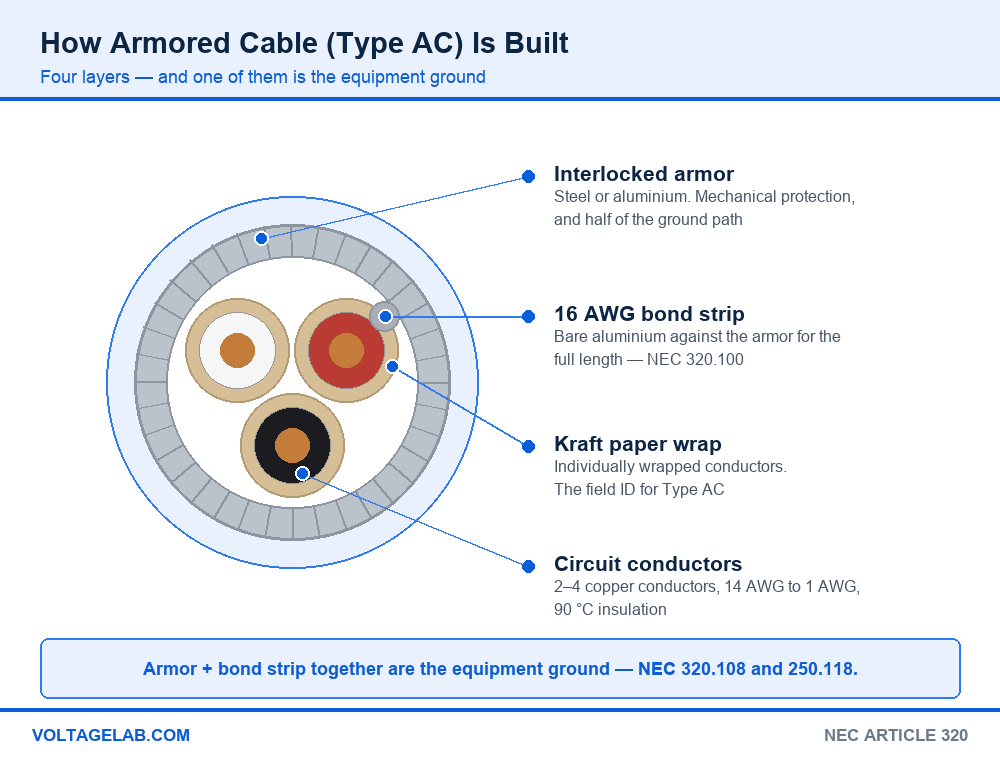
Armored cable is a factory assembly of insulated conductors inside a flexible interlocked metal armor, with a bonding strip in intimate contact with that armor along its entire length. Build it up from the middle out and every layer has a job:
Pass your electrical exam the first time
Practice real NEC exam questions with full code-referenced explanations and progress tracking — built for journeyman, master and apprentice exam prep.
Thousands of NEC practice questions with code-referenced answers
- Circuit conductors. Two to four copper conductors, 14 AWG through 1 AWG, with 90 °C thermoplastic insulation. Most of what ships today is THHN-insulated, which is why AC is often marked ACTHH.
- Kraft paper wrap. Each conductor is individually wrapped. This is the identifier that no amount of packaging confusion can fake — if the conductors come out wrapped in paper, you are holding Type AC.
- A 16 AWG aluminium bonding strip. Required by NEC 320.100 along the cable’s entire length, bare, pressed against the inside of the armor.
- Interlocked steel or aluminium armor. The mechanical protection, and half of the ground path.
The bonding strip is the part people misunderstand. On its own it is not an equipment grounding conductor — 16 AWG aluminium could never clear a fault by itself. What it does is short out the long helical path of the spiral armor. Current in an interlocked armor with no strip would have to corkscrew its way back to the panel, and the impedance of that spiral is high enough that a breaker may not see enough fault current to trip quickly. Laid straight along the inside of the armor, the strip gives the fault a direct path and drops the impedance of the assembly. That is why NEC 320.108 recognises the armor in combination with the bonding strip as the equipment grounding conductor, and why 250.118 lists it among the acceptable ground paths.
How to tell AC from MC with the cable in your hand
Outwardly they are the same product. Cut two inches off the end and the answer is immediate:
- Kraft paper on each conductor → Type AC. MC does not wrap its conductors in paper.
- A bare 16 AWG aluminium strip against the armor → Type AC. It will be dull silver and noticeably smaller than the circuit conductors.
- A printed marker tape under the armor → Type MC. Unjacketed MC always carries one, and it says so in print.
- A green insulated or bare copper grounding conductor bundled with the circuit conductors → Type MC. Type AC has no green wire; its ground is the armor.
If you find a green insulated copper conductor and kraft paper and a bond strip, you are holding hospital-grade Type AC, built for NEC 517.13 patient care spaces where two independent ground paths are required.
Armored cable vs MC cable — the differences that matter
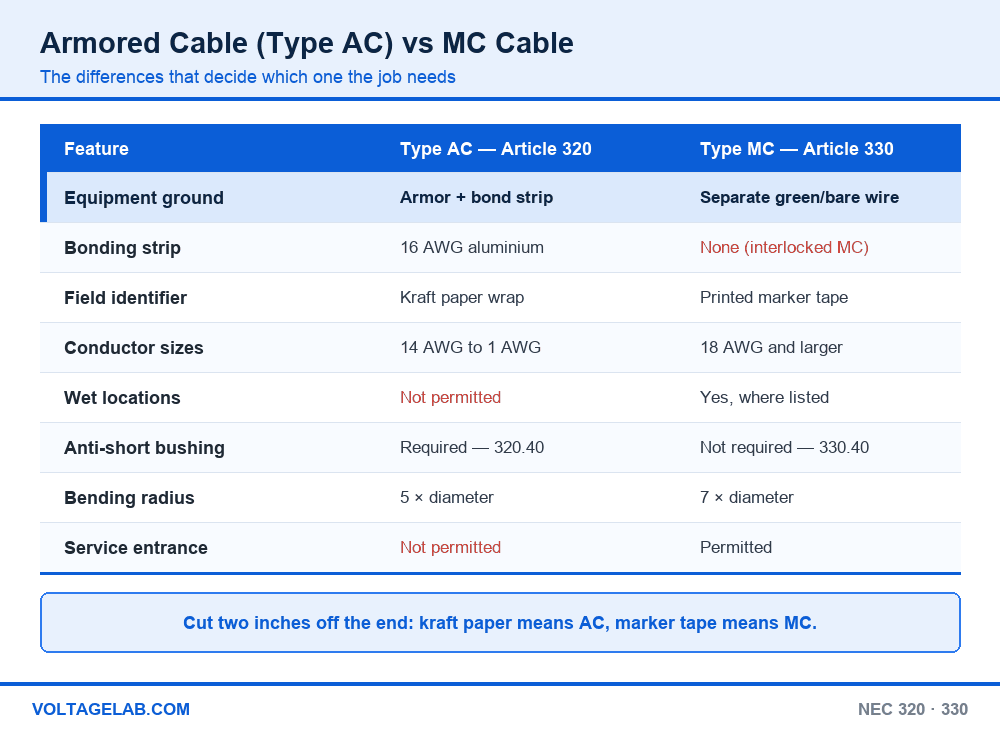
Both are complete wiring methods, both use interlocked armor, and both are supported the same way — secured within 12 inches of every box and at intervals not exceeding 4½ feet, with the last 6 feet permitted unsupported as a fixture whip in an accessible ceiling. Everything below is where they diverge:
| Feature | Armored Cable (Type AC) | Metal-Clad Cable (Type MC) |
|---|---|---|
| NEC article | Article 320 | Article 330 |
| Equipment grounding conductor | Armor + bonding strip, per 320.108 | Separate bare or green wire inside |
| Bonding strip | Always — 16 AWG aluminium, 320.100 | None on traditional interlocked MC |
| Conductor identification | Kraft paper wrap on each conductor | Printed marker tape under the armor |
| Conductor sizes | 14 AWG to 1 AWG copper | 18 AWG copper and larger |
| Wet locations | No — dry locations only, 320.12 | Yes, where listed — 330.10(A)(11) |
| Direct burial / concrete | No | Yes, with a PVC-jacketed listed type |
| Anti-short bushing | Required every termination, 320.40 | Not required with listed fittings, 330.40 |
| Bending radius | 5 × cable diameter, 320.24 | 7 × external diameter (interlocked), 330.24 |
| Service-entrance use | No | Yes, per 330.10 |
Read that table and the pattern is clear. Armored cable buys you a self-grounding assembly in a compact package for dry interior branch circuits. MC buys you range — smaller conductors for control work, much larger conductors for feeders and services, and the wet and buried locations AC cannot legally go. Our full breakdown of MC cable types, uses and NEC rules covers the MC side in its own right.
The bonding strip trap: do not land the aluminium bonding strip of armored cable on the grounding screw of a receptacle. That terminal is generally not listed for aluminium, and the strip is only intended to carry fault current in combination with the armor — on its own it is not an equipment grounding conductor. The correct method is to terminate the armor in a listed connector at the metal box; the armor-and-strip combination then satisfies the grounding requirement. Depending on the box and device, a bonding jumper from the receptacle to the box may still be required by NEC 250.146.
Most electricians fold the strip back over the anti-short bushing and wrap it around the outside of the armor. That is not a Code requirement — the NEC has no termination requirement for the strip at all, and it may simply be cut off — but folding it back does a useful job of holding the bushing in place while you make up the connector.
Armored cable ampacity — reading NEC Table 310.16
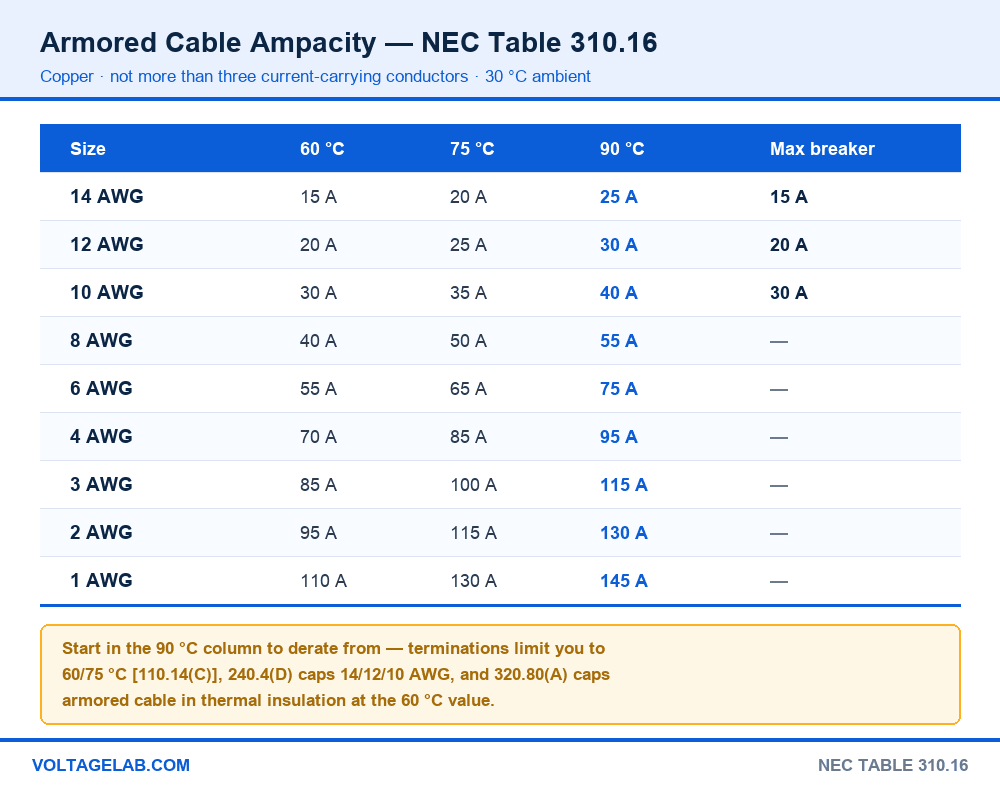
Conductors inside armored cable are sized from NEC Table 310.16, the same table you use for conductors in a raceway, and the same rules apply. Modern Type AC uses 90 °C conductors, so you start in the 90 °C column — but only to derate from. Our walkthrough of how to read NEC Table 310.16 covers the table’s own assumptions in detail.
| Copper size | 60 °C | 75 °C | 90 °C | Max OCPD per 240.4(D) |
|---|---|---|---|---|
| 14 AWG | 15 A | 20 A | 25 A | 15 A |
| 12 AWG | 20 A | 25 A | 30 A | 20 A |
| 10 AWG | 30 A | 35 A | 40 A | 30 A |
| 8 AWG | 40 A | 50 A | 55 A | — |
| 6 AWG | 55 A | 65 A | 75 A | — |
| 4 AWG | 70 A | 85 A | 95 A | — |
| 3 AWG | 85 A | 100 A | 115 A | — |
| 2 AWG | 95 A | 115 A | 130 A | — |
| 1 AWG | 110 A | 130 A | 145 A | — |
The four-step method for sizing an armored cable run
Step 1 — start in the 90 °C column. Type AC and Type MC both use 90 °C insulated conductors, so the 90 °C value is your legitimate starting point for every correction and adjustment factor that follows.
Step 2 — count the current-carrying conductors. More than three in a single cable, or bundled cables without spacing, triggers the adjustment factors in Table 310.15(C)(1). On a 3-phase, 4-wire branch circuit feeding electronic ballasts or LED drivers, the neutral counts as a current-carrying conductor — see multi-wire branch circuits for when the neutral does and does not count.
Step 3 — apply the ambient correction. Above or below the 30 °C (86 °F) table ambient, multiply by the correction factor. Armored cable run above a suspended ceiling in a hot mechanical space rarely sees 30 °C.
Step 4 — check the terminations and the small conductor rule. Under NEC 110.14(C) the temperature rating of the termination limits your final ampacity, which usually means the 60 °C or 75 °C column. Then NEC 240.4(D) caps 14, 12 and 10 AWG copper at 15, 20 and 30 amps no matter what the table shows.
Study smarter with VoltageLab
Built for electricians, apprentices, and electrical engineers who want faster practice and better exam prep.
⭐️ Join thousands of electricians upgrading their skills
Worked example: a home run with eight 12 AWG current-carrying copper conductors starts at 30 amps in the 90 °C column, takes a 70% adjustment for seven to nine conductors, and lands at 21 amps. That still supports a 20-amp branch circuit — provided no ambient correction is also required.
The one that catches everyone: NEC 320.80(A) requires armored cable installed in thermal insulation to have 90 °C conductors, but caps the resulting ampacity at the 60 °C value. You may use the 90 °C column for the adjustment and correction arithmetic, but the final number cannot exceed the 60 °C column. This is an Article 320 rule with no equivalent in Article 330 — bury Type AC in batt insulation and 12 AWG drops to 20 amps as its ceiling, not 30.
Where armored cable is allowed — and where it is not
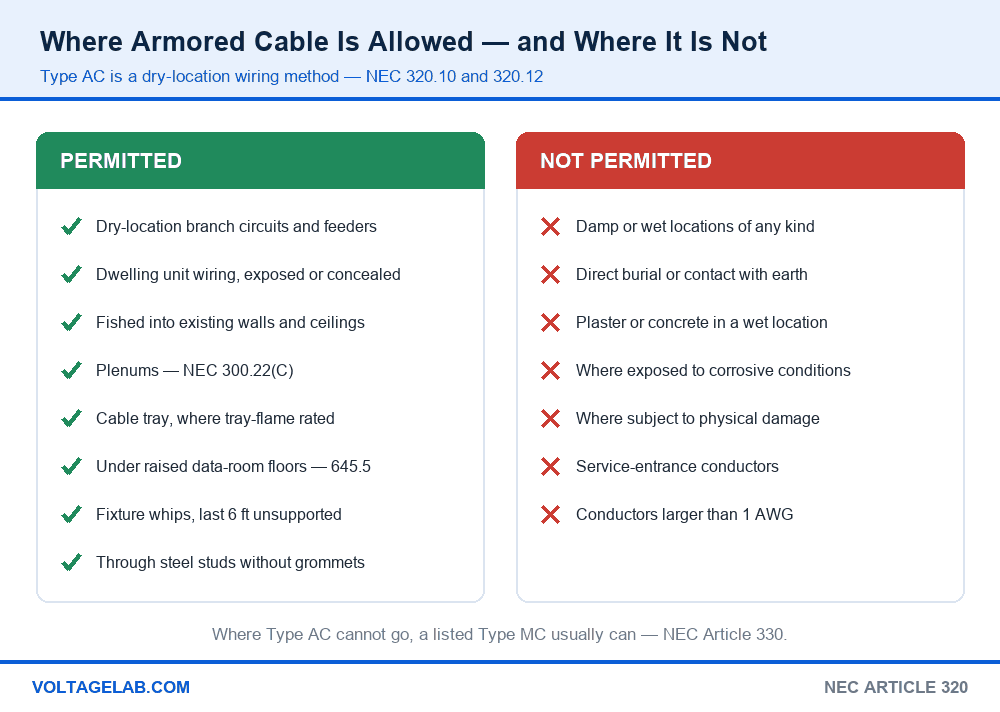
Article 320 is short, and the restrictions are the part worth memorising. The governing limitation is environmental: armored cable is a dry-location wiring method, full stop.
Permitted
- Branch circuits and feeders in dry locations, exposed or concealed
- Dwelling unit wiring — the armor resists nail penetration, crushing and rodents
- Fished into the walls and ceilings of existing buildings
- Cable trays, where the cable has passed the UL 1685 vertical tray flame test
- Plenums and other spaces used for environmental air, under NEC 300.22(C)
- Under raised floors in information technology rooms, per 645.5
- Fixture whips — the last 6 feet may run unsupported to a luminaire in an accessible ceiling, per 320.30 and 410.117(C)
- Through steel studs without grommets — 320.17 specifically exempts armored cable from that requirement
Not permitted
- Damp or wet locations of any kind
- Embedded in plaster finish or concrete in a damp or wet location
- Direct burial, or anywhere in contact with earth
- Where exposed to corrosive conditions
- Where subject to physical damage
- Service-entrance conductors — that is MC territory
- Conductors larger than 1 AWG, which UL 4 does not permit in Type AC
Box fill and terminations
Because the armor and bonding strip of Type AC form the equipment grounding conductor, there is no separate grounding wire to count in a box fill calculation — but every cable entering the box still counts, and the armor must terminate in a connector listed for Type AC. Our guide to pull box and junction box sizing covers the volume arithmetic. Where armored cable terminates into a raceway system, review the requirements for grounding versus bonding bushings before you assume the transition is bonded.
Armored cable vs the other wiring methods
AC and MC are not the only options on a commercial or residential job. Set them beside NM cable and a conduit-and-wire system and the trade-offs are easier to see:
| Requirement | Type AC | Type MC | NM (Romex) | EMT + THHN |
|---|---|---|---|---|
| Self-grounding armor | Yes | No | No | Yes |
| Physical protection | Good | Good | Minimal | Best |
| Wet locations | No | Yes, if listed | No | Yes, with THWN-2 |
| Commercial use | Yes | Yes | Restricted | Yes |
| Largest conductor | 1 AWG | Service sizes | 2 AWG typical | 1000 kcmil |
| Install speed | Fast | Fast | Fastest | Slowest |
| Future conductor changes | Replace cable | Replace cable | Replace cable | Pull new wire |
For the broader picture of insulation types and the standards behind them, see our overview of electrical cable types and standards. If your run is going into conduit instead, sizing conduits and raceways with NEC Annex C is the next calculation. And if the ground path itself is what you are working through, start with NEC Article 250 grounding and bonding basics. For an unusual cable that shows up in switch loops and shared-neutral work, 14-2-2 double-neutral cable is worth knowing about.
Is armored cable the right choice for your job?
Pros
- Self-grounding — no separate equipment grounding conductor to pull or land
- Steel armor resists nails, screws, crushing and rodents
- Far faster to install than conduit and wire
- Fishes into existing walls where a raceway could never go
- Accepted in plenums, cable tray and under raised data-room floors
- Fewer conductors in the box than MC, since there is no green wire
Cons
- Dry locations only — no wet, damp, buried or corrosive environments
- Capped at 1 AWG, so it cannot serve large feeders or services
- Anti-short bushing required at every single termination
- The 320.80(A) thermal insulation rule quietly costs you ampacity
- Generally costs more per foot than equivalent MC
Working with armored cable in the field
Do
- Cut the armor with a rotary armored cable cutter, not a hacksaw
- Install an anti-short bushing at every termination and confirm it seated
- Fold the bonding strip back over the bushing to hold it while you land the connector
- Use fittings listed for the cable type actually in your hand
- Secure within 12 inches of every box and every 4½ feet along the run
Avoid
- Landing the bonding strip on a receptacle grounding screw
- Running Type AC anywhere damp, wet or in contact with earth
- Bending tighter than 5× the cable diameter and crushing the armor
- Assuming a coil is MC because the connector box says MC
- Ignoring the 60 °C ampacity cap where the cable sits in thermal insulation
Frequently asked questions
What is the difference between armored cable and MC cable?
Armored cable (Type AC, Article 320) contains a 16 AWG aluminium bonding strip against the armor, and the armor plus that strip is the equipment grounding conductor. Type MC (Article 330) has no bonding strip; its interlocked armor is not a ground path, so it carries a separate bare or green grounding conductor inside. AC is also restricted to dry locations and to conductors no larger than 1 AWG.
Does armored cable need a separate ground wire?
No. NEC 320.108 and 250.118 recognise the armor in combination with the bonding strip as the equipment grounding conductor, so no additional grounding conductor is required. The one common exception is patient care spaces in health care facilities, where NEC 517.13 requires a green insulated copper equipment grounding conductor in addition to the qualifying cable armor.
Can armored cable be used outside or underground?
No. NEC 320.12 prohibits Type AC in damp and wet locations, in contact with earth, and where exposed to corrosive conditions. For an outdoor or buried run in an armored wiring method, use a Type MC cable that is listed and identified for wet locations or direct burial — typically one with a continuous PVC outer jacket.
What is the red thing inside armored cable?
That is the anti-short bushing, commonly called a red head. NEC 320.40 requires one between the conductors and the armor at every Type AC termination, so the sharp cut edge of the interlocked armor cannot slice the conductor insulation. Type MC does not require one when listed MC fittings with a smooth, rounded end stop are used.
How do I identify armored cable versus MC in the field?
Cut a short piece off the end. Type AC has kraft paper individually wrapping each conductor and a bare 16 AWG aluminium strip riding against the armor. Unjacketed Type MC has a printed marker tape under the armor identifying it, and a separate bare or green grounding conductor bundled with the circuit conductors.
How often does armored cable need to be supported?
NEC 320.30 requires Type AC to be secured within 12 inches of every outlet box, junction box, cabinet or fitting, and supported at intervals not exceeding 4½ feet. The last 6 feet may be run unsupported as a fixture whip to a luminaire or piece of equipment in an accessible ceiling.
Is armored cable allowed in a plenum?
Yes. NEC 300.22(C) governs wiring in spaces used for environmental air, and both Type AC and Type MC without an overall PVC jacket are permitted there. A PVC-jacketed MC is not, because the jacket is what the plenum rule objects to.
Which is cheaper, AC or MC cable?
Type MC is generally the less expensive of the two per foot and is stocked in far more configurations, which is why it dominates commercial work. Armored cable costs more but removes the separate grounding conductor and, on a small dry-location branch circuit, can still make up the difference in labour. Confirm current pricing with your supplier — it moves with copper and steel.
The bottom line
Armored cable earns its place on dry interior branch circuits because the armor does two jobs at once: it protects the conductors, and with the bonding strip behind it, it is the ground. That is a genuinely compact wiring method, and it fishes into places no raceway will ever reach. The two restraints that matter are both hard limits rather than judgement calls — it never goes anywhere damp, wet or buried, and it stops at 1 AWG.
Everywhere those limits bite, Type MC is the answer: wet locations, direct burial, control conductors below 14 AWG, and feeders and services above 1 AWG. Learn to tell them apart by the kraft paper and the bond strip rather than by the label on the carton, put an anti-short bushing in every AC termination, and remember that the bonding strip belongs on the box and not on the device. For the other half of this comparison in full, read our guide to MC cable types, uses and NEC rules.
FREE PRACTICE TOOL
Think you'd pass this on a real exam?
Test what you just read with instant-feedback quizzes built around real code questions — not generic trivia.
5
Code standards
10,000+
Active learners
100%
Free to start
Instant explanations on every answer, right or wrong
NEC, BS7671, AS/NZS, CEC, and DIN VDE covered
Bite-sized quizzes you can finish in 5 minutes
No signup required to try your first quiz
No account needed · Takes less than 2 minutes