


Walk a commercial site at rough-in and you will see two grey conduits that look almost identical lying side by side on the same rack. Same colour, same trade size, same bell end. Pick them up and the difference is obvious — one is noticeably heavier, and its opening is visibly smaller. That is the whole of Schedule 40 vs Schedule 80 PVC conduit in one handful: identical outside, different wall.
The difference bites because the outside is identical. Every fitting, coupling and glue joint interchanges, so nothing on the job site stops you running the wrong one. What stops you is the inspector, who knows that NEC 352.12(C) prohibits PVC conduit where it is subject to physical damage unless the conduit is identified for that use — and only Schedule 80 carries that identification.
Study smarter with VoltageLab
Built for electricians, apprentices, and electrical engineers who want faster practice and better exam prep.
⭐️ Join thousands of electricians upgrading their skills
This guide covers how the two are built, exactly what the wall thickness costs you in conduit fill, where the Code demands Schedule 80 rather than merely allowing it, and the support and expansion rules in Article 352 that apply to both.
Quick Answer
Schedule 40 vs Schedule 80 PVC conduit comes down to wall thickness. Both are rigid PVC conduit under NEC Article 352, both use the same outside diameter and the same fittings, and both are listed for 90 °C conductors. Schedule 80 has a thicker wall, which makes it stronger and gives it a smaller inside diameter.
That thicker wall is what makes Schedule 80 identified for areas subject to physical damage. Use Schedule 40 for underground runs, concealed work and protected exposed runs; use Schedule 80 for exposed risers, bollard-free parking areas, and anywhere conductors emerge from grade under NEC 300.5(D)(4). Expect to lose roughly 10–25% of your usable conduit fill when you switch to Schedule 80.
Key Takeaways
- Schedule 40 and Schedule 80 PVC conduit share the same outside diameter in every trade size, so all fittings and couplings interchange
- Schedule 80 has a thicker wall and a smaller inside diameter, which is the only reason its ratings differ
- Only Schedule 80 is identified for areas subject to physical damage, which is what NEC 352.12(C) requires in those locations
- NEC 300.5(D)(4) names Schedule 80 PVC as one of the raceways permitted to protect conductors emerging from grade
- Schedule 80 loses about 24% of the usable 40% fill area in ½ inch, falling to about 10% in 4 inch — the penalty is worst in small trade sizes
- NEC Chapter 9 Table 4 lists Schedule 40 and Schedule 80 separately — using the wrong half of the table overfills the raceway
- Support spacing under Table 352.30(B) and the expansion-fitting rule in 352.44 are identical for both schedules
- PVC is nonmetallic, so every PVC run needs a wire-type equipment grounding conductor sized from Table 250.122
What Schedule 40 and Schedule 80 PVC conduit actually are
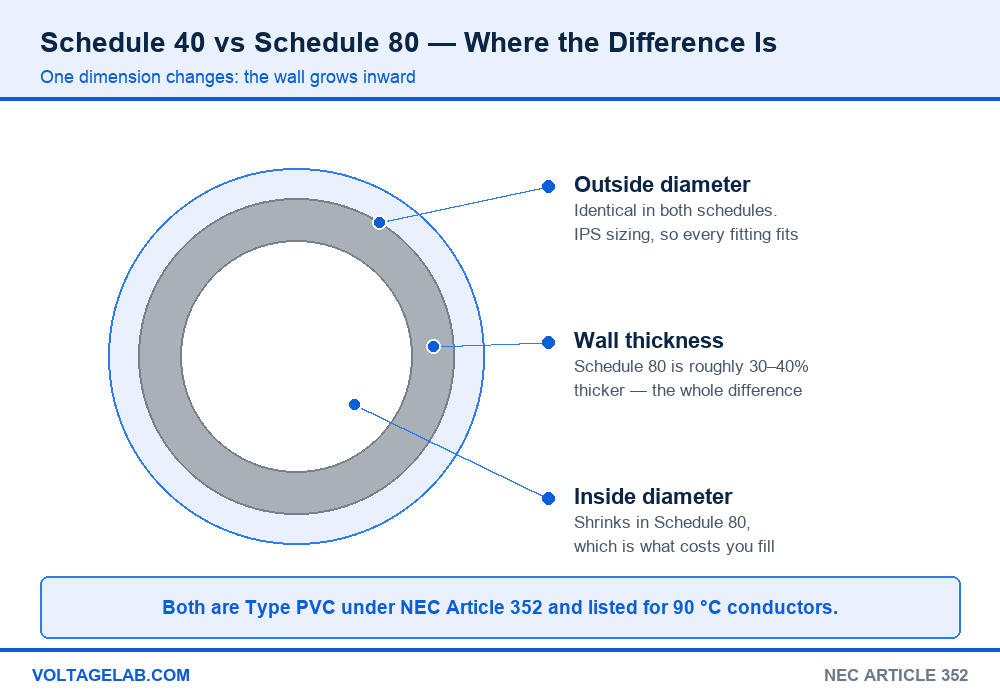
Both products are the same material and the same Code article. NEC Article 352 covers Rigid Polyvinyl Chloride Conduit, Type PVC, and it makes no distinction between the schedules in its own text — the distinction lives in the listing. Both are manufactured to UL 651, both are listed for use with 90 °C conductors, and both come in trade sizes ½ through 6 under 352.20.
Pass your electrical exam the first time
Practice real NEC exam questions with full code-referenced explanations and progress tracking — built for journeyman, master and apprentice exam prep.
Thousands of NEC practice questions with code-referenced answers
What separates them is one dimension:
- Outside diameter — identical. Both follow iron pipe size (IPS) dimensions. A 1 inch conduit measures 1.315 inches across the outside in either schedule.
- Wall thickness — different. That same 1 inch conduit has a 0.133 inch wall in Schedule 40 and a 0.179 inch wall in Schedule 80, roughly 35% thicker.
- Inside diameter — different, as a consequence. The wall grows inward, so the 1 inch bore drops from 1.049 inches to 0.957 inches.
Everything else follows from that. The thicker wall resists crushing and impact, which is why Schedule 80 is the one listed for physical damage. It also weighs more, costs more per foot, and swallows a meaningful share of your conduit fill.
What "schedule" actually means
The word is borrowed from plumbing, not from electrical work. Schedule numbers are a pipe-industry convention describing wall thickness relative to a given outside diameter — the higher the schedule, the thicker the wall and the higher the pressure rating. Schedule 40, Schedule 80 and Schedule 120 all exist in plumbing PVC.
Electrical PVC borrowed the dimensions but not the product. Grey electrical conduit and white plumbing pipe of the same schedule share an outside diameter and a wall thickness, but they are listed to different standards and are not interchangeable. White Schedule 40 plumbing pipe is not a raceway, has no sunlight-resistance rating, and is not permitted as a wiring method regardless of how well the fittings fit.
Schedule 40 vs Schedule 80 PVC conduit — the differences that matter
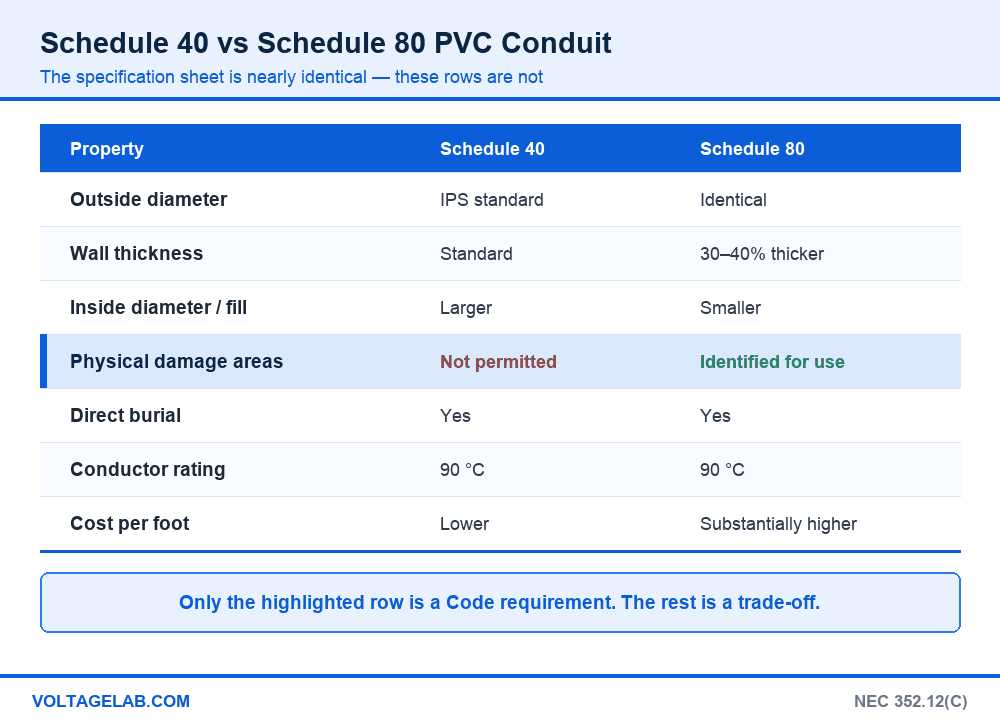
Put side by side, most of the specification sheet is identical. The short list of real differences is what you need on the truck:
| Property | Schedule 40 PVC | Schedule 80 PVC |
|---|---|---|
| Code article | NEC Article 352 | NEC Article 352 |
| Outside diameter | IPS dimensions | Identical to Schedule 40 |
| Wall thickness | Standard | Roughly 30–40% thicker |
| Inside diameter | Larger — more fill | Smaller — less fill |
| Areas of physical damage | Not permitted — 352.12(C) | Identified for the use |
| Direct burial | Yes | Yes |
| Conductor temperature | 90 °C | 90 °C |
| Marking colour | Grey, printed markings | Grey, often with a coloured stripe |
| Relative cost per foot | Lower | Substantially higher |
Read the row on physical damage carefully, because it is the only one that is a Code requirement rather than a trade-off. Everything above it is a decision you get to make. That row is not.
The physical damage trap: because the fittings are identical, Schedule 40 glues into a Schedule 80 elbow and nobody notices until inspection. NEC 352.12(C) prohibits PVC conduit where subject to physical damage unless it is identified for that use, and 352.10(F) permits exposed PVC only on the same condition. Schedule 40 in an exposed riser, a warehouse aisle or a parking area is a failed inspection and a rip-out — and the conduit is stamped with its schedule every few feet, so the inspector does not have to guess.
"Subject to physical damage" is a judgement call the NEC deliberately leaves to the AHJ. In practice the common triggers are exposed runs below about 8 feet in traffic areas, risers on the outside of a building, anything in a loading dock or parking area, and conduit within reach of forklifts or lawn equipment. When you are unsure, ask before you glue, not after.
Conduit fill — what the thicker wall costs you
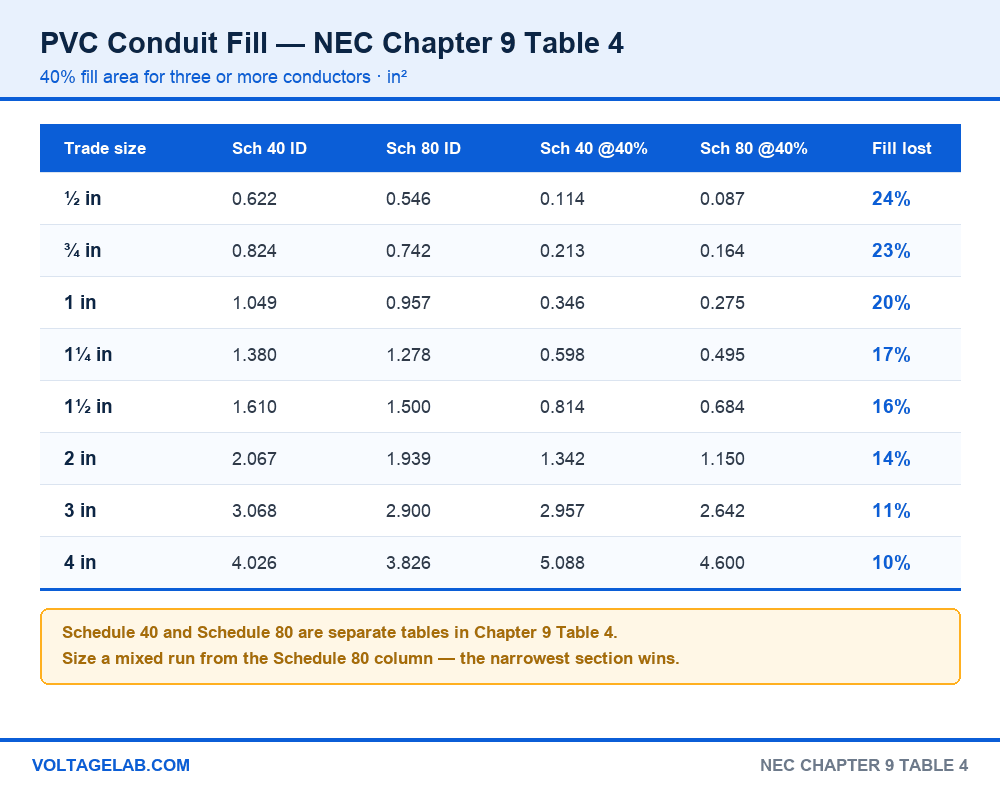
This is where Schedule 40 vs Schedule 80 stops being a materials question and becomes a design one. NEC Chapter 9 Table 4 lists PVC Schedule 40 and PVC Schedule 80 as two separate tables with two separate sets of areas. Look up the wrong one and your raceway is overfilled, which is a violation whether or not the conductors physically go in.
| Trade size | Sch 40 ID (in) | Sch 80 ID (in) | Sch 40 area at 40% | Sch 80 area at 40% | Fill lost |
|---|---|---|---|---|---|
| ½ in | 0.622 | 0.546 | 0.114 in² | 0.087 in² | 24% |
| ¾ in | 0.824 | 0.742 | 0.213 in² | 0.164 in² | 23% |
| 1 in | 1.049 | 0.957 | 0.346 in² | 0.275 in² | 20% |
| 1¼ in | 1.380 | 1.278 | 0.598 in² | 0.495 in² | 17% |
| 1½ in | 1.610 | 1.500 | 0.814 in² | 0.684 in² | 16% |
| 2 in | 2.067 | 1.939 | 1.342 in² | 1.150 in² | 14% |
| 3 in | 3.068 | 2.900 | 2.957 in² | 2.642 in² | 11% |
| 4 in | 4.026 | 3.826 | 5.088 in² | 4.600 in² | 10% |
The penalty is worst where you notice it least. In ½ inch you lose nearly a quarter of your usable area; in 4 inch you lose a tenth. A ¾ inch Schedule 40 run that holds sixteen 12 AWG THHN/THWN-2 conductors holds twelve in Schedule 80. On a job with dozens of short exposed drops, that difference decides your trade size.
The four-step method for sizing a PVC run
Step 1 — decide the schedule first. Walk the route and identify every section that is exposed or subject to physical damage. That decision sets which half of Chapter 9 Table 4 you are working in, and it has to come before the arithmetic.
Step 2 — total the conductor areas. Chapter 9 Table 5 gives the approximate area of each insulated conductor, including the equipment grounding conductor. Add them up.
Study smarter with VoltageLab
Built for electricians, apprentices, and electrical engineers who want faster practice and better exam prep.
⭐️ Join thousands of electricians upgrading their skills
Step 3 — apply the Table 1 fill percentage. One conductor gets 53%, two get 31%, three or more get 40%. Compare your total against the correct schedule’s column. Our walkthrough of sizing conduits and raceways with NEC Annex C covers the shortcut tables for same-size conductors — note that Annex C has separate tables for Schedule 40 and Schedule 80.
Step 4 — check derating separately. Conduit fill and ampacity adjustment are different rules that happen to share a trigger. More than three current-carrying conductors in the raceway means you also apply the adjustment factors before reading NEC Table 310.16. A legal fill does not mean a legal ampacity.
The one that catches everyone: a run does not have to be one schedule end to end. It is entirely legal — and usually the cheapest answer — to run Schedule 40 underground, transition at the elbow, and bring Schedule 80 up the riser to 8 feet above grade. But your fill calculation must use the Schedule 80 numbers for the whole run, because the conductors have to pass through the narrowest section.
Where the NEC allows each schedule
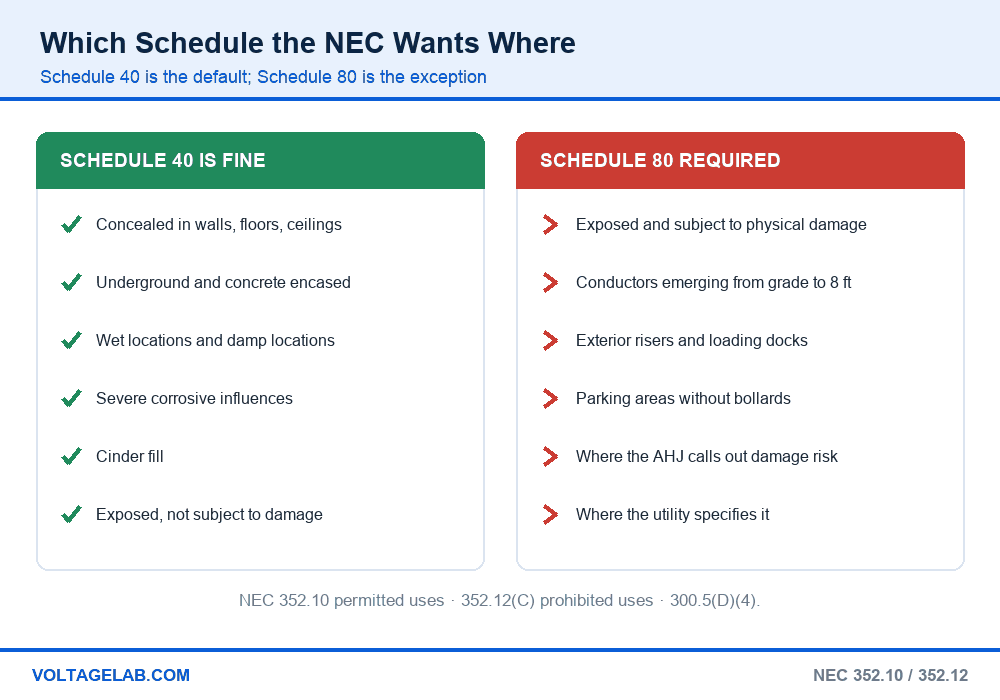
NEC 352.10 lists the permitted uses for PVC conduit generally, and most of them accept either schedule. The places where the schedule is decided for you are narrower than most electricians assume.
Where Schedule 40 is permitted
- Concealed in walls, floors and ceilings — 352.10(A)
- Underground, direct buried or concrete encased — 352.10(G)
- In locations subject to severe corrosive influences — 352.10(B)
- In cinder fill — 352.10(C)
- Wet locations, including underground raceway interiors — 352.10(D)
- Dry and damp locations — 352.10(E)
- Exposed, where not subject to physical damage — 352.10(F)
Where Schedule 80 is required
- Any exposed location subject to physical damage — 352.12(C) with 352.10(F)
- Protecting direct-buried conductors emerging from grade, from the required cover depth to at least 8 ft above finished grade, where subject to physical damage — 300.5(D)(4)
- Exposed risers on building exteriors, loading docks and parking areas, where the AHJ classifies them as subject to damage
- Service riser and meter-socket conduit where the utility or local amendment specifies it
- Under and around many types of equipment pads and traffic-exposed bollard-free runs
Note what is not on that list. Schedule 80 is not required simply because a run is outdoors, or because it is underground, or because it carries a service. Underground PVC is protected by the earth around it; NEC 300.5 minimum cover requirements handle that protection, and Schedule 40 is the normal choice below grade. Schedule 80 costs real money, and specifying it where it is not needed is as much an error as leaving it out where it is.
Prohibited for both schedules
- Where exposed to ambient temperatures above the listing — 352.12(D)
- For support of luminaires or other equipment, unless listed for the purpose — 352.12(B)
- In hazardous (classified) locations except as permitted by the Article 500 series
- Where exposed to sunlight, unless listed and marked sunlight resistant
- Trade sizes below ½ inch or above 6 inch — 352.20
Support and expansion — identical for both
The thicker wall buys no relief from the installation rules. NEC 352.30(A) requires PVC conduit to be securely fastened within 3 ft of every box, cabinet or termination, and Table 352.30(B) sets the maximum spacing between supports by trade size: 3 ft for ½ through 1 inch, 5 ft for 1¼ through 2 inch, 6 ft for 2½ through 3 inch, 7 ft for 3½ through 5 inch, and 8 ft for 6 inch. Those are the tightest support intervals of any common raceway, and they apply to Schedule 80 exactly as they do to Schedule 40.
NEC 352.44 requires an expansion fitting wherever the expected length change from thermal expansion and contraction is ¼ inch or more in a straight run between securely mounted points. PVC moves roughly five times as much as steel for the same temperature swing, so exposed outdoor runs of any real length need a fitting — and the run does not care which schedule you used. Bends are also capped at 360 degrees total between pull points under 352.26, the same limit as metallic raceway.
One more rule applies to both and catches people moving over from EMT: PVC is nonmetallic, so the raceway itself is not an equipment grounding path. Every PVC run needs a wire-type equipment grounding conductor sized from Table 250.122, pulled in with the circuit conductors, and it counts toward your conduit fill.
PVC vs EMT, RMC and RTRC
Choosing a schedule is the second question. The first is whether PVC is the right raceway at all:
| Requirement | PVC Sch 40 | PVC Sch 80 | EMT | RMC |
|---|---|---|---|---|
| Direct burial | Yes | Yes | Limited | Yes |
| Areas of physical damage | No | Yes | Limited | Yes |
| Corrosion resistance | Excellent | Excellent | Poor | Fair |
| Serves as EGC | No | No | Yes | Yes |
| Support spacing | Tightest | Tightest | 10 ft | 10–20 ft |
| Needs expansion fittings | Often | Often | Rarely | Rarely |
| Installed cost | Lowest | Moderate | Moderate | Highest |
If you want the raceway itself to carry fault current, PVC is the wrong choice and MC cable or a metallic raceway is the answer — and where metallic raceways terminate at concentric knockouts, see our guide to grounding versus bonding bushings. For runs that terminate in a wireway or trough, our overview of electrical gutters under Article 366 covers the fill rules there, which are different again.
Is Schedule 80 the right choice for your run?
Pros
- The only PVC identified for areas subject to physical damage
- Named directly in 300.5(D)(4) for conductors emerging from grade
- Uses the same fittings and cement as Schedule 40, so no separate inventory
- Survives impact that would crack a Schedule 40 riser
- Same corrosion immunity and same 90 °C conductor rating
Cons
- Costs a great deal more per foot than Schedule 40
- Loses up to a quarter of the usable fill area in small trade sizes
- Heavier to handle and slower to cut on long runs
- Identical outside diameter makes a mixed-up run easy to build and hard to spot
Working with PVC conduit in the field
Do
- Read the printed schedule on the stick before you cut it
- Deburr and chamfer every cut so the conductors do not catch on the pull
- Use the correct primer and cement, and give joints full cure time before backfill
- Pull a wire-type EGC in every run and count it in your fill
- Set expansion fittings on long exposed runs before the first cold snap proves you needed them
Avoid
- Sizing a Schedule 80 run off the Schedule 40 half of Chapter 9 Table 4
- Running Schedule 40 up an exposed riser because it was on the truck
- Substituting white plumbing pipe of the same schedule
- Stretching supports past the Table 352.30(B) intervals because the run looks rigid
- Assuming the conduit bonds the system the way EMT does
Frequently asked questions
What is the difference between Schedule 40 and Schedule 80 PVC conduit?
Wall thickness. Both share the same outside diameter and the same fittings, but Schedule 80 has a thicker wall, a smaller inside diameter, and a listing that identifies it for areas subject to physical damage. Schedule 40 has none of that identification and more usable fill area.
Can I use Schedule 40 instead of Schedule 80?
Only where the location is not subject to physical damage. NEC 352.12(C) prohibits PVC in those areas unless it is identified for the use, and Schedule 40 is not. Underground, concealed and protected exposed runs are fine in Schedule 40.
Can I use Schedule 80 instead of Schedule 40?
Yes, anywhere Schedule 40 is permitted. It is never a Code violation to go heavier. Just recalculate the fill from the Schedule 80 column, because the smaller bore may push you up a trade size.
Do Schedule 40 and Schedule 80 use the same fittings?
Yes. Both follow IPS outside diameters, so couplings, elbows, adapters and cement are common to both. That interchangeability is convenient and is also exactly why the wrong schedule ends up in a run without anyone noticing.
Which schedule do I use underground?
Schedule 40 is the normal choice for buried runs, and both schedules are listed for direct burial. The earth provides the physical protection; what you need to get right is the cover depth from the NEC 300.5 table. Schedule 80 is used where the conduit comes up out of the ground and becomes exposed.
How much conduit fill do I lose with Schedule 80?
Roughly 24% in ½ inch, 20% in 1 inch, 14% in 2 inch and about 10% in 4 inch. The smaller the trade size, the bigger the penalty, because the wall thickness is a larger fraction of the bore.
Is grey electrical PVC the same as white plumbing PVC?
No. The dimensions match, so the fittings will physically assemble, but plumbing pipe is not listed as a raceway, has no sunlight-resistance rating, and is not a permitted wiring method. Use conduit listed to UL 651 and marked as such.
How far apart do PVC conduit supports have to be?
Table 352.30(B) sets the maximum: 3 ft for ½ through 1 inch, 5 ft for 1¼ through 2 inch, 6 ft for 2½ through 3 inch, 7 ft for 3½ through 5 inch and 8 ft for 6 inch. On top of that, 352.30(A) requires a fastening within 3 ft of every box or termination. The intervals are the same for both schedules.
The bottom line
Schedule 40 vs Schedule 80 is not a quality question — both are the same listed product with the same Code article, the same conductor rating and the same fittings. It is a question of one wall thickness, and that wall buys exactly one thing the Code cares about: identification for areas subject to physical damage. Buy Schedule 40 for everything protected, buried or concealed, and spend the money on Schedule 80 where the conduit is out in the open and something can hit it.
The two restraints that matter are both easy to miss. Size the fill from the right half of Chapter 9 Table 4, and remember that PVC never bonds anything — the wire-type EGC is not optional. For the code-cycle changes worth knowing before your next inspection, see our summary of what changed in the 2026 NEC.
FREE PRACTICE TOOL
Think you'd pass this on a real exam?
Test what you just read with instant-feedback quizzes built around real code questions — not generic trivia.
5
Code standards
10,000+
Active learners
100%
Free to start
Instant explanations on every answer, right or wrong
NEC, BS7671, AS/NZS, CEC, and DIN VDE covered
Bite-sized quizzes you can finish in 5 minutes
No signup required to try your first quiz
No account needed · Takes less than 2 minutes