



 Scan to install
Walk the wire aisle at any big-box store and the 6/3 Romex is usually on the bottom rack: a black-jacketed cable thick enough that a 125-foot coil takes two hands to lift. It goes to ranges, 14-50 receptacles, garage sub-panels and EV chargers. It is also one of the most misapplied cables in residential work.
The trouble is the number people assume it carries. Look up 6 AWG copper in Table 310.16 and you see 65 amps at 75 °C or 75 amps at 90 °C. Neither applies to NM cable. NEC 334.80 holds it to the 60 °C column, so 6/3 Romex is a 55-amp cable, and that one fact decides which loads it can and cannot feed.
This guide covers what is inside 6/3 NM-B, how it compares with 6/2, 8/3 and 4/3, its real ampacity and breaker size, where the Code allows it, and the two installs that fail most often: the 48-amp EV charger and the outdoor run in conduit.
Quick Answer
6/3 Romex is NM-B cable with three insulated 6 AWG copper conductors (black, red and white) plus a bare 10 AWG ground. Under NEC 334.80 its ampacity is 55 amps, the 60 °C value for 6 AWG copper. It is the standard cable for a 50-amp range, a NEMA 14-50 receptacle and a 50- or 60-amp sub-panel.
A 60-amp breaker is allowed on it through the next-size-up rule in 240.4(B), but only when the calculated load is 55 amps or less. It cannot feed a 48-amp EV charger, which needs 60 amps of conductor ampacity, and it cannot be used outdoors, underground or in any wet location — even inside conduit.
Key Takeaways
- The “6” is the conductor size and the “3” counts the insulated conductors; the bare ground is not counted
- NEC 334.80 limits NM cable to the 60 °C column, so 6/3 Romex carries 55 amps, not 65 or 75
- The 90 °C rating of the conductors is only a starting point for derating
- A 60-amp breaker is permitted under 240.4(B) only when the calculated load fits within 55 amps
- EV charging is a continuous load, so 6/3 NM tops out at a 40-amp charger on a 50-amp circuit
- Use 6/2 when the load is 240-volt only and has no 120-volt parts
- NM-B is not permitted in wet or damp locations under 334.12, which includes conduit outdoors and underground
What 6/3 Romex actually is
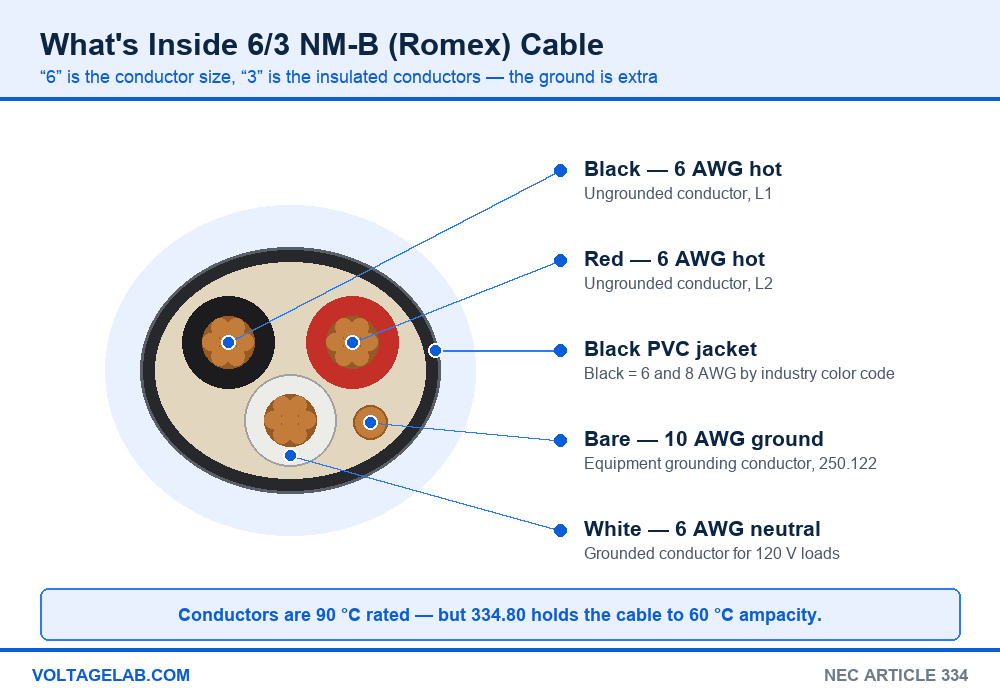
“Romex” is a Southwire brand name that became the trade word for nonmetallic-sheathed cable, Type NM-B under NEC Article 334. A 6/3 cable with ground contains:
- Black 6 AWG. An ungrounded (hot) conductor.
- Red 6 AWG. The second ungrounded conductor, on the other leg of a 120/240-volt system.
- White 6 AWG. The grounded (neutral) conductor, needed by any load with 120-volt parts.
- Bare 10 AWG copper. The equipment grounding conductor, sized for a 60-amp device under Table 250.122.
- Paper separator and PVC jacket. The outer sheath is black on 6 and 8 AWG cable by the industry color code (white is 14, yellow 12, orange 10). The color is a convenience, not an NEC rule.
The insulated conductors are stranded copper with a 90 °C rating. The “-B” in NM-B marks that 90 °C insulation. It matters for derating and nothing else, as the ampacity section shows.
Reading the label
- 6 — conductor size, 6 AWG
- 3 — number of insulated current-carrying conductors
- W/G — “with ground,” the bare equipment grounding conductor
- NM-B — nonmetallic-sheathed cable, 90 °C conductors, Article 334
- 600 V — voltage rating of the conductors
So “6/3 NM-B W/G” and “6-3 Romex with ground” are the same cable. “6/3” never means three conductors including the ground; a cable with two insulated conductors and a ground is 6/2.
6/3 vs 6/2 vs 8/3 vs 4/3 Romex
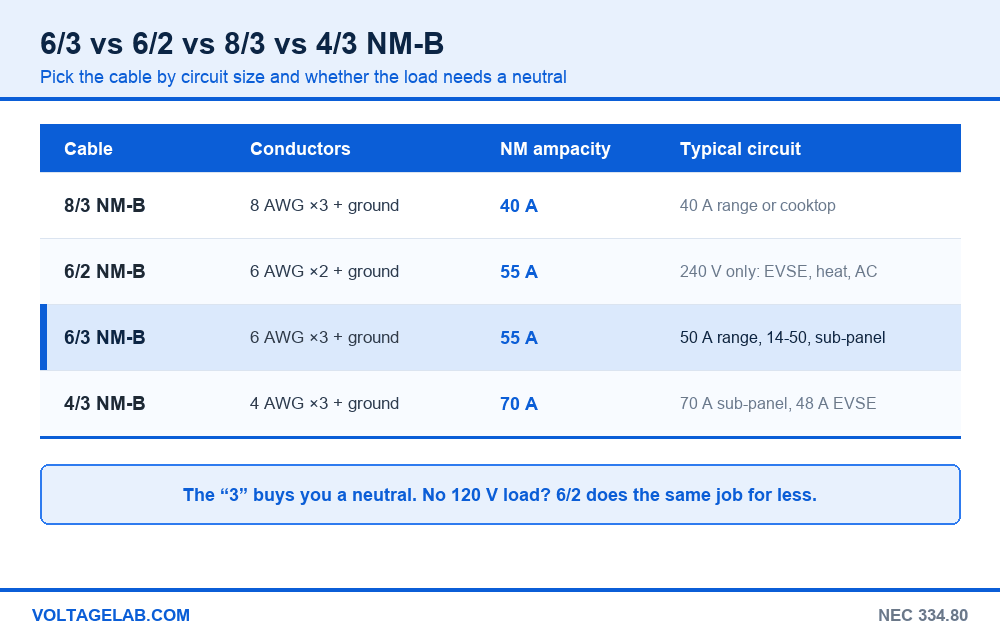
Two questions choose the cable: how big is the circuit, and does the load need a neutral?
| Cable | Neutral? | NM ampacity | Typical use |
|---|---|---|---|
| 8/3 NM-B | Yes | 40 A | 40 A range, cooktop or wall oven |
| 6/2 NM-B | No | 55 A | 240 V-only: hardwired EVSE, heat pump, 6-50 welder receptacle |
| 6/3 NM-B | Yes | 55 A | 50 A range, NEMA 14-50, 50–60 A sub-panel |
| 4/3 NM-B | Yes | 70 A | 70 A sub-panel, 48 A EV charger |
Ranges, cooktops with 120-volt controls, the NEMA 14-50 receptacle and any sub-panel need the neutral, so they take 6/3. A hardwired EV charger, an electric water heater or a heat pump usually runs on 240 volts alone, so 6/2 does the job for less copper. Read the installation instructions: if the terminal block shows N, pull 6/3.
The EV charger trap: a charger set to 48 amps is a continuous load, and NEC 210.19(A)(1) and 625.41 require conductors rated at 125% of it — 60 amps. 6/3 or 6/2 NM is a 55-amp cable, so it fails, even though the 60-amp breaker looks like it matches. On NM cable a 48-amp charger needs 4 AWG. With 6 AWG NM, set the charger to 40 amps on a 50-amp breaker.
6/3 Romex ampacity — NEC 334.80 and Table 310.16
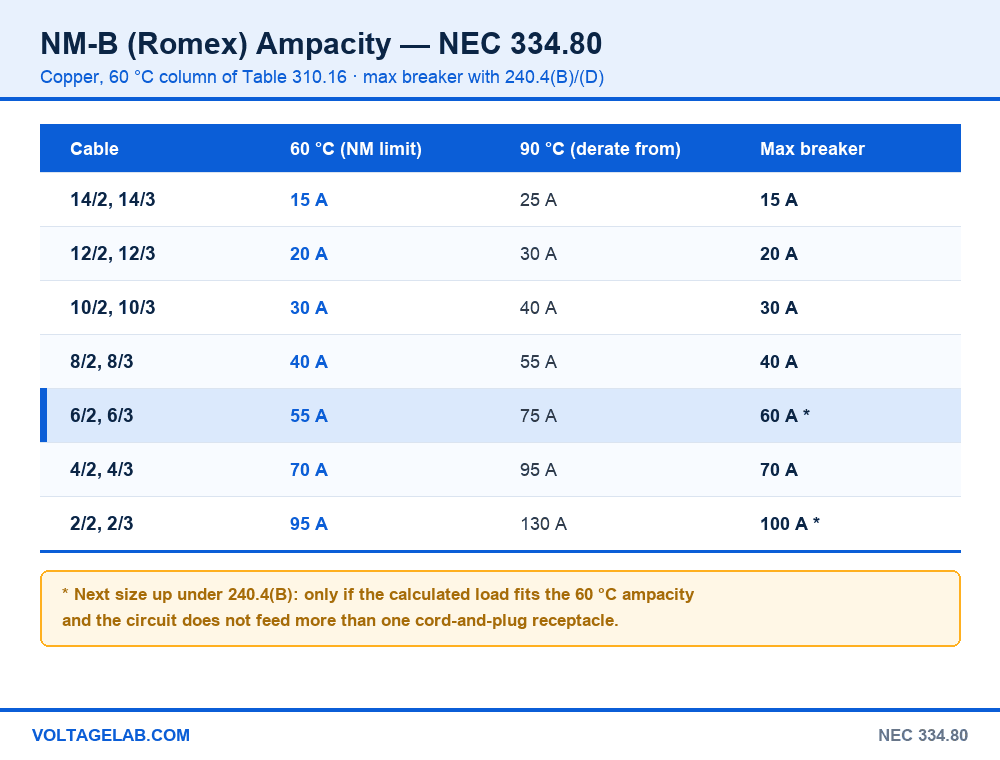
NEC 334.80 says the ampacity of NM cable is determined by 310.14 and shall be that of 60 °C conductors. The 90 °C rating may be used for derating, but the final ampacity cannot exceed the 60 °C value. For copper NM-B, that gives the familiar numbers. Our walkthrough of how to read NEC Table 310.16 covers the table itself.
| Copper NM-B | 60 °C ampacity (final) | 90 °C (derating start) | Max overcurrent device |
|---|---|---|---|
| 14 AWG | 15 A | 25 A | 15 A — 240.4(D) |
| 12 AWG | 20 A | 30 A | 20 A — 240.4(D) |
| 10 AWG | 30 A | 40 A | 30 A — 240.4(D) |
| 8 AWG | 40 A | 55 A | 40 A |
| 6 AWG | 55 A | 75 A | 60 A under 240.4(B) conditions |
| 4 AWG | 70 A | 95 A | 70 A |
| 2 AWG | 95 A | 130 A | 100 A under 240.4(B) conditions |
Sizing a 6/3 Romex circuit in four steps
Step 1 — find the load. Use the nameplate, or for a range the demand from Table 220.55. For a sub-panel, run a load calculation; our guide to calculating your home’s electrical load shows how.
Step 2 — add 25% for continuous loads. EV chargers, electric heat and anything that runs three hours or more need conductor ampacity of 125% of the load under 210.19(A)(1) for branch circuits or 215.2(A)(1) for feeders.
Step 3 — derate if needed. Start at 75 amps (the 90 °C value) and apply ambient correction and bundling adjustment. 334.80 triggers adjustment factors when more than two NM cables pass through the same opening in wood framing that is sealed with fire- or draft-stopping, or when cables are installed in contact with thermal insulation without spacing for more than 24 inches. See our guide to conductor adjustment factors. The result still cannot exceed 55 amps.
Step 4 — pick the breaker. 50 amps fits 6/3 directly. 60 amps is allowed under 240.4(B) only if the conductors are not part of a branch circuit supplying more than one receptacle for cord-and-plug loads, the 55-amp ampacity does not match a standard size, and the next standard size up does not exceed 800 amps — and the load itself must stay within 55 amps.
The one that catches everyone: 6/3 on a 60-amp breaker is legal for a 60-amp sub-panel feeder whose calculated load is 55 amps or less. It is not legal for a NEMA 14-50 receptacle. That is a single 50-amp receptacle, and 210.21(B)(1) requires a single receptacle on an individual circuit to be rated at least as high as the breaker. A 14-50 goes on a 50-amp breaker, full stop.
Where the NEC allows 6/3 Romex — and where it does not
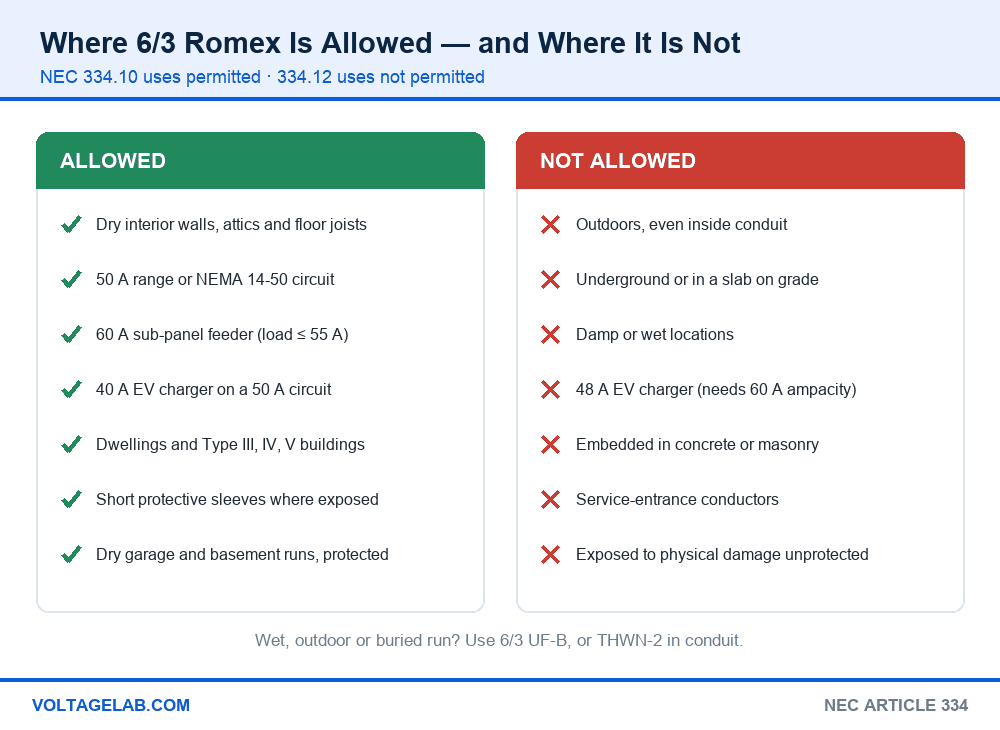
NM-B is an indoor, dry-location cable. Article 334 lists where it may and may not go, and most violations come from forgetting that “dry” excludes a lot of places that look dry.
Permitted (334.10)
- One- and two-family dwellings and their attached or detached garages and storage buildings
- Multifamily and other buildings of Types III, IV and V construction, except where 334.12 prohibits it
- Concealed in walls, floors and ceilings, and exposed where not subject to physical damage
- Fished in air voids of masonry block or tile walls that are not damp
- Through bored holes in framing, set back or protected under 300.4
Not permitted (334.12)
- Wet or damp locations — including the inside of conduit outdoors or underground
- Embedded in poured concrete, aggregate or masonry
- Exposed to corrosive fumes or vapors
- As service-entrance cable
- Where exposed to physical damage without protection
The detached garage is where this goes wrong. Pulling 6/3 Romex through PVC conduit to a garage sub-panel is a violation, because underground raceways are wet locations by definition and NM is not wet-rated. For a buried run, use 6/3 UF-B direct burial or individual THWN-2 conductors in conduit. Our 60-amp sub-panel wire size guide compares those options in detail.
Securing and bending
Under 334.30, secure the cable within 12 inches of every box, cabinet or fitting and at intervals not exceeding 4½ feet. Under 334.24, the inside radius of any bend must be at least five times the cable’s diameter — 6/3 is stiff, so plan room for that radius at the panel and the range box. In box fill, each 6 AWG conductor counts as 5.0 in³ under Table 314.16(B).
6/3 Romex vs other 6 AWG wiring methods
| Requirement | 6/3 NM-B | 6/3 UF-B | 6/3 MC | 6 AWG THHN in conduit |
|---|---|---|---|---|
| Ampacity | 55 A (334.80) | 55 A (340.80) | 65 A with 75 °C ends | 65 A with 75 °C ends |
| Wet or underground | No | Yes, incl. direct burial | Only if listed for it | Yes, if THWN-2 |
| Commercial buildings | Type III, IV, V only | Limited | Yes | Yes |
| 48 A EV charger | No | No | Yes | Yes |
| Cost and labour | Lowest | Higher, stiff to strip | Higher | Highest |
For the receptacle end of the most common 6/3 circuit, see the NEMA 14-50 outlet guide. If the 60 °C limit is what is holding you back, MC cable and THHN/THWN-2 in conduit both reach the 75 °C column when the terminations are rated for it. The one-size-down question is covered in 8 AWG wire ampacity, and the full size range in our wire gauge chart.
Get ampacity questions right every time
Which column, which exception, which breaker — ampacity is where exam points and inspections are lost. The VoltageLab: Electrician App (also on Android) has a Table 310.16 ampacity quiz where every answer cites the code section behind it. It is free to download.
Is 6/3 Romex the right cable for your run?
Pros
- Cheapest and fastest way to run a 50-amp circuit in a house
- Neutral and ground already included, sized correctly
- Works with 60 °C terminals, so the equipment rating never limits you further
- Stocked everywhere in standard coil lengths
Cons
- Stuck at 55 amps, 10 less than the same copper in conduit
- Dry locations only — no outdoor or buried runs
- Stiff and wide, so bends and box entries take room
Working with 6/3 Romex in the field
Do
- Check the appliance or charger instructions for a neutral before buying cable
- Torque lugs to the marked value, as 110.14(D) requires
- Strip the jacket so it enters the box at least ¼ inch, per 314.17
- Keep neutral and ground separate at a sub-panel
- Run the load calculation before using a 60-amp breaker
Avoid
- Sizing the breaker from the 75 °C or 90 °C column
- Pulling NM through conduit outdoors or underground
- Putting a 14-50 receptacle on a 60-amp breaker
- Feeding a 48-amp charger with 6 AWG NM
- Driving staples so tight they crush the jacket
Frequently asked questions
How many amps can 6/3 Romex carry?
55 amps. NEC 334.80 limits NM cable to the 60 °C column of Table 310.16, where 6 AWG copper is 55 amps. The 65-amp and 75-amp values belong to the 75 °C and 90 °C columns and do not apply to NM.
Can I put 6/3 Romex on a 60-amp breaker?
Yes, for a single load or a sub-panel feeder whose calculated load is 55 amps or less, under the next-size-up rule in 240.4(B). Not for a single 50-amp receptacle such as a 14-50, and not for a continuous load that needs more than 55 amps of conductor ampacity.
What is 6/3 Romex used for?
Mostly 50-amp electric ranges, NEMA 14-50 receptacles for RVs and EV chargers, and 50- or 60-amp sub-panel feeders. Each needs two hots and a neutral, which is what the “3” provides.
What size ground is in 6/3 Romex?
A bare 10 AWG copper conductor, which Table 250.122 permits for circuits protected at up to 60 amps.
Do I need 6/3 or 6/2 for an EV charger?
A hardwired charger usually needs no neutral, so 6/2 works. A NEMA 14-50 receptacle needs the neutral terminal connected, so it takes 6/3. Either way, 6 AWG NM supports a charger set to 40 amps on a 50-amp breaker, not 48 amps.
Can 6/3 Romex be run outside or underground?
No. NM-B is not permitted in wet or damp locations under 334.12, and the inside of an outdoor or underground raceway is a wet location. Use 6/3 UF-B or THWN-2 conductors in conduit.
Is 6/3 Romex enough for a 100-amp sub-panel?
No. A 100-amp feeder needs far larger conductors. See our 100-amp sub-panel wire size guide for the options.
The bottom line
6/3 Romex earns its place as the default cable for a 50-amp household circuit: it carries the neutral and ground you need, it is cheap, and it pulls through framing quickly. The two restraints that matter are both in Article 334 — it is a 55-amp cable under 334.80 no matter what the conductor insulation says, and it stays in dry locations under 334.12.
Put it on a 50-amp breaker for ranges and 14-50 receptacles, a 60-amp breaker only for a sub-panel or single load that calculates at 55 amps or less, and step up to 4/3 when a 48-amp charger enters the picture. For the panel side of that last case, our 60-amp sub-panel guide has the full sizing.